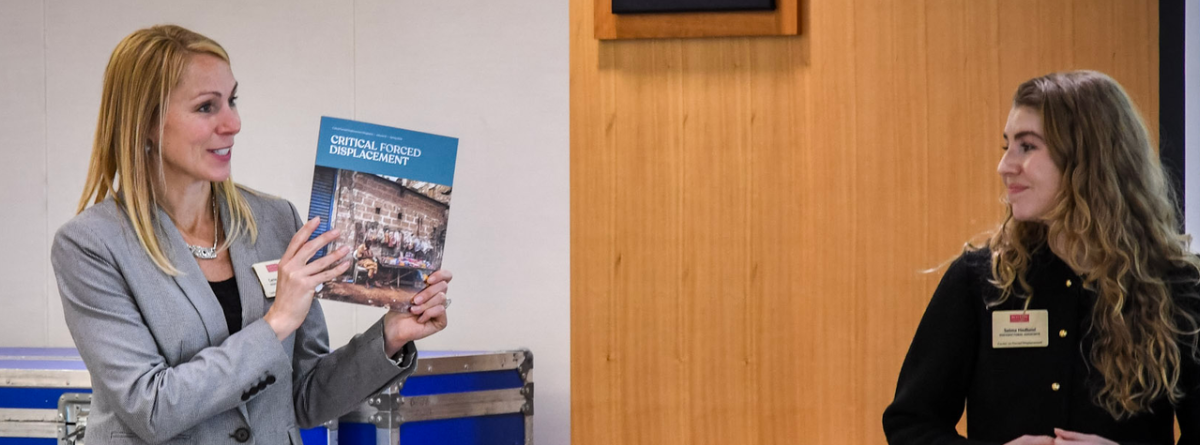
Critical Forced Displacement Magazine
Critical Forced Displacement (CFD) Magazine is an interdisciplinary, international, open-access magazine published by Boston University’s Center on Forced Displacement and featuring articles, essays, art, and argument concerned with forced displacement.
Visit our Online Publication:

Call for Contributions
Boston University’s Center on Forced Displacement invites contributions to our interdisciplinary, multi-genre magazine, published quarterly and bringing together a variety of original works. For our fifth issue we are looking for artistic submissions, including but not limited to poetry, paintings/murals, photography, sculptures, artisanal crafts, and other forms. We also welcome personal essays, book reviews, and op-eds. Artists and contributors who would prefer not to share their names have the option to have their work featured under a pseudonym.
The theme for this issue is (im)mobilities among forcibly displaced persons. We encourage submissions focusing on, but not limited to, the Boston area and beyond. We welcome writing on themes including but not limited to:
- Waiting and suspended time: asylum processes, detention, hospitalization, incarceration, temporary housing, family reunification, or simply living in limbo.
- Borders within the city: how housing, policing, transportation, documentation, race, disability, or poverty can restrict movement even without a formal border.
- Home, shelter, and confinement: the tension between places that offer safety and places that restrict freedom; shelters, camps, hospitals, prisons, temporary housing, and overcrowded homes.
- The right to stay: displacement is often discussed as movement, but immobility can also involve people struggling to remain in their homes, neighborhoods, or communities.
- Trapped between here and there: experiences of people who cannot return home but also cannot fully settle, belong, or move forward where they are.
- Paper borders: visas, immigration status, identification documents, court cases, bureaucratic requirements, and other administrative systems that determine who can move and who must wait.
- Mobility, disability, and forced displacement: how physical disability, illness, inaccessible infrastructure, institutionalization, and caregiving affect displaced people’s ability to move.
- Incarceration and enforced stillness: prisons, immigration detention, juvenile detention, electronic monitoring, house arrest, and other systems that restrict physical movement.
Please review our submission guidelines (below) prior to submitting your piece.
Please submit your piece by October 16th, 2026 for anticipated launch in November of 2026. We will consider submissions from scholars, practitioners, artists, advocates, policymakers, and concerned citizens, regardless of current publication status, university or professional affiliation, career stage, or manner of university affiliation (student vs faculty/staff status). Submit your piece using the button below or by emailing it to cfdmag@bu.edu
Submit HereSubmission Guidelines
Critical Forced Displacement is dedicated to amplifying voices and stories related to forced displacement. Our publication seeks narrative-driven contributions that highlight the diverse experiences and perspectives of displaced people, and engage the full complexity of this pressing global issue via reflection, art, and argument. We accept submissions for both our semi-annual print publication and our online platform, and publish a variety of non-scholarly formats.
Submission Types
We welcome contributions in the following formats. Please clarify the contribution type when submitting, and make sure that your piece adheres to our guidelines. We recommend that you peruse our previous publications for examples.
- Essays: Personal narratives and longer-form reflection pieces.
- Op-eds: Opinion pieces on current events and issues related to displacement.
- Visual Art: Photography, illustrations, and other visual media.
- Poetry: Original and translated poems.
- Book Reviews: Reviews of literature with broad appeal on migration and displacement.
*Please note: We do not accept scholarly articles or academic research papers.
Print Submission Guidelines
- Submission Windows: We accept submissions for print twice a year:
- Fall: on a rolling basis with a deadline of Sept. 1
- Spring: on a rolling basis with a deadline of Feb. 1
- Theme: Submissions must tangibly connect to each edition’s theme.
- Word Limits:
- Essays: 3,000 words
- Op-eds: 1,000 words
- Book Reviews: 1,000 words
- Visual Media:
- High-resolution images (300 DPI) may be submitted alongside the text.
- Please ensure that you have the rights to use any included images.
*All pieces accepted for print will also be published online, unless expressly requested by the author.
Online-Only Submission Guidelines
- Submission Windows: Online submissions are accepted on a year-round, rolling basis.
- Content: Online submissions do not need to adhere to a specific theme. We welcome contributions on a wide variety of topics related to migration and displacement.
- Types of Submissions: We accept essays, op-eds, book reviews, visual art, and poetry. As with our print submissions, we prioritize strong narrative storytelling grounded in individual human experience.
- Word Count:
- Essays: 3,000 words
- Op-eds: 1,000 words
- Book Reviews: 1,000 words
- Multimedia: We encourage the submission of images, videos, or other multimedia elements, either on their own or alongside written work.
- Images should be in JPEG or PNG format at a minimum resolution of 72 DPI.
Emerging Voices Section
Our Emerging Voices section is a digital forum for undergraduate students and other young writers and artists to reflect on, argue about, and create in relation to forced displacement. We seek to elevate fresh perspectives from young thinkers and artists from a variety of personal, educational, and disciplinary backgrounds. Submissions should not be recycled academic essays from coursework, but certainly can be adapted and revised from those origins. Contributors will work closely with a CFD editor to refine their personal essay, fiction, poetry, reflection piece, or op-ed on migration or displacement and publish them to a wider audience.
- Submission Windows: Emerging voices submissions are accepted on a year-round, rolling basis.
- Content: Emerging voices submissions do not need to adhere to a specific theme. We welcome contributions on a wide variety of topics related to migration and displacement.
- Types of Submissions: We accept essays, op-eds, book reviews, visual art, and poetry. As with our print submissions, we prioritize strong narrative storytelling grounded in individual human experience.
- Word Count:
- Essays: 3,000 words
- Op-eds: 1,000 words
- Book Reviews: 1,000 words
- Multimedia: We encourage the submission of images, videos, or other multimedia elements, either on their own or alongside written work.
- Images should be in JPEG or PNG format at a minimum resolution of 72 DPI.
How to Submit
- Submission Process:
- Print: Email your submissions via Word Doc to the magazine team (cfdmag@bu.edu) with the subject line “CFD Print Submission: [Author Last Name]; [Submission Type]; [Title of Work].”
- Online and Emerging Voices: Email your submissions via Word Doc to the magazine team (cfdmag@bu.edu) with the subject line “CFD Online Submission: [Author Last Name]; [Submission Type]; [Title of Work].”
- Please include an additional document with an author bio.
- Review and Notification Timeline:
- We aim to review online submissions within 6-8 weeks, and print submissions within 4 weeks of the bi-annual deadlines noted above. While we do our best to respond to all submissions, our resources are limited. You will be notified of your submission’s status via email.
- Submission Queries:
- For general queries regarding submissions please reach out to us at cfdmag@bu.edu.