Giving Poetry a Voice
A new undergraduate course brings students into the deeper meaning of poetry, through the power of video
A new undergraduate course brings students into the deeper meaning of poetry, through the power of video
It’s one thing to silently read a poem: to skim over its lines in your mind, to pass it by on auto-pilot mode.
“Poems are a funny thing, because they’re short. It doesn’t take much time to read a poem and decide it hasn’t done anything for you,” says Annette Frost, public humanities manager at the BU Center for the Humanities.
But something changes when you speak a poem out loud. “[It’s] the first step to cracking further in, because when you speak out loud, the tone of your voice is directed by the meaning,” Frost says. In other words, to read a poem in this way demands that you understand what it’s trying to convey, at least a little bit.
Still, this might leave you with only a surface-level grasp of what a poem means. One way to take that understanding deeper? Watching someone recite a poem on video, and then explain why it resonates with them.
On video, a reader might explain, “This poem was meaningful to me because I also lost a brother and reading this poem about losing a brother was a healing process,” which can help you see one potential meaning behind a poem, Frost says. “And suddenly [you’ve] found this access thread.”
This is what Frost is helping students do in a new undergraduate course in the CAS English department, titled “The Voice of Poetry.” It’s described as an “experiential poetry class” that exposes students to all kinds of work (from the 16th century to the present day), and then invites them to engage with it more deeply.
“We focus on reading poems out loud and figuring out what changes for the students when they hear [them]” says Frost.
In addition to teaching at BU, Frost is also the longtime director of the Favorite Poem Project, a deep well of resources created by Robert Pinsky, a professor emeritus in BU’s graduate creative writing program and a three-time U.S. poet laureate. He ran the project for decades, inviting ordinary people to read their favorite poems on camera and explain why they loved them.
“There has always been this wealth of poetry resources that is somewhat underutilized,” Frost says. Frost and Pinsky often dreamed of teaching a class that drew on this archive to focus on the physicality of an individual person crafting an individual relationship with an individual poem.
The Voice of Poetry made that vision a reality: These documentary-style videos, along with other articles and resources on the FPP website, were the inspiration for the course, Frost explains, and also serve as key course materials.
Frost worked with poetry professor Maggie Dietz to develop the syllabus. It’s not quite a traditional survey course, nor does it labor over every literary device, Frost says. So while the students cover a lot of ground, and many different types of poetry, the course is more about the experience of finding deeper meaning by reading poems out loud, and on video.
Ara Mishra, a comparative literature major and rising senior, was immediately drawn to the Voice of Poetry.
“The course description was something that really stood out to me,” she says. To her, it was also a rare opportunity for an undergraduate to take an advanced-level poetry course, which are mostly offered at the graduate level.
Over the span of the semester, Mishra and the other students were guided to choose their own favorite poems—eight of them, to be exact—and collect them into an anthology. For each poem, students wrote about why that poem stood out.
“That was really cool to introspect and find a poem that really resonates with me,” Mishra says.
But the flashship project of the course required each student to create their own documentary-style video in the mode of the Favorite Poem Project. Students were encouraged to work with partners, helping each other collect background footage that would accompany the poem readings. Friends also helped interview the students on camera, as they explained the resonance of the poems they chose—a crucial part of FPP videos.
Once completed, the students screened their videos in class and voted on their top three choices, weighing in not necessarily on the video quality, but on which relationship between poet and poem felt most compelling.
In addition to bragging rights, the winners earned the opportunity to have their videos professionally remade by staff at BU’s Institute for Excellence in Teaching & Learning.
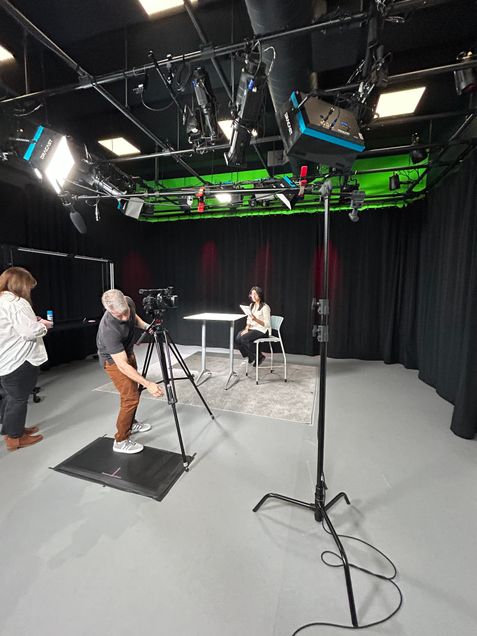
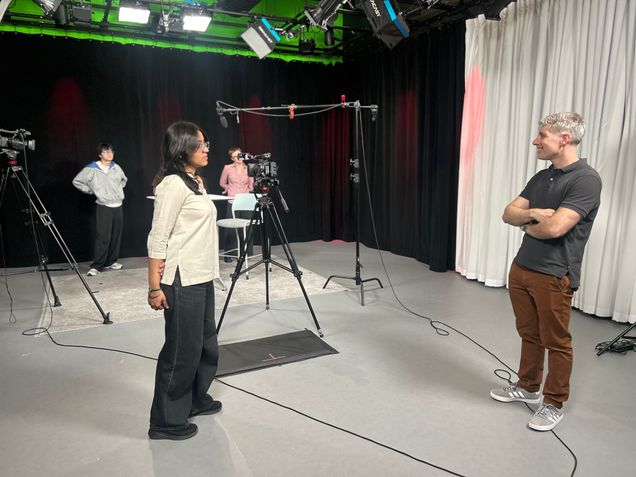
There, Frost reports that the students received the full TV-studio treatment: Big lights, crisp background, the works. Each winning student was interviewed on camera by their classmates, who prepped questions ahead of time and acted as amateur TV producers.
Mishra’s poem was not selected for the studio remake. But, even so, she reports that the experience was very impactful for her. “I’ve never seen something like that take place. Seeing how those Favorite Poem Project videos were filmed, and being a part of one, that was very interesting,” she says.
The impact of the experience, however, went beyond the glitz of the filming process. Indeed, Mishra felt how the video component gave the poems more staying power, when they might have otherwise been easily forgotten. “[It] sort of cements things for us,” Mishra says.