Skip to Main Content
Boston University
  • Bostonia
  • BU Today
  • The Brink
  • University Publications

    • Bostonia
    • BU Today
    • The Brink
  • School & College Publications

    • The Record
Other Publications
BU Today
  • Sections
News, Research, Community

For Growth, UROP Looks to the University
September 18, 2007
  • Jessica Ullian
Twitter Facebook
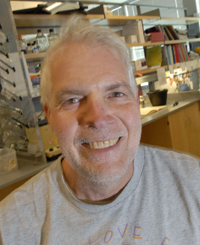
Thomas Gilmore, a College of Arts and Sciences professor of biology, hopes to expand the Undergraduate Research Opportunities Program to include more humanities-based projects. Photo by Frank Curran

Hiring undergraduates to assist with special research projects may seem risky to some faculty, who prefer to bring more experienced master’s or doctoral students on board. But Thomas Gilmore, a College of Arts and Sciences professor of biology, makes a compelling case for working with juniors and seniors.

Several years ago, an undergraduate named Emily Pace (CAS’02, GRS’02) approached him and John Porco, a CAS professor of chemistry and director of the Center for Chemical Methodology and Library Development, about working in their laboratories through the Undergraduate Research Opportunities Program (UROP). Since then, the preliminary results of her study on the effects of natural, nonsynthetic proteins on lymphatic cells — which could affect treatment of cancers such as Hodgkin’s lymphoma — have yielded five collaborative papers for Gilmore and Porco, as well as research funding from the National Institutes of Health (NIH) and the American Cancer Society.

“If one student a year does something important that results in outside funding, it’s money well spent at every level: good for students, good for the University, good for faculty,” says Gilmore, who typically employs three to five undergraduates each year. “All you need is one of them.”

A member of the BU faculty since 1987, Gilmore was named the director of UROP this summer, replacing Mary Erskine, the Clare Boothe Luce Professor of Biology. The program, now in its 10th year, fosters student-faculty mentorships and teaches students how to prepare detailed research proposals and how to apply for funding. Of the 200-plus students who seek funding each year, from sources such as the NIH and the National Science Foundation, 30 to 50 percent are successful.

Gilmore, who has worked with undergraduates in his laboratory for years, wants to make faculty in other disciplines more aware of the benefits of participating in the program. And he hopes to find new funding sources that will enable more BU students to conduct advanced research well before they enroll in graduate programs. “I think it’s a really valuable way to increase analytical skills and real-life skills and get them thinking about whether they want to go to grad school,” he says. “They learn all these things in classes, but they really have trouble grasping the method until they get in and do something. Here, they’re able to put their knowledge to use, to apply their academic training in some real ways.”

Students can submit research proposals to the evaluation committee for either semester or for the summer session. While some students who participate during the academic year get college credit for their work, others receive up to $4,000 so they can stay in Boston and continue their research during the summer.

Once in the laboratory, a UROP student’s responsibilities can range from assisting a graduate student on an ongoing project to conducting spin-off research, which is related to the laboratory’s purpose, but is not critical. The projects may not yield promising or useful results, Gilmore says, but having the undergraduates on board allows the scientists to conduct new clinical or lab investigations without worrying about whether the results will be worthwhile.

In the past, approximately 70 percent of UROP projects have focused on the life sciences. Gilmore hopes to find new ways for humanities and social sciences faculty to get involved and make undergraduate research a core part of the experience at BU. He also plans to work with the provost’s office to research new areas of outside funding, with the intent of building alumni donations as well as private-sector contributions.

Students say UROP gives them a chance to work in the life sciences before they commit to a graduate program or to a career. In addition, it makes them feel part of a smaller community at a big university. “You have all of these resources — when you’re doing your homework here and you don’t know something, you can ask a grad student,” says biology major Melissa Chin (CAS’08), who received an Arnold and Mabel Beckman Foundation scholarship to work in Gilmore’s lab. “Some people have to go find professors for office hours. For us, office hours are here, all the time.”

Jessica Ullian can be reached at jullian@bu.edu.


Explore Related Topics:

  • Faculty
  • Research
  • Students
  • UROP
  • Share this story

Share

For Growth, UROP Looks to the University

Share

  • Twitter
  • Facebook
  • Reddit
  • LinkedIn
  • Email

Latest from BU Today

  • Things-to-do

    A Trip to the Sea via the T

  • University News

    BU Schedules Informational Town Halls Regarding New Federal Cap on International Students’ Time in the US

  • Film & TV

    As Christopher Nolan’s The Odyssey Hits Movie Screens, BU Students Already Know the Story

  • Health & Medicine

    Chobanian & Avedisian School of Medicine’s Chief Resident Immersion Training (CRIT) Marks 25th anniversary

  • Theatre

    CFA’s Jim Demler and His Identical Twin Brother Make Their Off-Broadway Debut

  • Accolades

    Dream of Being a Fulbright Scholar? Hear from Recent Awardees

  • University News

    BU Leaders Ask Federal Government to Reconsider Changes to Research Grants’ Approval Process Rules

  • University News

    Three New College of Arts and Sciences Master’s Programs Will Take Students to the Cutting Edge

  • Things-to-do

    Want to Beat the Summer Heat? Check Out One of the Boston Area’s Many Public Pools

  • University News

    Boston University Announces Leadership Updates

  • International Sports

    FIFA World Cup Gives a SHA Grad Student Hands-On Experience in Event Management

  • University News

    Boston University Hospitality Dean Arun Upneja Stepping Down

  • University News

    Meet the 38 Charles River Campus Faculty Promoted to Ranks of Associate Professor, Full Professor

  • University News

    BU Opens Cooling Stations on Charles River Campus as First Heat Wave of the Summer Arrives

  • Things-to-do

    Looking for Places to Watch Fireworks This Fourth of July? BU Has You Covered

  • In the City

    How to Celebrate the Fourth of July in Boston During America’s 250th Birthday

  • Things-To-Do

    Getting to Know Your Neighborhood: Newbury Street

  • Photography

    Photo Gallery Offers a Look Back at Spring 2026 Highlights on Campus

  • Arts & Culture

    Cheese Is Now a Protein Source? Five Things to Know About the Updated Mediterranean Diet

  • Theatre

    CFA Students Bring Their Design Talents to World’s Largest Shakespeare Festival

Section navigation

  • Sections
  • Must Reads
  • Videos
  • Series
  • Close ups
  • Archives
  • About + Contact
Get Our Email

Explore Our Publications

Bostonia

Boston University’s Alumni Magazine

BU Today

News, Research, Community

The Brink

Pioneering Research from Boston University

  • Twitter
  • Facebook
  • Youtube
  • LinkedIn
  • Instagram
  • Weibo
  • TikTok
© Boston University. All rights reserved. www.bu.edu
© 2026 Trustees of Boston UniversityPrivacy StatementAccessibility
Boston University
Notice of Non-Discrimination: Boston University prohibits discrimination and harassment on the basis of race, color, natural or protective hairstyle, religion, sex or gender, age, national origin, ethnicity, shared ancestry and ethnic characteristics, physical or mental disability, sexual orientation, gender identity and/or expression, genetic information, pregnancy or pregnancy-related condition, military service, marital, parental, veteran status, or any other legally protected status in any and all educational programs or activities operated by Boston University. Retaliation is also prohibited. Please refer questions or concerns about Title IX, discrimination based on any other status protected by law or BU policy, or retaliation to Boston University’s Executive Director of Equal Opportunity/Title IX Coordinator, at titleix@bu.edu or (617) 358-1796. Read Boston University’s full Notice of Nondiscrimination.
Search
Boston University Masterplate
loading Cancel
Post was not sent - check your email addresses!
Email check failed, please try again
Sorry, your blog cannot share posts by email.
For Growth, UROP Looks to the University
0
share this