BU Students Showcase Real-World Data Projects at Spark! Demo Day

Spark! Demo Day is part of the larger Experiential Learning Expo, which also featured student projects from the Learning Assistant Program and the Cross-College Challenge (XCC). Photos by Isabella Boncser
BU Students Showcase Real-World Data Projects at Spark! Demo Day
From a font-design tool to a dashboard tracking federal grant cuts, undergrads demonstrate that data science is as much about people as it is about code
At the recent BU Spark! Demo Day, students showcased their semester-long data projects, exhibiting not just their technical chops, but also their confidence, professionalism, and presentation skills.
“It’s a space where students, clients, and teachers can all come and have a common ground and really just express themselves in a positive way,” says postbaccalaureate fellow Abigail Gualda (CAS’23, MET’26).
Demo Day highlights unique CDS Duan Family Spark! Initiative data science and computing projects, dreamt up by ambitious students or initiated through partnerships with external clients. With student posters and presentations, and food and more, the event, held in the Duan Family Center for Computing & Data Sciences, drew a range of attendees, from students and professors to industry and civil society partners.
The event is part of the larger Experiential Learning Expo, which also featured student projects from the Learning Assistant Program and the Cross-College Challenge (XCC).
At the end of Demo Day, the BU Spark! Audience Engagement Award and Innovation Award were announced.
A team of seniors working with Senator Edward Markey (Hon.’04) (D-Mass.) took home the Audience Engagement Award. Dheer Doshi (CDS’26), Enoch Ngan (CDS’26), and Yeabsera Mekebeb (CDS’26, CAS’26) were tasked with reshaping an interactive data dashboard that tracks canceled, rescinded, and modified federal grants to Massachusetts since 2025.

Doshi says the team spent the semester adding maps and comparisons that show how grant cuts vary by state and neighborhood, timelines that reveal when and how individual grants changed, and alerts that surface new funding shifts.
The team says much of the work wasn’t just technical. Ngan estimated that they spent about five to eight hours a week on the project over the semester, a large part of which was spent communicating with each other and Markey’s office.
“The data science part we learned through classes, but the experience that we’re gaining with this project was working with a client,” Mekebeb says. “Maybe this is not what they really want, maybe adapting and going back and forth is that key thing that we learned within this class.”
The group’s instructor, Jane Urban, a Faculty of Computing & Data Sciences lecturer, says the team exemplified BU Spark!’s mission of applying technical skills to real-world problems, while learning to work with people outside their own circles.
“I think they do some really great work, and the fact that they stayed so focused on what the client wanted is really the idea of the class,” Urban says. “They know a lot about data science, but to be able to figure out how to apply it, how to learn how to interact with very different people and listen and learn from them, that is a great skill to learn and then use throughout your whole career.”
Alara Kalfazade (CFA’27), Margarita Gomez-Puche (CFA’27), Melih Yilmaz (CAS’28) and Yue Zhou (CFA’27) won the Innovation Award for creating a font-creation tool called Percent. The web-based platform was made for students and beginners who wish to design their own fonts from scratch and are frustrated with complex or expensive software.
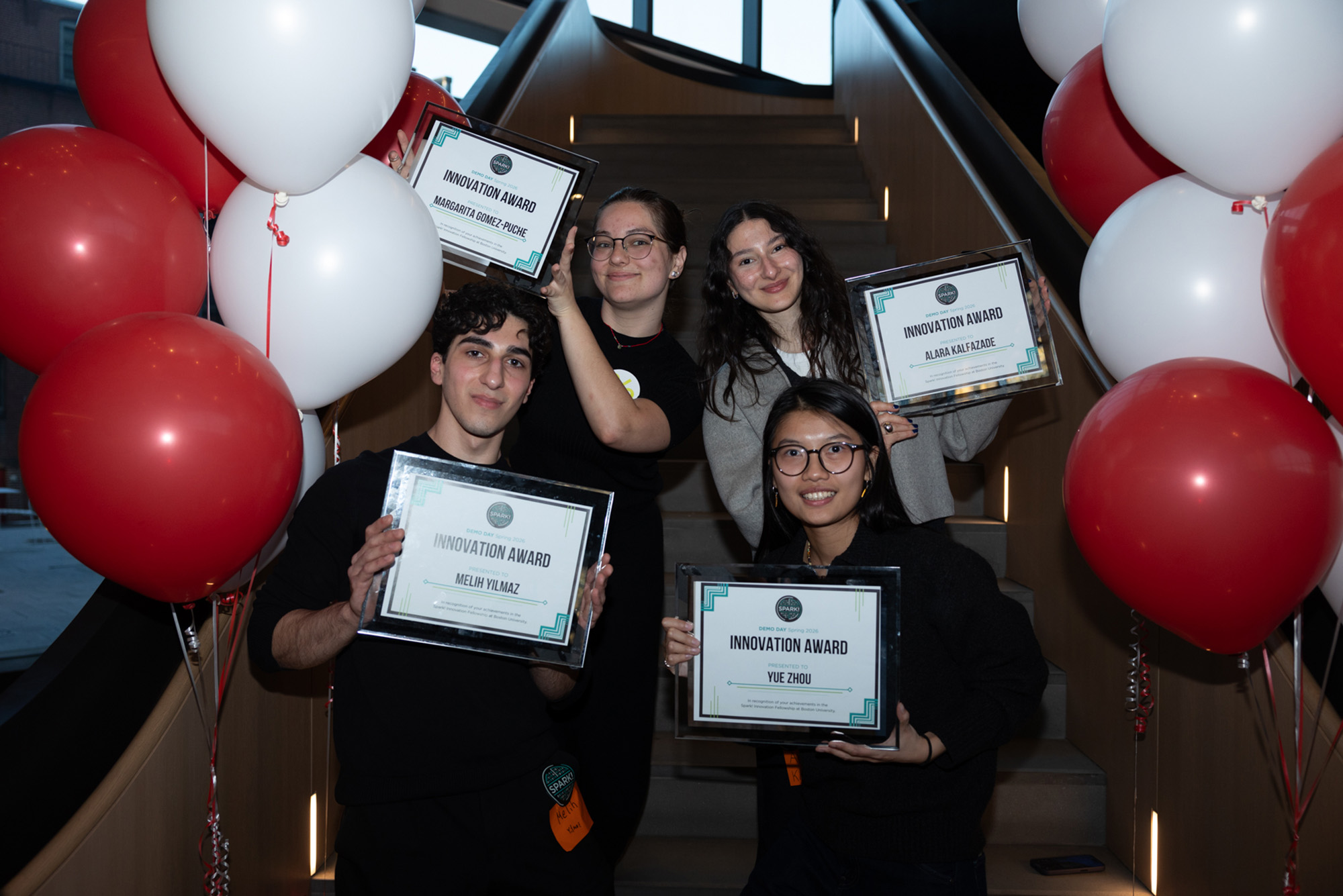
The idea came from the team’s struggle in a type-design class, where they found the existing tools difficult to use. “We began experimenting with simplifying letterforms into basic shapes, and learned the letterform anatomy with circles,” Kalfazade says. “Then we got the idea that resizing circles could be a way to create typefaces” in a browser-based tool, accessible by anyone.
Gomez-Puche says the group wanted to give non-designers a way into typography without the steep learning curve or cost of traditional software. “Percent is meant for anyone who has ever wanted to play with type, but doesn’t have that design background,” she says.
According to postbaccalaureate fellow Nolan Thompson (CFA’24, COM’24, MET’26), the event doubles as a networking hub for BU’s STEM community and industry partners. “It’s the first taste of the industry,” Thompson says. “Clients come [to meet] a lot of really amazing companies and organizations.”
BU Spark! director Ziba Cranmer says what stood out most to her this year is how AI dramatically accelerated the scale and sophistication of the projects that students were able to build. She also was blown away by how deeply the audience—both in-person and online—wanted to celebrate the work of the students. “We had mentors, students, alumni, faculty, community partners, and I even saw quite a few parents who showed up to recognize the creativity and impact of the Spark! student teams,” she says.
Behind the scenes, postbaccalaureate fellows at Spark! oversee external projects in data visualization, data science, and engineering design, and help recruit real-world clients for student teams. Gualda described the two-year fellowship as a launchpad. She and Thompson completed their master’s degrees as fellows and are now heading into full-time jobs.
Thompson says that alumni of the fellows program, particularly student project managers, routinely talk about their Demo Day work in job interviews and have gone on to positions at companies such as Apple and Bloomberg. “I think that Demo Day is a real place for collaboration when competition is a very large player in the space,” Gualda says. “Students really learn what it means to work with one another and take it to the next level.”