Terriers Reflect on Attending This Year’s United Nations Climate Conference
Four BU doctoral students traveled to Brazil for COP30
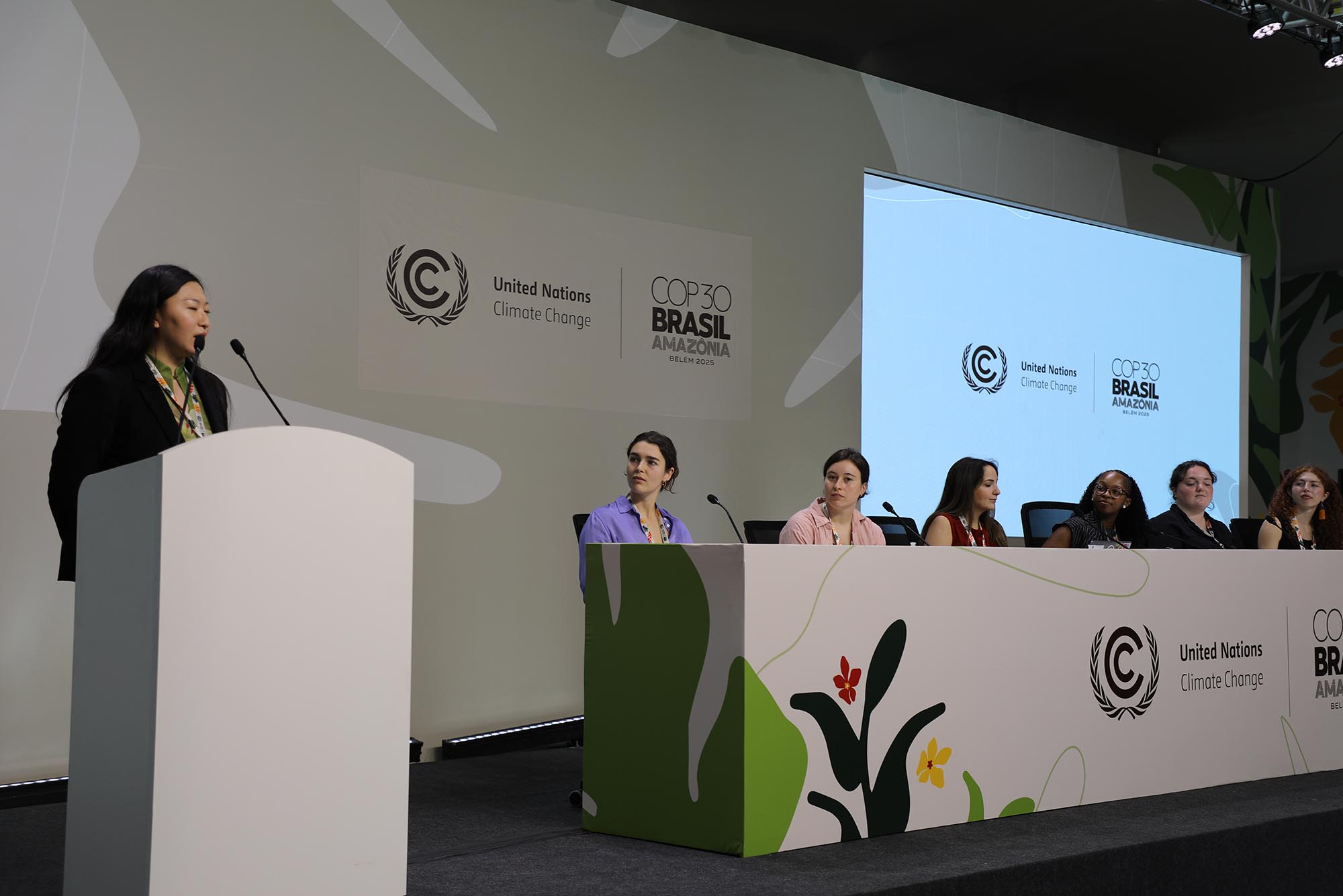
Yu-Qing Chua (GRS’29) (far left) moderates a panel with student fellows from the National Science Foundation–supported Climate Leaders Academy, including BU classmates Flannery Black-Ingersoll (SPH’20,’27) (third from left) and Sheida Hooshmandi (GRS’29) (fourth from left). Photo courtesy of Chua
Terriers Reflect on Attending This Year’s United Nations Climate Conference
Four BU doctoral students who traveled to Brazil for COP30 talk about the urgency they heard and solutions that were discussed
For those in environmental health fields, there’s no better place to join a global effort to address the Earth’s ever-changing climate than at the United Nations annual climate change conference. This November, four Boston University doctoral students had the opportunity of a lifetime when they traveled to Belém, Brazil, to attend the 2025 UN conference, COP30.
They say the experience proved invaluable to their continuing climate research.
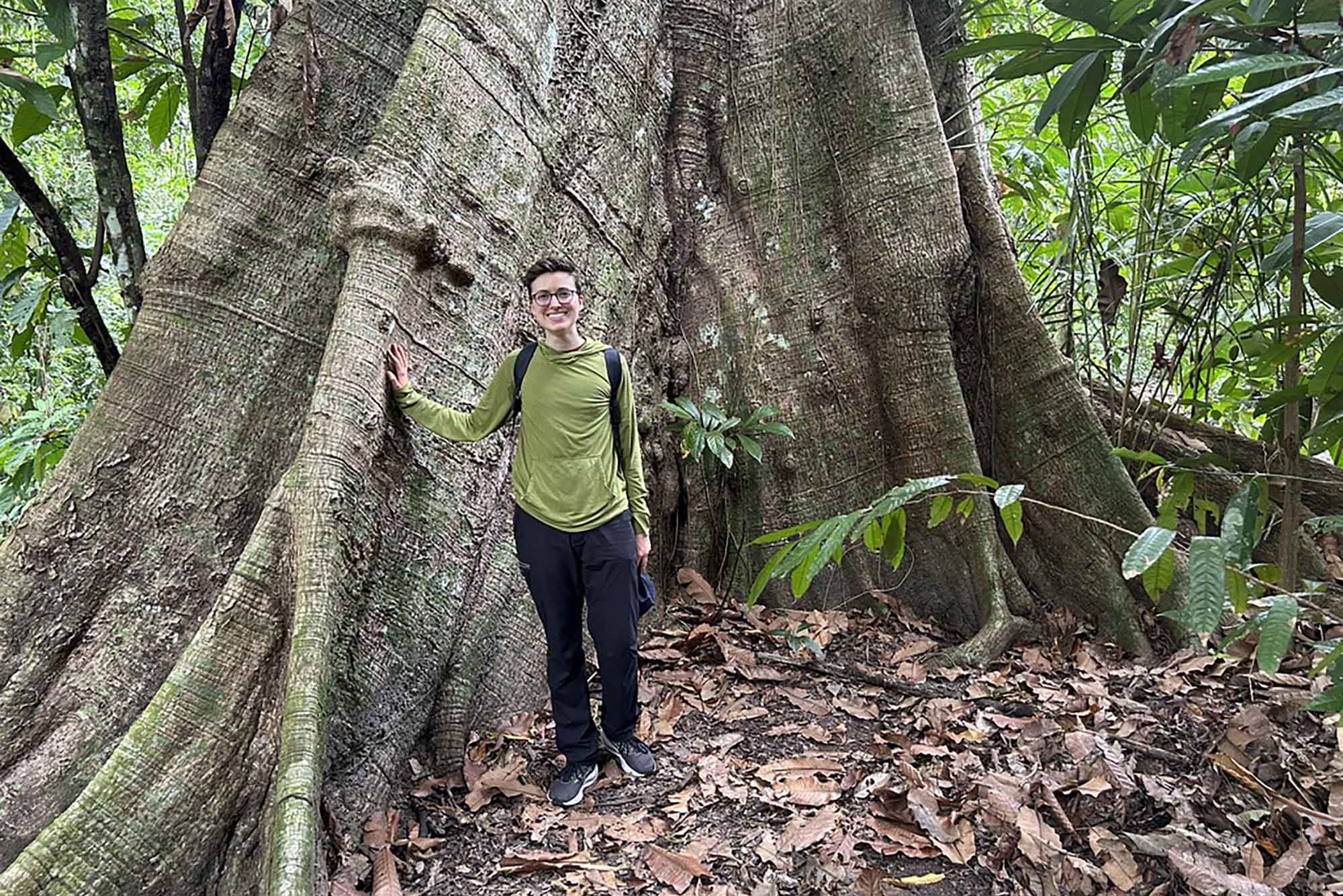
“Through COP30, I learned about ways to increase the inclusivity of assessments and scientific monitoring efforts, such as [by paying] increased attention to geographical areas with fewer data, authors with historically underrepresented identities, and diverse knowledge systems,” says Emerson Conrad-Rooney (GRS’25,’26), who studies how climate change impacts forest carbon sequestration.
For Sheida Hooshmandi (GRS’29), whose research centers on climate policy adaptation, the conference highlighted the importance of crafting policy from the bottom up.
“Being in the Amazon, you could feel how urgent these issues are,” she says. “This experience clarified how essential it is to focus on who actually benefits from projects and whether those projects reduce vulnerability in meaningful ways.”
And for Yu-Qing Chua (GRS’29), the conference served as a reminder that climate science goes beyond research and journal articles.
“At this point, we know enough about climate change to know that action must be taken—it’s communicating that urgency and building momentum that’s the more challenging part,” says Chua, who researches how climate change affects nutrient cycling in forests. “This has led me to change the way I think about the scientific process: that science is not done when you write up the results, but that it’s my responsibility to communicate them in such a way that they reach a wider audience, make science less intimidating and more interesting, and promote trust and engagement.”
COPs, as the climate conferences are known, are short for the annual “Conference of the Parties” to a 1992 UN climate treaty. The events attract representatives from almost 200 countries, including politicians, business leaders, scientists, and Indigenous peoples, who come together to assess climate goals and decide on future actions. This year marked the 30th conference, held in Belém, Brazil, from November 10 to 21.
BU students have participated in COPs for several years under the auspices of a variety of grants and programs. This year’s contingent, which also included Flannery Black-Ingersoll (SPH’20,’27), attended COP30 through the Climate Leaders Academy, a National Science Foundation grant program that trains students in international environmental negotiation before sending them to the conference. They were joined by Pamela Templer, a Distinguished Professor and College of Arts & Sciences chair of biology. Patricia Fabian, a School of Public Health associate professor of environmental health, attended virtually.
“We’ve been taking students to COPs for years because we want to expose them to how international environmental negotiations and diplomacy work, and so they can see science being used in these international agreements,” Templer says.
The students spent their time in Brazil attending their choice of press conferences, talks, panels, and presentations and observing the UN negotiations. Conrad-Rooney attended the first week of the conference. Chua, Hooshmandi, and Black-Ingersoll were there during the second week and participated in a Climate Leaders Academy panel discussion on youth voices at COP.
The programming not only allowed a front-row look at environmental policy at work, but also offered unprecedented access to major players. Case in point: during a fishbowl discussion with UN representatives and Brazil’s Vice-Minister of the Environment and Climate Change, Chua had an opportunity to speak about her work at BU and ask the key speakers about their decision-making processes for environmental health issues.
“It was an amazing experience to be able to speak so candidly and directly to people across the world who have dedicated their entire careers to addressing the needs of people on the axis of climate change and health,” Chua says. “It’s something I could have only done at an event like COP30.”
Watching the UN negotiations was both enlightening and frustrating, the students say.
“My main takeaway from COP30 is how uneven progress can look when you see it up close,” Hooshmandi says. The energy around responding to immediate climate problems outside of the negotiation halls was enthusiastic and purposeful. But inside, “the pace of the formal process still does not match the scale of the challenge,” she says. “You leave appreciating the dedication of everyone here, but are also aware of the limits of consensus when the stakes are this high.”
Each of the BU students say they were heartened by the focus on Indigenous perspectives at the conference. And ultimately, they all left reaffirmed about their commitment to environmental work.
“Many events at COP30 highlighted the importance of focusing on the synergies between nature and climate change,” Conrad-Rooney says. “I came away thinking even more than ever that nature-based solutions should be central to climate action.”
“Attending this conference gave me a sense of hope,” says Black-Ingersoll, whose research includes how climate change creates public health hazards for vulnerable populations.
“Looking across the multiple pavilions representing many countries, nongovernmental organizations, and nonprofits, I saw a global effort to tackle climate change adaptation and mitigation,” she says. “I saw the emerging focus on climate change and public health—with this year launching the first international climate and health adaptation plan, the Belém Health Action Plan—which also gives me hope, [even as we see] the politicization of climate change and a growing anti-science sentiment.”