Skip to Main Content
Boston University
  • Bostonia
  • BU Today
  • The Brink
  • University Publications

    • Bostonia
    • BU Today
    • The Brink
  • School & College Publications

    • The Record
Other Publications
BU Today
  • Sections
News, Research, Community

Defending Memory from Alzheimer’s

BU geneticists help uncover new gene for debilitating disease
February 21, 2007
  • Chris Berdik
Twitter Facebook
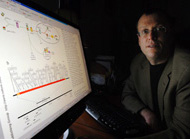
Lindsay Farrer, MED chief of genetics, is leading BU researchers in the hunt for the genes behind Alzheimer’s.

Alzheimer’s disease does more than steal its victims’ memories — gradually, it kills their identities. About a decade ago, scientists discovered the first genetic link to this progressive dementia afflicting more than four million Americans. Now, Boston University geneticists, collaborating with an international team of researchers, have uncovered a second major genetic association with Alzheimer’s. Their discoveries are outlined in a paper published in this month’s issue of Nature Genetics.

Along with researchers from the University of Toronto and Columbia University, the BU scientists analyzed the DNA of about 6,800 individuals from nine populations, representing four main ethnic groups (Caucasians, African-Americans, Caribbean-Hispanics, and Israeli-Arabs). They found that variants of the SORL1 gene were more common in people with late-onset Alzheimer’s, the most common form of the disease.

Lead BU researcher Lindsay Farrer, a School of Medicine professor and chief of the genetics program, describes the protein produced by SORL1 as a kind of “traffic cop” in human cells, directing other proteins and molecules where they can and can’t go. One of the key pieces of this intercellular traffic pattern is amyloid precursor protein (APP). When SORL1 is functioning normally, Farrer and his team believe, its protein shuttles APP down a pathway where it metabolizes harmlessly. But, they believe, the genetic variants of SORL1 either reduce the amount of this traffic cop protein or they lead to an altered variety that allows APP to stray into a region of the cell where it degrades into its toxic form, leading to plaques that, in Farrer’s words, “gunk up the brain.”

At this point, that biological scenario remains a hypothesis. What the researchers have found is an association between gene variants and Alzheimer’s disease. The replication of this finding across several populations gives the association strength and scientific validity, but, Farrer notes, “people should not be thinking they can go get their SORL1 gene analyzed and then make a prediction that they will or won’t get Alzheimer’s based on it.”

Fully understanding the biological mechanism that underlies these associations is complicated by the unusually large size of SORL1, which contains at least 500 known variants. So far, researchers have examined only about 30. Further discoveries, says Farrer, will most likely require the type of multi-institution effort that was the hallmark of the initial research.

BU geneticists are already engaged in several collaborative efforts. The Alzheimer’s researchers, for example, have been contributing their data and DNA specimens (when subjects consent) to a national repository that can be used by other researchers. And in September 2006, the MED department of genetics and genomics launched a Genetic Medicine Database (GMED), a searchable collection of prepublication results from BU researchers’ genetic analysis of 320 families from the Framingham Heart Study, the long-running epidemiological study begun by the National Heart, Lung, and Blood Institute in 1948 and run by BU since 1971.

Farrer and his fellow researchers plan to continue investigating the SORL1 gene in order to zero in on the “biologically causal variants.” They’ll also begin investigations of related genes “to see if [SORL1] has any co-conspirators.” Farrer says that SORL1 is an “attractive therapeutic target” because of its genetic association with Alzheimer’s and its role in APP processing. Eventually, he says, “we will begin working with others who have greater pharmacological and cell biological expertise than us, in order to try to translate this finding into a possible treatment.”

Chris Berdik can be reached at cberdik@bu.edu.


Explore Related Topics:

  • Faculty
  • Research
  • Share this story

Share

Defending Memory from Alzheimer’s

Share

  • Twitter
  • Facebook
  • Reddit
  • LinkedIn
  • Email

Latest from BU Today

  • Things-to-do

    A Trip to the Sea via the T

  • University News

    BU Schedules Informational Town Halls Regarding New Federal Cap on International Students’ Time in the US

  • Film & TV

    As Christopher Nolan’s The Odyssey Hits Movie Screens, BU Students Already Know the Story

  • Health & Medicine

    Chobanian & Avedisian School of Medicine’s Chief Resident Immersion Training (CRIT) Marks 25th anniversary

  • Faculty

    CFA’s Jim Demler and His Identical Twin Brother Make Their Off-Broadway Debut

  • Accolades

    Dream of Being a Fulbright Scholar? Hear from Recent Awardees

  • University News

    BU Leaders Ask Federal Government to Reconsider Changes to Research Grants’ Approval Process Rules

  • University News

    Three New College of Arts and Sciences Master’s Programs Will Take Students to the Cutting Edge

  • Things-to-do

    Want to Beat the Summer Heat? Check Out One of the Boston Area’s Many Public Pools

  • University News

    Boston University Announces Leadership Updates

  • International Sports

    FIFA World Cup Gives a SHA Grad Student Hands-On Experience in Event Management

  • University News

    Boston University Hospitality Dean Arun Upneja Stepping Down

  • University News

    Meet the 38 Charles River Campus Faculty Promoted to Ranks of Associate Professor, Full Professor

  • University News

    BU Opens Cooling Stations on Charles River Campus as First Heat Wave of the Summer Arrives

  • Things-to-do

    Looking for Places to Watch Fireworks This Fourth of July? BU Has You Covered

  • In the City

    How to Celebrate the Fourth of July in Boston During America’s 250th Birthday

  • Things-To-Do

    Getting to Know Your Neighborhood: Newbury Street

  • Photography

    Photo Gallery Offers a Look Back at Spring 2026 Highlights on Campus

  • Arts & Culture

    Cheese Is Now a Protein Source? Five Things to Know About the Updated Mediterranean Diet

  • Theatre

    CFA Students Bring Their Design Talents to World’s Largest Shakespeare Festival

Section navigation

  • Sections
  • Must Reads
  • Videos
  • Series
  • Close ups
  • Archives
  • About + Contact
Get Our Email

Explore Our Publications

Bostonia

Boston University’s Alumni Magazine

BU Today

News, Research, Community

The Brink

Pioneering Research from Boston University

  • Twitter
  • Facebook
  • Youtube
  • LinkedIn
  • Instagram
  • Weibo
  • TikTok
© Boston University. All rights reserved. www.bu.edu
© 2026 Trustees of Boston UniversityPrivacy StatementAccessibility
Boston University
Notice of Non-Discrimination: Boston University prohibits discrimination and harassment on the basis of race, color, natural or protective hairstyle, religion, sex or gender, age, national origin, ethnicity, shared ancestry and ethnic characteristics, physical or mental disability, sexual orientation, gender identity and/or expression, genetic information, pregnancy or pregnancy-related condition, military service, marital, parental, veteran status, or any other legally protected status in any and all educational programs or activities operated by Boston University. Retaliation is also prohibited. Please refer questions or concerns about Title IX, discrimination based on any other status protected by law or BU policy, or retaliation to Boston University’s Executive Director of Equal Opportunity/Title IX Coordinator, at titleix@bu.edu or (617) 358-1796. Read Boston University’s full Notice of Nondiscrimination.
Search
Boston University Masterplate
loading Cancel
Post was not sent - check your email addresses!
Email check failed, please try again
Sorry, your blog cannot share posts by email.
Defending Memory from Alzheimer’s
0
share this