Skip to Main Content
Boston University
  • Bostonia
  • BU Today
  • The Brink
  • University Publications

    • Bostonia
    • BU Today
    • The Brink
  • School & College Publications

    • The Record
Other Publications
BU Today
  • Sections
News, Research, Community

A Map of the Bacterial World

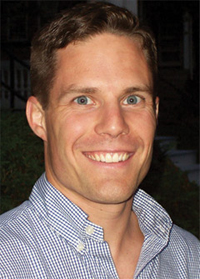
Timothy Gardner, an ENG assistant professor of biomedical engineering, is studying the metabolism of E. coli.
March 6, 2007
  • Chhavi Sachdev
Twitter Facebook

The bacterium E. coli is among the most-studied organisms on Earth, but there are still secrets to explore. Timothy Gardner (ENG’00), a College of Engineering  assistant professor of biomedical engineering, has for the first time mapped more than 1,000 interactions in the cell’s regulatory network, potentially opening the window to understanding how bacteria mutate and develop resistance to antibiotics.

Bacteria resist antibiotics because they have strong survival skills, Gardner says. “They respond to varying conditions, nutrients, toxins, stresses, and competition from different organisms in constantly varying environments by basically changing their metabolic program,” he says. “The system that orchestrates these responses is not a trivial system. It is actually hundreds of genes that are connected in an interdependent network.”

In a study published in the journal PLoS Biology, Gardner and his research team looked at existing models of metabolism in E. coli, then came up with an algorithm to make predictions about what would happen if they tweaked a cell. They collected data sets on about two million data points detailing E. coli genes and regulatory interactions between them, then ran the data through the algorithm. “By studying precisely all the things that come out, you can infer what’s actually inside the black box,” says Gardner, who was recently elected to the governing council for the Institute for Biological Engineering.

Gardner’s map of the E. coli bacterium’s
regulatory system.

The researchers found that their algorithm exceeded the accuracy of existing models by about 40 percent. “It could predict regulatory interactions from the data with about 80 percent confidence, so about 8 out of 10 predictions were correct,” says Gardner. “For computational work in biology, that’s an extremely good performance.”

Having proved with E. coli that the algorithm could calibrate the control system, the researchers are now expanding their data set to try to map microbial interactions in other bacteria. As Gardner explains it, their approach is like using a satellite to map a coastline rather than sailing a boat around it.

So far, the research team has targeted pathways of virulence or infection, coordinated group action, and antibiotic tolerance. The researchers disturb the physiological mechanisms to induce group responses, examine virulence expression and responses, and then mix those responses with different types of stresses and environmental conditions to see if there is a relationship between them. They also plan to do antibiotic studies where they start to treat the virulence with combinations of antibiotics to see how those responses interact with the virulence pathways.


This article was originally published on the College of Engineering Web site.


Explore Related Topics:

  • Faculty
  • Research
  • Share this story

Share

A Map of the Bacterial World

Share

  • Twitter
  • Facebook
  • Reddit
  • LinkedIn
  • Email

Latest from BU Today

  • Humanities

    BU PhD Student Highlights Overlooked Revolutionary War Voices Through Internship at the Boston Athenaeum

  • Student Life

    Interning at City Hall: Making an Impact Where It Matters Most

  • BUTI

    Strike Up the Band for Boston University Tanglewood Institute’s 60th Anniversary

  • University News

    MBTA Green Line B Branch Service to Be Suspended Twice in August

  • Things-to-do

    A Trip to the Sea via the T

  • University News

    BU Schedules Informational Town Halls Regarding New Federal Cap on International Students’ Time in the US

  • Film & TV

    As Christopher Nolan’s The Odyssey Hits Movie Screens, BU Students Already Know the Story

  • Health & Medicine

    Chobanian & Avedisian School of Medicine’s Chief Resident Immersion Training (CRIT) Marks 25th anniversary

  • Theatre

    CFA’s Jim Demler and His Identical Twin Brother Make Their Off-Broadway Debut

  • Accolades

    Dream of Being a Fulbright Scholar? Hear from Recent Awardees

  • University News

    BU Leaders Ask Federal Government to Reconsider Changes to Research Grants’ Approval Process Rules

  • University News

    Three New College of Arts and Sciences Master’s Programs Will Take Students to the Cutting Edge

  • Things-to-do

    Want to Beat the Summer Heat? Check Out One of the Boston Area’s Many Public Pools

  • University News

    Boston University Announces Leadership Updates

  • International Sports

    FIFA World Cup Gives a SHA Grad Student Hands-On Experience in Event Management

  • University News

    Boston University Hospitality Dean Arun Upneja Stepping Down

  • University News

    Meet the 38 Charles River Campus Faculty Promoted to Ranks of Associate Professor, Full Professor

  • University News

    BU Opens Cooling Stations on Charles River Campus as First Heat Wave of the Summer Arrives

  • Things-to-do

    Looking for Places to Watch Fireworks This Fourth of July? BU Has You Covered

  • In the City

    How to Celebrate the Fourth of July in Boston During America’s 250th Birthday

Section navigation

  • Sections
  • Must Reads
  • Videos
  • Series
  • Close ups
  • Archives
  • About + Contact
Get Our Email

Explore Our Publications

Bostonia

Boston University’s Alumni Magazine

BU Today

News, Research, Community

The Brink

Pioneering Research from Boston University

  • Twitter
  • Facebook
  • Youtube
  • LinkedIn
  • Instagram
  • Weibo
  • TikTok
© Boston University. All rights reserved. www.bu.edu
© 2026 Trustees of Boston UniversityPrivacy StatementAccessibility
Boston University
Notice of Non-Discrimination: Boston University prohibits discrimination and harassment on the basis of race, color, natural or protective hairstyle, religion, sex or gender, age, national origin, ethnicity, shared ancestry and ethnic characteristics, physical or mental disability, sexual orientation, gender identity and/or expression, genetic information, pregnancy or pregnancy-related condition, military service, marital, parental, veteran status, or any other legally protected status in any and all educational programs or activities operated by Boston University. Retaliation is also prohibited. Please refer questions or concerns about Title IX, discrimination based on any other status protected by law or BU policy, or retaliation to Boston University’s Executive Director of Equal Opportunity/Title IX Coordinator, at titleix@bu.edu or (617) 358-1796. Read Boston University’s full Notice of Nondiscrimination.
Search
Boston University Masterplate
loading Cancel
Post was not sent - check your email addresses!
Email check failed, please try again
Sorry, your blog cannot share posts by email.
A Map of the Bacterial World
0
share this