Training Under Pressure
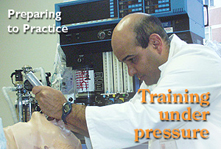
Sedated and unable to move on the operating table, Mrs. S suddenly is in distress. An otherwise healthy 76-year-old, she has been sailing smoothly through a total knee replacement. Then the steady beeping of the pulse monitor suddenly shifts into an erratic jig. The young anesthesiologist, a first-year resident at Boston Medical Center, looks alarmed. The patient’s blood pressure is rising quickly, and the electrocardiogram is sketching out a telltale pattern. “She’s having an MI,” the resident says, meaning myocardial infarction — a heart attack.
He takes swift action to resolve the crisis, which is convincingly realistic. Mrs. S’s heart attack is actually a simulated crisis; the patient, mostly covered with surgical drapes, is SimMan, a sophisticated mannequin that can be programmed to simulate various medical scenarios. SimMan is the centerpiece of the new Simulation Center at BU-affiliated Boston Medical Center, where anesthesiology residents and other physicians learn how to respond to potentially catastrophic events in the operating room.
“The majority of the things we do as anesthesiologists are pretty dangerous,” says Keith Lewis, a School of Medicine associate professor of anesthesiology and chair of the department. “We put breathing tubes in people, we paralyze them, and when they stop breathing, we take over their physiologic functions.”
Lewis spearheaded the development of the Simulation Center, which opened in April and features two full-sized SimMen. The center consists of a simulated operating room with a table, an anesthesia machine, surgical drapes, and a one-way mirror behind which Lewis and other faculty in a control room watch the medical crises unfold. They adjust SimMan’s vital functions on the fly with a laptop computer, causing oxygen saturation — a measure of how well a patient is breathing — to plummet or his heart rate to suddenly spike. “We can change the situation second-by-second in terms of heart rate and blood pressure, as well as what’s going on with the airway or other situations,” says Lewis. “From my perspective, it’s stressful, it’s tense, and it’s real.”
For students, the simulators look, feel, and sound like real patients. You can feel SimMan’s pulse near its wrist — the strength and rhythm of the pulse rises and falls according to SimMan’s blood pressure and heart rate, which can be programmed to mimic more than 2,500 different cardiac rhythms. “SimMan can be used to re-create any kind of scenario you’d encounter in the operating room,” Lewis says, “such as extensive blood loss, constricted airway, high heart rate, and low blood pressure — the list is endless.”
Anesthesiology residents learn such skills as intubating, or inserting a breathing tube down the trachea into the lungs. “Learning to put in a breathing tube is not always easy,” says Lewis. “In the operating room, we may already have a patient who’s paralyzed and not breathing on his own and have only a short period of time to successfully intubate him. Under pressure, the resident putting in the breathing tube may chip a tooth or cause some injury to the lips or tongue. But in the Simulation Center, we can create those stressful scenarios, so that by the time the resident or medical student gets into the operating room, it’s much less risky for the patient and perhaps much less stressful for the doctors.”
Students and residents can also practice inserting intravenous lines in SimMan, perform CPR on it, or even do a cricothyroidotomy, an emergency procedure to open a hole in the trachea below the voice box. The center has infant- and adolescent-sized mannequins as well.
Many otherwise well-qualified residents stumble when they first encounter SimMan. “They may get the right answer on the test, but under the tension of the situation, with the patient’s blood pressure and heart rate going up, they may actually not know what to do, and freeze,” Lewis says. With practice, however, the residents learn to respond to such crises more effectively.
In an adjacent debriefing room, students, residents, and faculty watch videos of the simulations and critique performances. Lewis assesses a new doctor’s medical decisions and gives candid feedback, but he’s also concerned with how the resident interacts with the surgeons and nurses who are occasionally recruited to act out a scenario. Miscommunication can precipitate a crisis, he says, or exacerbate an already dire situation.
Simulation centers will play an increasingly important role at all levels of medication education, he says, because there’s growing evidence that training on mannequins such as SimMan improves patient safety in the operating room. Although Lewis’s focus is on anesthesia, his goal is to open the Simulation Center to other specialties. Jonathan Olshaker, a MED professor of emergency medicine and chair of the department, is interested and would like to develop a more extensive center for the entire Boston University Medical Center. “We’re still in the early stages of planning this,” Olshaker says, “but it’s an exciting concept. I think in the next 10 years it will become mandatory for emergency medicine residencies to have such a center.”
This story was first published in the Fall 2005 issue of Bostonia.