Skip to Main Content
Boston University
  • Bostonia
  • BU Today
  • The Brink
  • University Publications

    • Bostonia
    • BU Today
    • The Brink
  • School & College Publications

    • The Record
Other Publications
BU Today
  • Sections
News, Research, Community

Mapping the Milky Way

Astronomy student leads search for new stars
December 15, 2005
  • Chris Berdik
Twitter Facebook
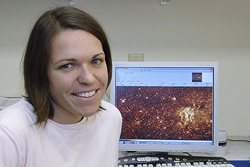
Emily Mercer (GRS`07) recently led a team of astronomers in the discovery of nearly 100 new star clusters in the Milky Way. Photo by Kalman Zabarsky

It may be hard to imagine stargazing under the glare of Boston’s city lights, but a Boston University graduate student recently led a team of astronomers in the discovery of nearly 100 new star clusters in the Milky Way, each with up to hundreds of never-before-seen stars.

Emily Mercer (GRS’07), in her fifth year as a doctoral student in astronomy, discovered the majority of the new stars using a computer program she created. The program sifted through more than a year’s worth of data from NASA’s Spitzer space telescope and identified the patterns that indicate the existence of star clusters. Her work was featured in the December 10 issue of the Astrophysical Journal.

“It took about a year or so of fine-tuning to make sure the method worked,” says Mercer, adding that it took her computer about two weeks to crunch all the numbers. “I was pretty excited to see the results.”

Along with Dan Clemens and James Jackson, both College of Arts and Sciences astronomy professors, Mercer represents the University on the multi-institutional Galactic Legacy Infrared Mid-Plane Survey Extraordinaire (GLIMPSE) team, which is using data from Spitzer to create a census and map of the star clusters, where the galaxy’s new stars are born.

From the darkness of space, Spitzer uses infrared light to penetrate the clouds of dust and gas that fill the Milky Way and obscure stars from view. More than 30 million stars have already been catalogued by GLIMPSE, and Mercer’s computer algorithm was able to find about 60 new clusters among them. About 30 more clusters were identified in the traditional way — visually scrutinizing Spitzer’s images for dense areas of stars.

While the GLIMPSE team hopes eventually to catalogue 50 million stars, they have collected all the data they plan to from Spitzer, which launched in 2003 and will shut down in 2008, after it runs out of the liquid helium used to cool its instruments. The star catalogues are public and available for research by other astronomers.

Now that her algorithm has helped locate all this new galactic glitter, Mercer says the GLIMPSE team will map the star clusters to “better understand the structure of our galaxy.” Because our solar system sits within the Milky Way’s flat, spiral disk, Clemens explains, our normal view of the galaxy is “edge on,” making it appear like a blurry band of light stretching across the sky.

“We’d like to untangle that line of sight,” he says. “We hope to place these star clusters in a three-dimensional context within the galaxy.”

Explore Related Topics:

  • Astronomy
  • Research
  • Students
  • Share this story

Share

Mapping the Milky Way

Share

  • Twitter
  • Facebook
  • Reddit
  • LinkedIn
  • Email

Latest from BU Today

  • Public Safety

    BUPD Offers Tips for How to Keep You and Your Property Safe

  • Arts & Culture

    Wheelock Family Theatre Gives High School Students a Hands-On Role in Theater Management

  • Student Life

    10 BU Hacks to Navigate the Student Experience

  • Film & TV

    BU Alum Julian Shapiro-Barnum Takes Late-Night Outdoors

  • CLASS SELECTION

    Student Creates AI-Powered Tool to Analyze Classroom Space Usage on Charles River Campus

  • University News

    New financial aid program covers tuition for families earning less than $200,000

  • BUTI

    Photos Capture Excitement of BU Tanglewood Institute’s 60th Anniversary Celebration

  • Things-to-do

    Want to Beat the Summer Heat? Check Out One of the Boston Area’s Many Public Pools

  • Student Life

    BU Chobanian & Avedisian School of Medicine Welcomes First-Year Medical Students During White Coat Day

  • Move-in 2026

    Boston University Move-In 2026: Everything You Need to Know

  • Student Life

    BU’s Chobanian & Avedisian School of Medicine Matches Mentees & Mentors

  • Humanities

    BU PhD Student Highlights Overlooked Revolutionary War Voices Through Internship at the Boston Athenaeum

  • Student Life

    Interning at City Hall: Making an Impact Where It Matters Most

  • BUTI

    Strike Up the Band for Boston University Tanglewood Institute’s 60th Anniversary

  • University News

    MBTA Green Line B Branch Service to be Suspended Twice in August

  • Things-to-do

    A Trip to the Sea via the T

  • University News

    BU Schedules Informational Town Halls Regarding New Federal Cap on International Students’ Time in the US

  • Film & TV

    As Christopher Nolan’s The Odyssey Hits Movie Screens, BU Students Already Know the Story

  • Health & Medicine

    Chobanian & Avedisian School of Medicine’s Chief Resident Immersion Training (CRIT) Marks 25th anniversary

  • Arts & Culture

    CFA’s Jim Demler and His Identical Twin Brother Make Their Off-Broadway Debut

Section navigation

  • Sections
  • Must Reads
  • Videos
  • Series
  • Close ups
  • Archives
  • About + Contact
Get Our Email

Explore Our Publications

Bostonia

Boston University’s Alumni Magazine

BU Today

News, Research, Community

The Brink

Pioneering Research from Boston University

  • Twitter
  • Facebook
  • Youtube
  • LinkedIn
  • Instagram
  • Weibo
  • TikTok
© Boston University. All rights reserved. www.bu.edu
© 2026 Trustees of Boston UniversityPrivacy StatementAccessibility
Boston University
Notice of Non-Discrimination: Boston University prohibits discrimination and harassment on the basis of race, color, natural or protective hairstyle, religion, sex or gender, age, national origin, ethnicity, shared ancestry and ethnic characteristics, physical or mental disability, sexual orientation, gender identity and/or expression, genetic information, pregnancy or pregnancy-related condition, military service, marital, parental, veteran status, or any other legally protected status in any and all educational programs or activities operated by Boston University. Retaliation is also prohibited. Please refer questions or concerns about Title IX, discrimination based on any other status protected by law or BU policy, or retaliation to Boston University’s Executive Director of Equal Opportunity/Title IX Coordinator, at titleix@bu.edu or (617) 358-1796. Read Boston University’s full Notice of Nondiscrimination.
Search
Boston University Masterplate
loading Cancel
Post was not sent - check your email addresses!
Email check failed, please try again
Sorry, your blog cannot share posts by email.
Mapping the Milky Way
0
share this