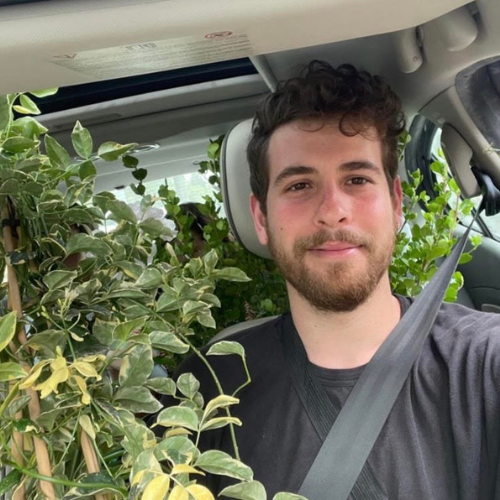
PhD Student Sociocultural Anthropology
He/Him/His
Matriculated September 2024
Research Interests
Social and Political transformations; Citizenship, Nationality and Transnationalism; Belonging and Recognition; Migration and Minority relations; Emotions/Affect, Morality and Political subjectivity; Aging, Neoliberalism and Wellbeing; Family life; Gender and Queer theory; Political Anthropology, Psychological Anthropology, Medical Anthropology; Jews in contemporary Europe; Israel/Palestine, Germany, Europe.
About
Ofir is intrigued by how sociopolitical transformations shape people’s emotional and moral positions toward the taken-for-granted elements of their own personal lives, and is particularly curious about moments of individual or collective self-reflection, decision-making, and ambivalence.
In his doctoral studies, Ofir studies the lives of Jewish Israeli immigrants in Berlin, Germany. His project ethnographically examines how Israeliness in Berlin has been renegotiated since 2023, while geopolitical dynamics in Israel/Palestine and Germany continue to reconfigure the social climate of Berlin. At this stage of his preliminary fieldwork, Ofir is particularly interested in how different social actors—individuals as well as organizations—re-orient themselves within changing political landscapes and discourses; how people negotiate competing understandings of vulnerability and solidarity; and how Germany’s post-Holocaust commitments to protect Jewish life intersect—and at times clash—with the experiences and political commitments of Israelis themselves. Looking at questions of belonging, recognition, safety, and vulnerability, this project examines how so-called “favored” migrants navigate the tension between institutional recognition and everyday experiences of ambivalence and rejection, as well as the affective contradictions that such a position generates.
Prior to joining Boston University, Ofir completed his B.A. (2021) and M.A. (2024) in the Department of Sociology and Anthropology at Tel Aviv University, where he also worked as a teaching fellow in several courses. In his master’s thesis project, based on ethnographic fieldwork in an assisted living residence for elders, he explored how upper-middle-class Jewish Israeli elders experience a national crisis. His thesis focused on their complex relationship with the nation-state and the uncertain future of themselves, their descendants, and the state—and on how socioeconomically privileged elders navigate a pursuit of neoliberalized scripts of well-being amid a sociopolitical collapse that threatens to undermine that very aspiration.
Awards & Grants
- The American Ethnological Society (AES) – Graduate Student Research Awards (2026)
- International Association for the Study of German Politics (IASGP) – Fieldwork Grant (2026)
- Institute on Culture, Religion & World Affairs (CURA), Boston University – Travel Grant (2026)
- The Center for Innovation in Social Science (CISS), Boston University – Research Travel Grant (2026)
- The Elie Wiesel Center for Jewish Studies, Boston University – Grant for Preliminary Fieldwork (2025)
- The SPA / Robert Lemelson Foundation Fellowship – Summer Research Grant (2025)
Publications
- forthcoming