News
OSTP Nominee, Humanities Funding, Nutrition & Health
BU IN DC
Roscoe Giles of the College of Engineering participated in a meeting of the U.S. Department of Energy’s Advanced Scientific Computing Advisory Committee, of which he is a member, on July 21st and 22nd.
SENATE HEARS FROM OSTP NOMINEE
On Wednesday, the Senate Commerce, Science, & Transportation Committee held a hearing to consider the nomination of Dr. Arati Prabhakar as director of the White House Office of Science and Technology Policy (OSTP). In her testimony, Dr. Prabhakar acknowledged the need to develop a respectful workplace culture at OSTP in the wake of allegations of bullying under the previous director; she pledged to make it a top priority if confirmed. Senators questioned Dr. Prabhakar about climate change research, increasing National Science Foundation support for institutions in states that historically don't receive significant funds, cybersecurity, and broadening participation in science. Next, the Committee will vote on Prabhakar's nomination and send it to the full Senate for a confirmation vote.
BUZZ BITS...
- On Wednesday, the U.S. House of Representatives passed legislation to increase funding for research programs at the U.S. Department of Energy and the National Endowment for the Humanities by 7% and 14%, respectively, in fiscal year 2023. Lawmakers rejected an amendment to reduce funding for the National Endowments for the Arts and the Humanities by more than $100 million. The U.S. Senate has not yet unveiled its version of the spending bills, which will need to be reconciled with the House version before a final package can be sent to the White House.
- The House passed the annual defense policy bill (H.R. 7900) last week. The measure includes a provision to create a limited visa program for immigrant scientists who are engaged in research related to national security. The Senate is expected to take up its version of the National Defense Authorization Act this fall.
- The White House is hosting a virtual Roundtable on Ensuring Safety and Opportunity in STEM Environments: Preventing and Addressing Identity-based Harassment today at 1 p.m. Eastern. Participants will reflect on the 50th anniversary of Title IX and discuss both advancements in and barriers to women's participation in science.
AGENCY NEWS YOU CAN USE
The National Institutes of Health (NIH) Office of Nutrition Research (ONR) released a request for information (RFI) on the impact of diet, food environment, and related exposures on the developmental origins of health and diseases (DOHaD). NIH is seeking responses to inform the agency’s future research on the effects of parental health and nutritional status and eating behaviors during pregnancy and in early developmental stages on their children’s growth, eating patterns, and vulnerability to diet-related diseases. The RFI specifically solicits input on topics including research gaps on DOHaD, women’s health, or child development; relevant social determinants for vulnerable or underrepresented populations; practices to address barriers and gaps in this research; potential pre- or periconceptual interventions; and projected challenges in data collection. Responses are due by August 15th.
Live from Space, BU Alum and Astronaut Bob Hines Talks Gravity, Lasagna, NASA Careers
University event lets high school students and others ask questions of astronauts on the International Space Station.
Spending Bills, NSF Social Science, Global Health Research
BU IN DC
Nahid Bhadelia of the Center for Emerging Infectious Diseases Policy & Research joined the White House's COVID-19 Response team as a senior policy advisor for global disease response.
Micaelah Morrill of Innovate@BU and Megan Sandel of the School of Medicine participated in a White House Hunger Summit Listening Session hosted by Congresswoman Ayanna Presley (D-MA) and Project Bread in East Boston on July 11th.
President Joe Biden nominated Martha Guzman (LAW '92) to serve on the United States District Court for the District of Massachusetts on July 13th.
HOUSE SPENDING PANEL APPROVES SCIENCE, STUDENT AID INCREASES
The House Appropriations Committee recently passed several spending bills which propose significant increases to federal research agencies and student aid for fiscal year 2023. The Committee proposed:
- National Institutes of Health: $47.5 billion, a 5.6% increase
- National Science Foundation: $9.6 billion, a 9% increase
- Department of Energy Office of Science: $8 billion, a 7% increase
- NASA Science: $7.9 billion, a 4% increase
- Department of Defense Basic Research: $2.6 billion, a 6% decrease
- Pell Grant maximum award: $7,395, a 7.3% increase
- National Endowment for the Humanities: $207 million, a 15% increase
- Advanced Research Projects Agency-Health: $2.75 billion, a 175% increase
The U.S. Senate has not begun consideration of its version of the spending bills. Lawmakers are not expected to reach agreement on the final bills prior to the October 1st start of the federal fiscal year and are likely to enact a continuing resolution to keep the government operating at current funding levels.
BUZZ BITS...
- The National Science Foundation (NSF) announced that Dr. Kellina Craig-Henderson will serve as the next assistant director of the NSF Social, Behavioral and Economic Sciences (SBE) Directorate. Dr. Craig-Henderson has served as SBE's interim director since January and has been with NSF for over 16 years. She previously served on the faculty at the University of Illinois Urbana-Champaign.
- The National Oceanic and Atmospheric Administration (NOAA) appointed Dr. Sarah Kapnick as NOAA's next chief scientist. Dr. Kapnick previously served as senior climate scientist and sustainability strategist at J.P. Morgan after spending ten years at NOAA’s Geophysical Fluid Dynamics Laboratory.
- On June 8th, the U.S. Department of Education announced that Dr. Jordan Matsudaira will serve as ED's first chief economist. Dr. Matsudaira will conduct research to guide the Department's policymaking and serve as a liaison to the education policy research community. He will also continue as ED's deputy undersecretary for higher education. Matsudaira was previously an economist with Teachers College at Columbia University.
AGENCY NEWS YOU CAN USE
The National Institutes of Health (NIH) has issued a request for information (RFI) seeking public input on how the agency can better promote equity in global health research. NIH is particularly interested in submissions that address the elements of successful collaborations with researchers in low and middle-income countries. Responses will be used to inform NIH's practices and procedures for supporting global health research and are due by August 1st.
BU’s Nahid Bhadelia Joins White House COVID-19 Response Team
Bhadelia, an infectious diseases physician and global leader in pandemic preparedness, named senior policy advisor for global COVID response.
Reproductive Rights, Refugees, Data Gaps
ON THE CHARLES RIVER
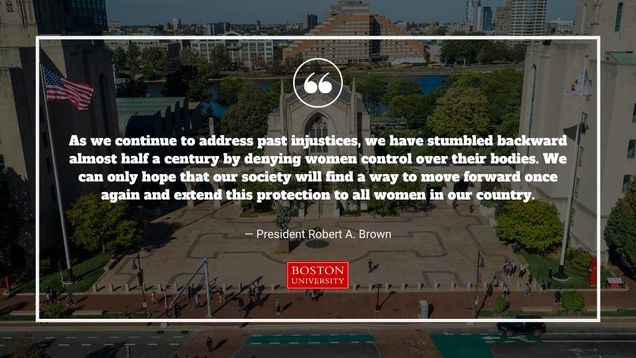
University Affirms Commitment to Guaranteeing Women’s Reproductive Rights
In a letter following the Supreme Court's decision to overturn Roe v. Wade, President Brown assured the BU community that the University remains steadfastly committed to guaranteeing women’s reproductive rights under Massachusetts law.
FACULTY EXPERT

America the Miserly: How Our Refugee System Fails Desperate People
With thousands fleeing Ukraine and millions still displaced by the Syrian civil war, BU sociologist Heba Gowayed's new book faults the United States, Canada, and Germany for letting down refugees.
Understand the refugee experience
RESEARCH HIGHLIGHT

Data Gaps for Race and Ethnicity Are Holding Back Antiracism Efforts, New Report Says
Ibram X. Kendi–led BU Center for Antiracist Research calls for new federal data standards to help confront racial inequities and injustice.
THOUGHT LEADERS
In Case You Missed It...
Dean Angela Onwuachi-Willig of the BU School of Law tells WGBH that Justice Ketanji Brown Jackson could have a huge impact on a divided Supreme Court... Catherine Klapperich of the BU College of Engineering describes how the Dobbs decision will change her research on reproductive health technology in STAT... Julia Raifman of the BU School of Public Health calls the Supreme Court's recent abortion decision structural violence in Vox... Alumna Shwetika Baijal (CGS’07, UNI’09) is organizing a national response to the Supreme Court's Dobbs decision for the Planned Parenthood Action Fund... the BU Global Development Policy Center posted job openings for a policy liaison and a project coordinator.
The Battle for Reproductive Rights
Following a historic Supreme Court decision on abortion, alum Shwetika Baijal is organizing a national response for the Planned Parenthood Action Fund.
America the Miserly: How Our Refugee System Fails Desperate People
With thousands fleeing Ukraine and millions still displaced by the Syrian civil war, a BU sociologist’s new book faults the United States, Canada, and Germany for letting down refugees.
Two Technologies That Can Make Diagnosing Dementia Easier for Doctors and Patients
With millions of older adults projected to develop Alzhiemer’s in the next few decades, researchers are creating novel systems for diagnosing the disease.
White House Science Advisor, Title IX, ARPA-H
BU IN DC
Doctoral students in the BU URBAN program met with Congressional staff, science policy experts, and leaders in nongovernmental organizations about science policymaking between June 14th and 16th.
Kevin Gallagher of the Global Development Policy Center hosted a discussion and reception with members of the Task Force on Climate, Development and the International Monetary Fund at the National Press Club on June 23rd
David Glick of the College of Arts & Sciences and Katharine Lusk of the Initiative on Cities briefed White House staffers on the findings of the Menino Survey of Mayors on June 21st.
Ryan Lovell of the Wheelock College of Education & Human Development attended the National Charter Schools Conference from June 19th through 23rd.
Ibram X. Kendi of the Center for Antiracist Research discussed his How to Raise an Antiracist book at an event hosted by Politics & Prose bookstore on June 15th.
BIDEN NOMINATES SCIENCE ADVISOR
On Tuesday, President Joe Biden announced he will nominate Dr. Arati Prabhakar as director of the White House Office of Science and Technology Policy (OSTP). Once confirmed by the U.S. Senate, Dr. Prabhakar will also serve in the President's Cabinet as Chief Advisor for Science and Technology. Dr. Prabhakar is a physicist who previously led the Defense Advanced Research Projects Agency during the Obama Administration and the National Institute of Standards and Technology during the Clinton Administration. She is the first woman, immigrant, or person of color nominated to serve as leader of OSTP. Prabhakar will replace Acting Science Advisor Dr. Francis Collins and Acting OSTP Director Dr. Alondra Nelson, who will remain as Deputy Director of OSTP. Collins and Nelson assumed their roles earlier this year after former OSTP Director Dr. Eric Lander resigned in the wake of a White House investigation that determined he bullied OSTP staff.
ADMINISTRATION PROPOSES NEW TITLE IX RULES
The U.S. Department of Education proposed a new set of rules yesterday for Title IX, the federal law that prohibits discrimination based on sex in educational settings. The proposal would reverse many Trump Administration policies governing how colleges adjudicate sexual misconduct, including eliminating a requirement that schools use live hearings and cross-examination to determine whether misconduct has occurred. The rule would also add a new federal prohibition against discrimination based on sexual orientation and gender identity in educational programs. After a 60-day comment period, the Biden Administration will review stakeholder input and issue a final rule with an implementation date.
HOUSE APPROVES ARPA-H BILL
On Wednesday, the U.S. House of Representatives passed the Advanced Research Projects Agency - Health (ARPA-H) Act (H.R. 5585), a bill to guide the new federal agency created this spring to support high-risk, high-reward biomedical breakthroughs. The bill would separate the new agency from the National Institutes of Health (NIH), where it is currently housed, and make the director a Senate-confirmed, term-limited position. The Biden Administration opposes removing ARPA-H from the NIH, but nonetheless urged support for the House bill. A Senate committee approved its own ARPA-H legislation this spring as part of a pandemic preparedness bill, but its prospects for moving through the chamber are unclear.
Read the Biden Administration's views
A NOTE TO OUR READERS...
With Congress heading into its Fourth of July District Work Period, Beltway BUzz will temporarily pause publication. We will be back in your inbox in July.