News
You’ve Heard of Red States and Blue States. But What About Red and Blue Neighborhoods?
Research by BU political scientist and Andrew Carnegie Fellowship winner Jacob Brown shows that where you live might have a lot of influence on partisan divides and how you vote.
BU Joins 23 Universities in Backing Harvard’s Court Case Over Research Funding and Government Control
Joint filing says research cuts may prevent cures for cancer, heart disease, or Alzheimer’s from ever happening.
Supporting Boston University’s International Community—Q&A with President Melissa Gilliam and Willis Wang, Head of Global Operations
“You matter deeply to us. Boston University would not be what it is without you,” Gilliam tells international students and scholars.
Through Instagram, BU Deaf Studies Empowers the Deaf Community
Accounts focus on research, student life, and public outreach; “All of the posts have impacted someone who is in need.”
Wage Equity, Breaking Encryption, USAID
COMMUNITY RESOURCE
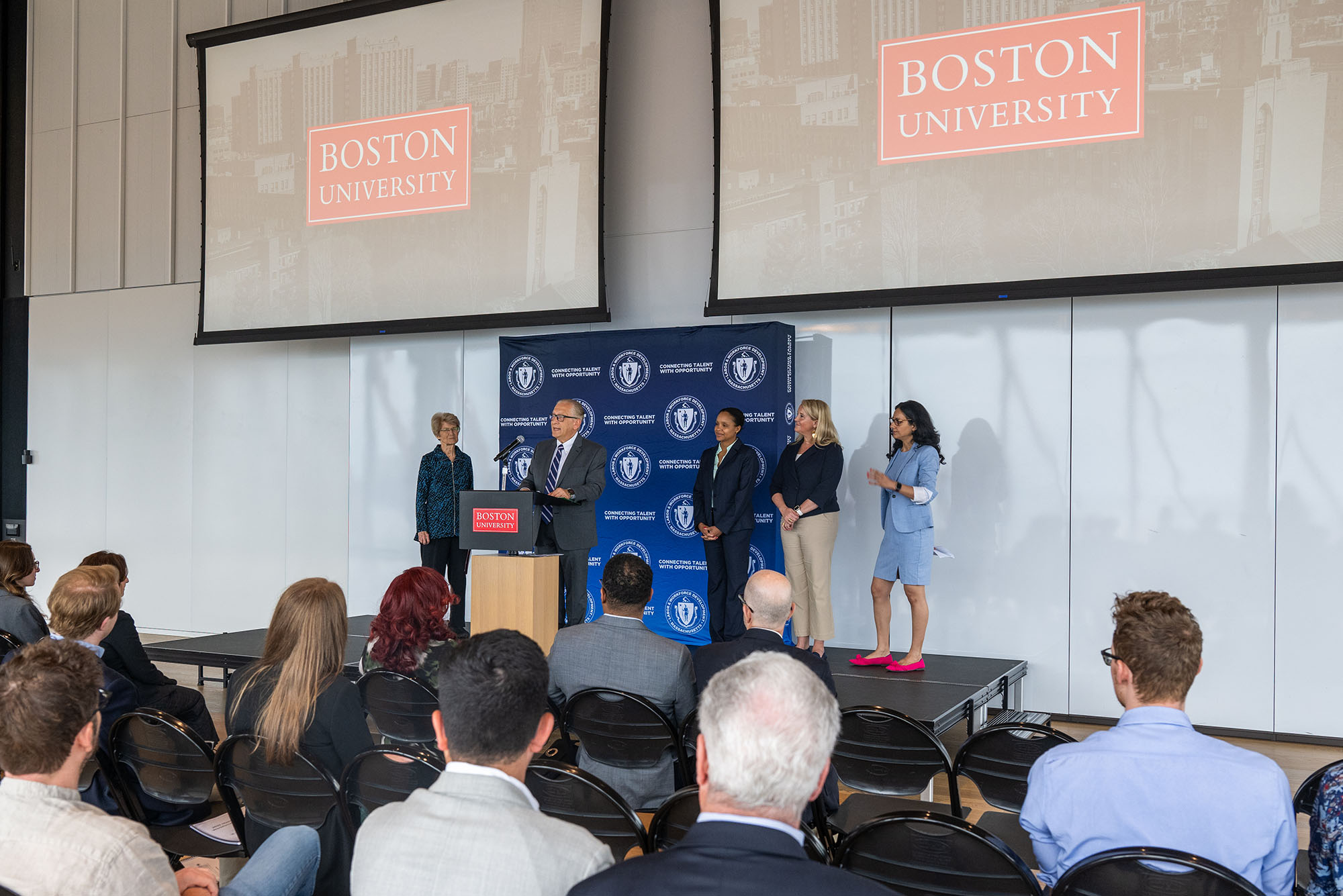
BU Data Platform Will Help Massachusetts Track, and Work to Close, Wage Gaps
BU researchers will extend across the state an encrypted data program already in use to track the gender and racial wage gaps in Boston. The platform was developed with support from the National Science Foundation and the Defense Advanced Research Projects Agency.
See how data is driving policy
RESEARCH HIGHLIGHT

Our Online World Relies on Encryption. What Happens If It Fails?
Quantum computers will make traditional data encryption techniques obsolete; with support from the National Science Foundation, BU researchers have turned to physics to come up with better defenses.
FACULTY EXPERT

Policymakers Discuss BU Professor’s Work Tracking the Impact of USAID Cuts
The Washington Post Fact Checker featured a tracking tool developed by BU School of Public Health Professor Brooke Nichols, after Secretary of State Marco Rubio denied that people have died due to the Administration's foreign aid cuts.
THOUGHT LEADERS
In Case You Missed It...
BU President Melissa Gilliam spoke with Washington-area alumni in May as part of her Presidential Welcome Series... BU infectious disease researcher Nahid Bhadelia discusses the recent changes in COVID vaccine guidance and who will be eligible for a shot this fall... In The New Republic, Professor Madison Condon of BU School of Law shares how losing federal global climate data could mean higher homeowner insurance costs... Professor Jennifer Greif Green of the BU Wheelock College of Education & Human Development weighs in on the possible reasons behind student violence against teachers — and possible remedies.
Travel Ban; Proposed Pell Cuts; Gold Standard Science
BU IN DC
President Melissa Gilliam addressed more than 200 Washington-area alumni on May 28th as part of her Presidential Welcome Series.
Andrew Taylor of the Chobanian & Avedisian School of Medicine attended the Association of American Medical Colleges Group on Research Advancement and Development (GRAND) meeting between June 4th and 6th.
Diane Baldwin, Rachelle Joseph, Kathryn Mellouk, and Ryan Russell of the Office of Research attended the Council on Governmental Relations meeting on June 5th and 6th.
Vinit Nijhawan of the Questrom School of Business received the Bayh-Dole Coalition's American Innovator Award at a ceremony on June 4th.
ADMINISTRATION ANNOUNCES TRAVEL BAN, CHINA VISA SCRUTINY, PAUSE TO STUDENT VISA INTERVIEWS
On Wednesday, President Donald J. Trump issued a proclamation that will ban foreign nationals from 12 countries, including Iran and Myanmar, from entering the United States after June 9th. The order also restricts visas for nationals from nine additional countries, including Venezuela and Cuba. Unlike the travel bans imposed in the first Trump Administration, the proclamation applies to students and exchange visitors. The President also signed a proclamation temporarily preventing international students and scholars from entering the country to attend Harvard University.
The proclamations follow news from last week that the Administration intends to revoke visas for certain Chinese students with ties to the Chinese Communist Party or who are studying in sensitive fields. The State Department has also paused interviews for student visas while it updates its policy on reviewing applicants' social media.
Last week, the Massachusetts Congressional delegation decried the Administration's treatment of international students in a letter sent to several Trump Administration officials.
The BU International Students & Scholars Office maintains a news webpage with updates for the BU community.
WHITE HOUSE RELEASES MORE DETAILS ON PROPOSED STUDENT AID, RESEARCH CUTS
On Friday, the White House released additional details on the President's Budget Request for fiscal year 2026, building on the "skinny budget" released in early May. Members of Congress have already expressed bipartisan opposition to the President's proposal, which merely serves as a starting point as Congress writes the spending bills that determine the federal budget. In addition to the previously announced recommendation to cut the National Science Foundation by 56% and the National Institutes of Health by 40%, the White House revealed it would like to reduce the maximum Pell Grant award for low-income students by 23% and have colleges and employers pay for more of the Federal Work-Study program.
Read the White House's proposed education budget
BUZZ BITS...
- The White House withdrew the nomination of Jared Isaacman to serve as administrator of NASA on Saturday, with a spokesperson saying, "it’s imperative everyone, especially in a role as important as the head of NASA, is mission-aligned with the Trump administration." Isaacman was scheduled to be confirmed by the U.S. Senate this week.
- Last week, the Department of Education announced that Dr. Amber Northern will join the agency as a senior advisor "who will focus on reforming the Institute of Education Sciences." Northern will take leave from her role as senior vice president for research at the right-leaning Thomas B. Fordham Institute.
- President Trump issued an executive order on "Restoring Gold Standard Science" last week calling on federal agencies to support science that is “reproducible, transparent, accepting of negative results as positive outcomes, and subject to unbiased peer review.” The order gives political appointees responsibility for correcting the scientific information their agencies produce.
- Secretary of Education Linda McMahon defended the Trump Administration's proposed budget cuts during appearances before Congressional committees this week. Both Republican and Democratic Senators criticized the Administration's plan to cut funding for TRIO college preparatory programs and the Department's Office for Civil Rights.
- On Wednesday, a House Judiciary Subcommittee held a hearing entitled, "The Elite Universities Cartel: A History of Anticompetitive Collusion Inflating the Cost of Higher Education." Subcommittee Chairman Scott Fitzgerald (R-WI) claimed that Ivy League universities "collude to raise prices and spend their inflated cartel earnings on administrative bloat."