News
BU Researcher Helps Women Veterans Find Their Place After Serving Their Country
Tara Galovski started the Women Veterans Network (WoVeN) in 2017 with six participants. Now, 6,500 women have joined from all 50 states and Puerto Rico.
Justice Sotomayor, Rep. McGovern, Antimicrobial Resistance
ON THE CHARLES RIVER
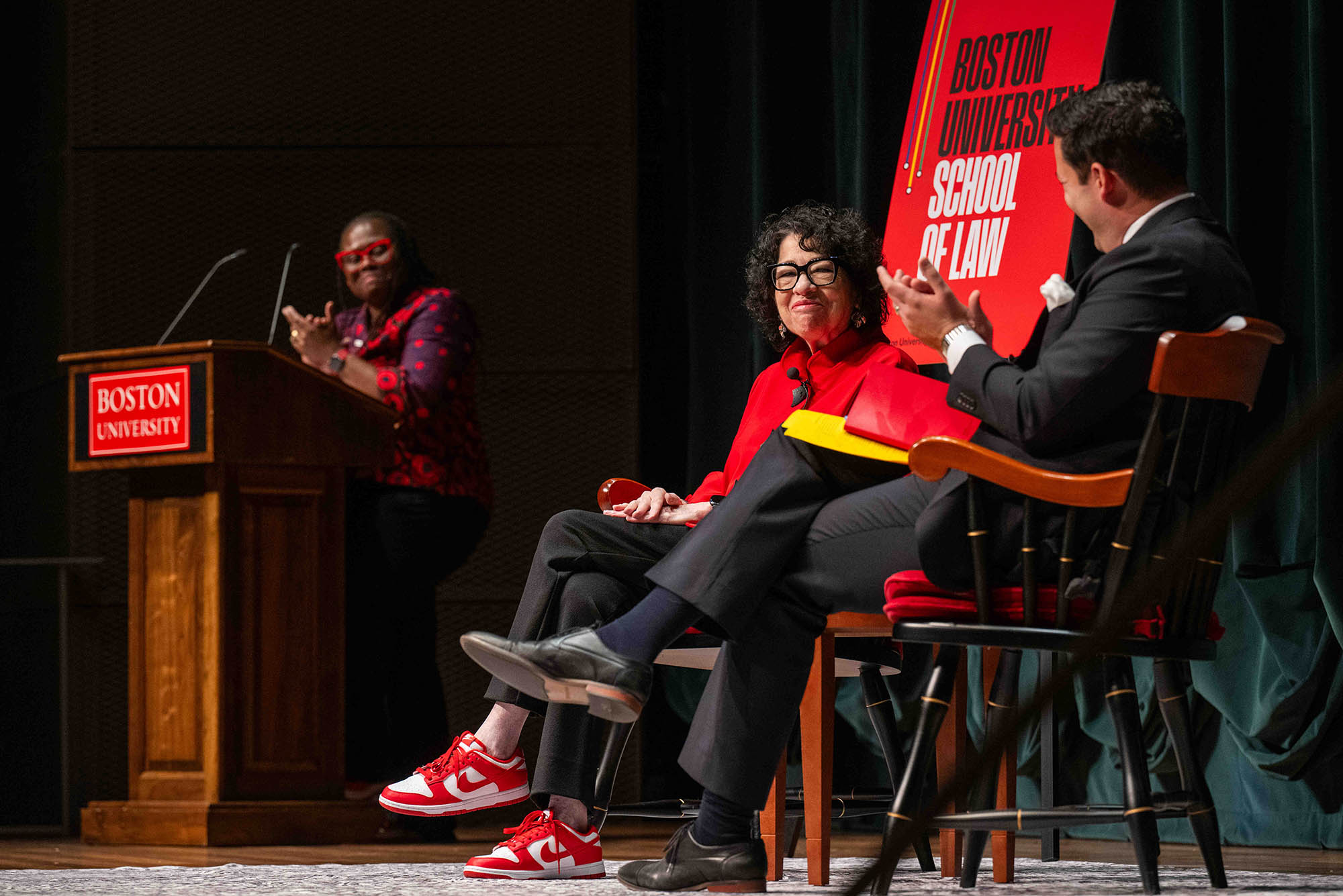
Supreme Court Associate Justice Sonia Sotomayor Offers Advice, Insight to BU Law Students
In a wide-ranging conversation, she emphasized, "Your reputation — and your integrity — are all you have. You must guard them.”
BU IN DC

BU President Melissa Gilliam Meets with Congressman McGovern
President Gilliam discussed the federal government's investment in scientific research and how BU is supporting students with Congressman Jim McGovern (D-MA) on Capitol Hill last week.
RESEARCH HIGHLIGHT

World Health Organization Reports 40 Percent Jump in Antibiotic-Resistant Infections; BU-Based Nonprofit Leads the Fight Back
CARB-X, an antibiotics research accelerator, is helping bring new medicines, vaccines, and tests to clinics worldwide with support from the U.S. Biomedical Advanced Research and Development Authority (BARDA) and other funders.
Understand how they are fighting back
THOUGHT LEADERS
In Case You Missed It...
BU College of Communication students are filling local news gaps, covering 26 local communities with guidance from Professor Tina McDuffie... BU School of Public Health Professor Sarah K. Lipson's national Healthy Minds Study finds that college student mental health continues to improve... BU School of Public Health Professor Noel Vest shares his journey from incarceration to earning a Ph.D... Steven Sandage and Laura Captari at the BU Albert & Jessie Danielsen Institute examine whether news and social media negatively impact mental health... Elizabeth Bettini of BU Wheelock College of Education & Human Development talks with Education Week about how overburdened special education teachers are turning to artificial intelligence.
Brink Bites: BU Health Researchers Win Major NIH Grants; BU Device Named Among Time’s Best Inventions of 2025
Other research news, stories, and tidbits from around BU, including big funding wins, opposition to deepfakes, and studying LGBTQ+ suicide risk factors.
ARPA-H; Defense Workshop; Social Sciences and Humanities
BU IN DC
President Melissa Gilliam met with Congressman Jim McGovern (D-MA) on October 28th. She also attended the Association of American Universities (AAU) Fall Membership Meeting from October 26th to 28th.
Wheelock College of Education & Human Development Dean Penny Bishop joined the AAU Deans of Education Annual Meeting on October 27 and 28th.
Jennifer Gómez of the School of Social Work moderated a panel discussion at the National Academies Action Collaborative on Preventing Sexual Harassment in Higher Education 2025 Public Summit on October 28th.
Tianyu Wang of the College of Engineering attended the Nvidia GTC conference on October 28 and 29th.
Jonathan Feingold of the School of Law addressed A History Teach-In on the National Mall on October 26th.
Diane Baldwin, Kathryn Mellouk, Renna Lilly, Rachelle Joseph, and Ryan Russell of the Office of Research attended the Council on Governmental Relations (COGR) Membership Meeting on October 23 and 24th.
Chobanian & Avedisian School of Medicine Dean Emeritus Karen Antman participated in the National Academy of Medicine Annual Meeting on October 19 and 20th.
BUZZ BITS...
On the 31st day of the federal government shutdown, pressure is building, but negotiators still remain far apart on resuming operations. Meanwhile:
- Dr. Alicia Jackson was sworn in as the new director of the Advanced Research Projects Agency for Health (ARPA-H) last week. Jackson is a health technology entrepreneur who previously served at the Defense Advanced Research Projects Agency (DARPA).
- Dr. Kyle Walsh is the new leader of the National Institute of Environmental Health Sciences at the National Institutes of Health. Walsh was previously an associate professor in the field of neuroepidemiology at Duke University; he replaces Dr. Richard Woychik.
- The U.S. Department of Education issued a final rule on Thursday that alters the definition of eligible employers under the Public Service Loan Forgiveness program, which allows individuals to have their federal education loans forgiven after working for a nonprofit or governmental organization. The new rule excludes employers who "participate in illegal activities," such as "aiding and abetting violations of Federal immigration laws [or] supporting terrorism or engaging in violence."
EVENT NEWS YOU CAN USE
Interested in learning more about Department of Defense (DOD) research funding, but unsure where to begin? The Office of Research and Federal Relations will host a webinar on "Strategies for Pursuing Department of Defense Funding" on Thursday, November 6th at 1:00 p.m. Join Lewis-Burke Associates LLC, a Washington, DC based consulting firm, for an informative session that will offer an overview of key DOD funding opportunities, guidance on building relationships with DOD program managers, strategies for demonstrating your research’s relevance to national security, and practical steps to successfully pursue DOD funding. Faculty Alexander Green of the College of Engineering, Maria Kamenetska of the College of Arts & Sciences, and Jennifer Schlezinger of the School of Public Health will share insights learned from their experiences successfully securing DOD research grants.
GRANT NEWS YOU CAN USE
An updated "Overview of Federal Funding Opportunities for the Behavioral and Social Sciences, Arts, and Humanities" is now available to the BU community on the Federal Relations website. The popular guide from Lewis-Burke Associates provides information on a wide range of federal agencies and programs, including the National Institutes of Health, National Science Foundation, National Endowments for the Arts and Humanities, and many others. This year's update includes recent program changes, terminations, and deadlines. Investigators may use the document to identify relevant programs and develop proposals and strategies for engagement with funding agencies.
A Note to Our Readers: BU Government & Community Affairs launched the Friday FiliBUster, a newsletter covering state government activities that impact BU.
BU President Gilliam Meets with Ranking Member on Capitol Hill
President Melissa Gilliam met with Congressman Jim McGovern (D-MA) on Tuesday, October 28, 2025.
50 Years After Mandated by US Law, Special Education’s Future in Question, BU Scholar Says
Wheelock’s Elizabeth Bettini, longtime special ed researcher, on the potential impact of cuts to students and the special ed workforce.
Wheelock Program Aims to Broaden Who Stands in Front of Classrooms
BU’s Holmes Scholars chapter is part of a national effort to create a more representative educational workforce.
National BU-Led Study Finds College Student Mental Health Continues to Improve
BU public health researcher Sarah K. Lipson on decrease in students experiencing depression—and what you can do to support your own well-being.
Supreme Court Associate Justice Sonia Sotomayor Offers Advice, Insight to BU Law Students at Annual Shapiro Lecture
She spoke with her former law clerk Cesar Lopez-Morales (LAW’14) in a wide-ranging conversation at the Tsai Performance Center.
Supreme Court Justice Offers Insight to BU Law Students
Supreme Court Associate Justice Sonia Sotomayor offered advice and insights to BU Law students at Annual Shapiro Lecture. She spoke with her former law clerk Cesar Lopez-Morales (LAW’14) in a wide-ranging conversation at the Tsai Performance Center on Friday, October 24, 2025.