News
Follow Your Ears
BU researchers study how people with hearing loss locate sounds
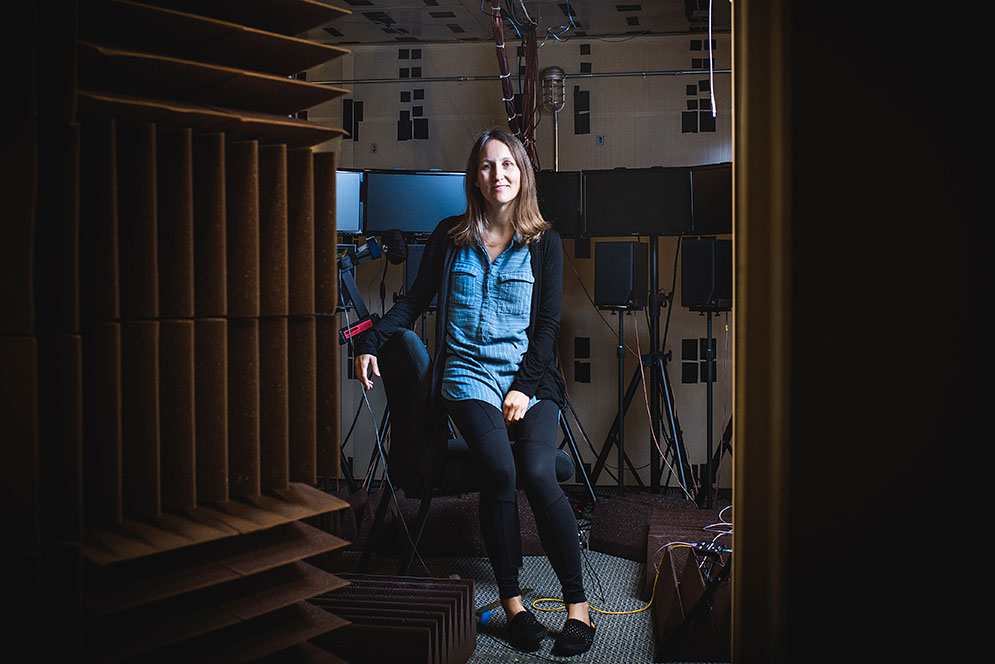
Virginia Best (above) and colleague Gerald Kidd are studying how people with hearing impairments locate sounds, a skill called spatial hearing. Photo by Jackie Ricciardi.
The next time you’re at a loud party, close your eyes and listen. At first, the sounds are just a fog of noise. But quickly you begin to pick out individual voices and locate them, even without looking. This ability to locate voices using sound alone is called spatial hearing, and it helps listeners follow conversations in noisy places, like cocktail parties and restaurants. For people with normal hearing, it happens almost effortlessly. But people with hearing loss often have trouble with spatial hearing, even when they have hearing aids on. Why?
“This is a problem that conventional hearing aids don’t solve,” says Gerald Kidd, a Sargent College of Health & Rehabilitation Sciences professor of speech, language, and hearing sciences, who heads BU’s Psychoacoustics Lab. “In a room full of people talking—a party, a social situation—sometimes people with hearing loss are lost and they disengage. It has a real human consequence.”
With the support of a five-year, $1.5 million National Institutes of Health grant, Virginia Best, a Sargent research associate professor of speech, language, and hearing sciences, will be examining how spatial hearing works differently in people with hearing impairments. The new research brings together Kidd and Best, the lead investigator, with experts in audiology, neuroscience, and biomedical engineering: neuroscientist Barbara Shinn-Cunningham, a College of Engineering professor of biomedical engineering, H. Steven Colburn, an ENG professor of biomedical engineering, who develops neural models of spatial hearing, and Jayaganesh Swaminathan, a Sargent research assistant professor and a hearing aid researcher at the Starkey Hearing Research Center in Berkeley, Calif. Their discoveries may one day guide the development of new hearing aids that give hearing-impaired listeners the location information they have been missing, potentially solving the cocktail party problem in a way not currently possible with traditional hearing aids.
Just as having two eyes helps us locate things in three dimensions, our two ears help us pick out the location of sounds. “A sound off to the right gets to your right ear a little bit before it gets to your left ear, and it also tends to be a little louder in the ear that’s closer,” says Best. The differences are so small that we don’t consciously notice them: the time delay is just a matter of microseconds, and the volume difference (that is, the difference in sound pressure on the ear) can be as little as a decibel. Yet the brain uses this tiny ear-to-ear discrepancy to draw up a remarkably precise mental sound map, accurate to about one degree, that it uses to locate and focus attention on a single voice.
For people with hearing loss, though, this process breaks down, and Best wants to find out why. One hypothesis is that people with hearing loss are not getting the full timing and volume information they need to locate sounds accurately. Another possibility is that they are getting all the right information, but the brain cannot decipher it properly, so the resulting mental sound map comes out fuzzy.
Before they can begin to test these ideas, Best and her colleagues must first figure out how to untangle spatial hearing from other functions that are undermined by impairments. This is tricky, because although we often think that people with hearing loss experience the world with the volume knob turned down, the reality is more complicated. For some listeners, low-pitched sounds are clear while high-pitched sounds are muffled, for others, it’s the other way around, while still others experience distortion all across the sound spectrum. “We want to estimate how much of the real-world difficulty experienced by a person with hearing loss can be attributed to the audibility of sounds, and how much can be attributed to spatial factors,” says Best. “These results could also help guide our colleagues in audiology and in the hearing-aid industry to focus their efforts in the appropriate places.”
Next, Best and her colleagues will bring volunteers into the lab to test their spatial hearing. Using headphones and arrays of loudspeakers, they will find out how well people with hearing impairments can locate the sources of computer-generated sounds. Similar experiments have been done before, but unlike those earlier studies, the new experiments will use speech-like sounds instead of electronic beeps. “Our sounds will still be computer-generated, but they will be more natural in their acoustical structure and their content,” says Best. By using realistic sounds, she hopes to more closely mimic the challenges hearing-impaired listeners face in the real world.
While the researchers will compare hearing-impaired volunteers with volunteers who hear normally, they will also be looking for differences within the hearing-impaired group. The goal is to see if some subgroups—for instance, elderly people—have bigger spatial hearing losses than others. In the past, it has been difficult for them to isolate pure hearing loss from normal aging, because they so often go hand in hand. But Boston, with its large population of students and other young people, is an ideal place to study hearing loss clear of age-related confounds.
Best and her colleagues will also be taking a closer look at how listeners tune in to specific speakers in noisy environments. This process of zeroing in happens quickly and automatically for people with normal hearing, usually within just a few words or sentences. Best wants to find out whether listeners with hearing loss experience something similar and to discover more about how it happens.
Ultimately, the researchers hope that they can use what they learn to help build better hearing aids. Some new noise-reducing hearing aids send exactly the same sounds to both ears, blotting out potentially helpful spatial cues. But, says Best, “there are ways of maintaining some of that spatial information, and it might be that different listeners need that to different extents, depending on how sensitive they are to that spatial information.” Best and Kidd have already tried this on a version of their visually guided hearing aid, an experimental device that uses eye tracking to guide a beam of amplification toward sounds coming from a particular direction. Early results are promising, but, says Kidd, it will take more basic research to invent a hearing aid that can untangle the cocktail party problem. “The real essence of the problem, the ability to hear one talker in uncertain and difficult situations,” he says, “is something that hasn’t been solved yet.”
Author, Kate Becker can be reached at kate@spacecrafty.com.
Hearts, Minds, and Microbubbles
Sargent, ENG profs collaborate to prevent strokes that cause dementia

BU faculty Tyrone Porter and Kathleen Morgan are using a $2.5 million grant from the National Institute on Aging to develop a drug, and a delivery system, that may help prevent blood vessels from bursting and causing early-stage dementia. Photo by Jackie Ricciardi.
- Stiffened arteries can cause microbleeds in the brain, possibly leading to dementia
- A prototype drug might control artery stiffness
- Microscopic bubbles and ultrasound beams could deliver the drug straight into artery walls
Memory loss in old age starts small, with misplaced keys or wallets. In some people, it can be the sign of a far more serious disorder. Dementia can eventually set in, robbing people of the memories of faces, names, and important events. It’s devastating for both patients and family members—and it’s distressingly common. According to the World Health Organization, more than 47 million people currently suffer from dementia worldwide.
While Alzheimer’s disease is probably the most well-known form, dementia also comes in other, lesser-known varieties, like vascular dementia—caused when tiny blood vessels burst in the brain, leading to microstrokes and minute bleeds. The resulting condition is closely linked with other age-related memory disorders.
“I suspect that vascular dementia and Alzheimer’s are really just two different angles on the same disease,” says Kathleen Morgan, a Sargent College of Health & Rehabilitation Sciences professor of health sciences. “There are plaques in the brain tissue of Alzheimer’s patients that are visible at autopsy, but we know that if you have them, you’ll probably see evidence of microbleeds as well.”

Morgan holds a vial containing a mouse brain removed from an aged mouse. It’s comparable to the brain of a 75-year-old human. She and collaborator Tyrone Porter are using mice to test a prototype drug that could prevent stroke-causing microbleeds. Photo by Jackie Ricciardi.
And if burst blood vessels are implicated in early-stage dementia, Morgan says, it may be possible to stop that damage before it starts. With a $2.5 million grant from the National Institute on Aging (NIA), she is examining a synthetic prototype drug that could prevent microbleeds in mouse brains. She’s joining forces with Tyrone Porter, a College of Engineering associate professor of mechanical engineering, working across disciplines to develop a new delivery system for the drug. Their solution uses a novel system of microbubbles—tiny bubbles of inert gas smaller than capillaries—along with a focused ultrasound beam to help push the drug into a very specific part of the body: the large blood vessels next to the heart.
Most brain bleeds, Morgan says, actually start in the aorta, the body’s largest artery, which connects directly to the heart. With each beat, the heart exerts enormous amounts of pressure straight onto that conduit, which is made of smooth muscle cells that expand and contract like a rubber hose as blood flows past them. “Those smooth muscle cells are very important for controlling the pressure of your vascular system on a beat-to-beat basis,” she says.
In younger bodies—both mouse and human—smooth muscle in the aorta expands with each beat, acting as a sort of shock absorber for the pressure coming out of the heart. In older bodies, though, it becomes gradually less elastic, meaning that the energy of each pulse travels farther through the vascular system. If the aorta becomes stiff enough, blood can surge at high pressure straight into tiny, sensitive blood vessels in the brain, which may burst under the strain.
Morgan is developing new ways to reverse the stiffening of arteries. If she can restore some of the aorta’s elasticity, she reasons, it may be possible to prevent new microbleeds. To test this idea, she’s concocted a new peptide—a small chain of amino acids—that can control smooth muscle stiffness.

Morgan and Porter’s drug delivery system. The scientists attach the drug to microbubbles smaller than capillaries and use a focused ultrasound beam to guide the bubbles and then burst them, delivering the drug directly into smooth muscle cells. Eventually, they hope their system may be used to deliver drugs to the large blood vessels next to the heart. Illustration by Tyrone Porter.
In smooth muscle tissue, she says, elasticity is determined in part by two types of long, stringy molecules called actin and myosin, which form a web inside each cell. As the two strands latch onto each other, they restrict the cell’s movement, stiffening its structure. “It’s a bit like a Chinese finger trap,” says Morgan. “The harder you tug on actin, the harder it clamps down.” The peptide her team has created, however, can effectively stop this process in its tracks by binding to the molecules, preventing them from grabbing onto their counterparts in the first place. As a result, the cell remains relaxed and supple. Morgan can control how stiff or loose the tissue gets by controlling the amount of peptide she administers.
The challenge is delivering those molecules directly to the smooth muscle inside a living aorta. Unlike other drugs, releasing this one system-wide—or even artery-wide—could be disastrous. “Smooth muscle tissue isn’t just in the aorta. It’s in your vascular system, urinary tract, uterus, lung tissue, and digestive system,” she notes. “If the peptides got into those tissues, it could cause incontinence, premature labor, all sorts of awful things.”
To get the drug exactly where it’s needed, however, you first have to dig into the artery itself.
“The cells we need to target don’t come in contact with flowing blood. They’re behind a layer or two of other cells and connective tissue in the blood vessel walls,” says Porter. To break through those layers and deliver the drug directly to smooth muscle cells, he’s attaching Morgan’s peptides directly to the outside of each microbubble. Focused ultrasound can be used to push the microbubbles toward the aortic wall and pop them to release the peptide. The popping process also subtly and reversibly disrupts the lining of the aorta, making the blood vessel wall temporarily permeable. “Once that happens, the peptide can flow directly into the spaces that open up in the vessel wall and go straight into the smooth muscle tissue,” he says.
These microbubbles themselves are simple to make, Porter adds, and the FDA has already approved them for use. “Microbubbles have been used for years as contrast agents for ultrasound. They scatter sound much better than tissue, so they’re used to distinguish blood from the chambers in heart and surrounding muscle,” he says. They’re also tiny enough to fit through the smallest blood vessels in the body and eventually disappear as the gas, which is harmless, escapes into the blood and is expelled out of the body through the lungs.
In addition to being relatively safe, the clinical advantage of this approach is that it can be done with a standard ultrasound probe commonly used in a cardiac echo test. Using a low-powered ultrasound beam, a technician can track where the bubbles are going, then pop them at a specific location by simply turning up the strength of the beam. Existing ultrasound tools “can focus the beam down to the millimeter, so it’s extremely accurate,” Porter says.
Until now, Morgan has been able to test her peptide and its new delivery system only on smooth muscle cells in a petri dish. With the new NIA grant, however, she and her collaborators are looking to scale up their research, and they will use their approach for the first time on a living animal.
“My earlier work was just on the fundamental mechanics of these peptides. Moving into a whole mouse is a big leap for someone used to sitting at a bench dealing with cells,” she says with a laugh. “The people I’ve connected with here at BU make it feasible, though. That’s how you get basic discoveries translated into practical ones—you have lots of scientists working in parallel. You need teams instead of a single investigator.
Author, David Levin can be reached at delevin@bu.edu.
Can’t Find Your Keys? Don’t Panic
Memory lapses: MED prof’s book tells when to worry, when not to

Andrew Budson, a MED neurologist who specializes in treating patients with memory disorders, has written a book that can help with distinguishing between serious memory warning signs and normal lapses. Photo by Cydney Scott.
It took you half an hour to find your keys this morning. You forgot the name of a longtime colleague at a meeting yesterday. You got lost driving to a friend’s house last week—it’s true that you were more focused on NPR than the road, but you’ve made that drive countless times and you should be able to do it on autopilot.
Relax. All of these memory lapses are related to normal aging, says Andrew Budson, a School of Medicine professor of neurology, who specializes in memory disorders. They can happen to anyone.
 Because we live in an age of multitasking and distracted attention, says Budson, we need to pay careful attention to form and retrieve memories. In his latest book, Seven Steps to Managing Your Memory—What’s Normal, What’s Not, and What to Do about It(Oxford University Press, 2017), coauthored with Maureen K. O’Connor, a MED assistant professor of neurology, Budson writes that not paying sufficient attention is the main reason that healthy people get lost while driving to a familiar place or have trouble remembering names or where they put their keys.
Budson, director of the Alzheimer’s Disease Center Education Core and associate chief of staff for education at the Veterans Affairs Boston Healthcare System, wants to help people worry less about their memories—and understand more about what’s happening inside their brains and what they can do about it. His book is intended to help lay readers recognize signs of memory problems that are more than just part of normal aging. He describes the markers of mild cognitive impairment, dementia, Alzheimer’s, and other neurodegenerative diseases and emphasizes the importance of getting tested as early as possible if these markers are present.
The book also gives advice on how to discuss memory problems with your doctor. Budson explains how a doctor can evaluate memory and discusses what therapies are available to improve memory—and what things don’t work. With the currently available FDA-approved symptomatic medications—such as donepezil, available as a generic and as the brand Aricept—he says he can “turn back the clock” by 6 to 12 months to improve memory in patients with Alzheimer’s.
What doesn’t help, he says, are brain training games, crossword puzzles, and Sudoku; there isn’t enough evidence to show their effectiveness. Do them if you enjoy them, he says, not because you think they’re going to improve your memory.
“I’m trying to help people with the fear of Alzheimer’s disease,” Budson says. “The first thing people should know is that some memory problems are due to normal aging. The second thing is that many memory problems are due to things that are easily treatable and correctable, such as vitamin deficiencies and thyroid disorders, medication side effects, or even an infection.”
BU Today talked with Budson about his book, the “magic bullet” he recommends for brain health, strategies that can improve memory, and why it’s important to have a positive attitude about aging.
BU Today: What is the difference between normal aging-related memory problems and abnormal problems?
Budson: In normal aging, we expect that information may need to be repeated a couple of times for it to become stored. We expect that one may need a hint or a cue to retrieve information. We expect it may take longer to retrieve the information than when the individual was younger. The key thing is that if the information got stored as a memory, you should be able to retrieve it with a little bit of time or a cue.
In abnormal memory, in a memory lapse that could be due to Alzheimer’s disease, the key finding is that there is a rapid rate of rapid forgetting. Information that was initially stored can’t be retrieved, even if you give a hint or a clue.
I want to stress that just because the memory is abnormal doesn’t mean it has to be due to Alzheimer’s disease. One reason we want people to come and see us in the clinic is that memory problems can be due to something simple that can be easily treated.
What are some questions you get asked most frequently about memory?
People want to know if there is a magic bullet. I tell them there is a magic bullet. It’s called aerobic exercise. Aerobic exercise—any activity that gets you breathing harder and gets your heart beating faster—releases brain growth factors that actually allow one to grow new brain cells.
Brisk walking is a good aerobic exercise. We recommend a minimum of 30 minutes of aerobic exercise a day at least five days a week. The data show that some aerobic exercise is good and more is better. If somebody is doing 30 minutes five times a week, well, that’s great—why don’t you do 30 minutes seven days a week? Why don’t you do an hour seven days a week?
Unfortunately, I don’t think we can prevent memory problems, but I do think that the evidence is we can delay them with aerobic exercise and some other activities. The other things that are very important include staying socially active and keeping a positive mental attitude. When one has a positive attitude about aging and life in general, one tends to take better care of oneself.
Why do you recommend the Mediterranean diet—heavy on fruits and vegetables, fish, olive oil, avocado, nuts, beans, and whole grains and with red wine in moderation?
We’re not sure how it works, but it’s the only dietary change that has been shown to help people’s memory compared to a controlled diet. One way it helps the brain is by reducing risk factors for stroke, such as high cholesterol and diabetes. As we write in the book, not all studies support the idea that the Mediterranean diet is good for cognition and reduced risk of memory loss, but many studies do, and none of the studies reported any side effects that would caution against adopting such a diet.
What about sleep?
Sleep can be tied up with memory problems. The first reason is obvious: if you’re tired, it’s hard to pay attention and if you can’t pay attention, you’re not going to remember things well. The second reason is that we now know that memories go from short-term storage to long-term storage when we sleep. If we don’t get enough sleep, we’re not going to be able to hold on to our memories for a lifetime.
What are some of your strategies for remembering names—and other things?
Difficulty remembering names is something that everyone struggles with, whether they have normal memories or early Alzheimer’s. It really works to say the person’s name back when you meet someone. They say, “Oh, hi, my name is Sara,” so you say, “Oh, hi, Sara, it’s nice to meet you.” Then you can think of an association you have with that name: “Oh, Sara, I can remember that because it’s Abraham’s wife in the Bible and my Hebrew name is Abraham.” It’s really amazing how well these types of strategies work.
What other strategies for remembering things have you been testing in your lab?
Some of the research we are working on now shows that if someone works at being more mindful and really paying attention to the information they’re trying to remember, they’re going to remember it better.
Another finding is that if there is a piece of information you want to remember, think about that information in a way that it personally relates to you. This can also be applied to people’s names.
We’ve also shown that healthy older adults and patients with mild cognitive impairment can improve their memory by using mental imagery. For example, if someone’s name is Rose, you can remember their name by imagining a rose on top of their head.
You write that you’re optimistic about future treatments that may slow down the progress of Alzheimer’s and that it’s important for people to not be so afraid of it that they avoid treatment.
There is a lot we can do for individuals who have Alzheimer’s disease today. Sometimes the knowledge that somebody understands what’s going on can be extremely empowering and helpful to families in terms of coping with everyday life. There’s no doubt that people can live in their homes longer if they figure out what’s causing their memory loss early and have it treated with medication and if they exercise, eat right, use strategies for remembering, and get help from friends and family.
It’s never good to have any disease, but if you have Alzheimer’s disease there is no better time to have it. In addition to the standard FDA-approved treatments, there are more drugs in clinical trials than ever before—more than 100 different compounds. Most of the compounds being developed are aimed at slowing down the progression of the disease.
At any one time, there are five to a dozen clinical trials going on that the majority of individuals diagnosed with mild cognitive impairment or mild Alzheimer’s dementia can get into. That’s another reason to come into the clinic early.
I don’t want people to be sitting at home, becoming isolated, worrying about their memory, not wanting to be with friends and family because they’re worried people will notice their memory problems and then they would feel embarrassed. Just like you wouldn’t hide from someone that you have another disease—high blood pressure, say, or diabetes—it’s important not to hide from family and good friends that you are suffering from a memory disorder, even if that disorder is Alzheimer’s disease. If someone is going to shy away from you because you have Alzheimer’s disease, maybe they’re not such a good friend.
A Vacation with a Mission
BU students travel the globe, serving and learning, over spring break

Last year, students in BU’s Alternative Service Breaks program spent a week engaged in cleanup and other environmental initiatives at Harpers Ferry National Historical Park in West Virginia. Another group will visit the site this year. Photos courtesy of Alternative Service Breaks.
For many students, spring break is a chance to head to a tropical climate for some rest and relaxation. But a lot of Terriers take the opportunity to give back or to enhance their course work with fieldwork and travel.
This past Saturday, 275 students and many chaperones participating in this year’s Alternative Service Breaks (ASB) program traveled by plane, bus, and van to 29 locations across the United States and Canada to volunteer with various nonprofits in areas like public health, environmental reform, and immigrant and refugee services.
Brand-new this year is a trip to St. Louis, Mo., where students will work with two community partners: LifeBridge Partnership, which helps people with disabilities develop skills for living independently, and Almost Home, an organization that helps young mothers on the path out of poverty to self-sufficiency. They’ll coordinate social events at LifeBridge and help with painting and groundskeeping at Almost Home.
St. Louis trip coordinator Alex Navarro (CAS’19) says ASB has been an important part of his BU experience since he first went on a trip as a freshman. “Going on ASB that first year was especially transformative since it was one of the first major steps I took to get outside of my bubble. I was put into new situations, learned about new ideas, and discussed important issues with people I had barely known. It sounds uncomfortable and intimidating, and at times it definitely was, but it was overall a very rewarding experience and I loved every second of it. I want to enable others to enjoy and grow from this program like I have.”

BU volunteers cleaned up the Blue Ridge Parkway in Roanoke, Va., last year—but still had time for fun in the leaves. The trip is also on the agenda this year.
Three dozen School of Law students are spending the week performing pro bono legal work at sites from Maine to Michigan to Puerto Rico, partnering with local legal assistance organizations. For many, the decision to use their vacation to give back is personal.
Mario Paredes (LAW’18) is among those working with the Southern Poverty Law Center Southeast Immigrant Freedom Initiative at the LaSalle Detention Center in Jena, La., providing legal representation to detained immigrants.
“Our role as law students will be to meet with detained immigrants, draft legal documents in support of their deportation defense claims, and interpret for attorneys,” says Paredes. “Our ultimate goal is to help protect the due process rights of detained immigrants, especially in light of recent and anticipated immigration enforcement actions by the federal government. This work is personal for me because I have many family members and friends who are directly affected by our immigration system and constantly fear for their safety and well-being. My parents originally came to the United States as undocumented immigrants from Guatemala, so I feel a deep sense of personal and communal obligation to use my privilege for the greater good.”
Similarly, for Chloe Sugino (LAW’20) personal connections are the reason she’s returning to her native Puerto Rico. She’ll be working with the nonprofit Ayuda Legal Huracán María, helping victims of Hurricane Maria file FEMA appeals.
“Puerto Rico is my home. I was born and raised on the island. Many of my friends and family members are still on the island, and they were all seriously affected after the hurricane,” she says. “This kind of pro bono work is important to me because, especially in this case, volunteer work fills in the gaps where government programs have fallen short or lacked the resources to provide services.”
Back by popular demand
And back by popular demand, the Questrom School of Business is again offering a variety of global experience courses for MBA students over spring break: Asia Field Seminar in Hanoi, Vietnam; Innovation Ecosystems in Israel; a Europe Field Seminar in Paris, France; and Digital Transformation: Immersive Interactions and Insights at Silicon Valley, in Palo Alto, Calif.
Students in the Asia Field Seminar, guided by Questrom senior lecturer Yoo-Taek Lee, are visiting companies throughout the region and examining the dramatic transformation of Vietnam’s economy in the last 30 years.
Led by Joseph LiPuma, a Questrom senior lecturer, students in the Israel program will examine how the young country, often referred to as the “Start-Up Nation,” gained its status as a global powerhouse in entrepreneurship. They’ll visit a number of tech start-ups and speak with the venture capitalists and entrepreneurs who built them.
Students taking part in the Paris seminar, overseen by Frederic Brunel, a Questrom associate professor of marketing, will home in on France’s luxury goods industry, focusing on businesses serving niche industries, like private jets, high-end cosmetics, wine, and more. During the trip, they’ll visit a number of firms and meet with high-level executives.
Those enrolled in the Digital Transformation seminar, led by N. Venkatraman, Questrom’s David J. McGrath, Jr., Professor of Management, will visit major companies in Silicon Valley and meet with entrepreneurs and venture capitalists to learn about the growing influence of information technologies in business, and the rapid digital transformation of businesses.
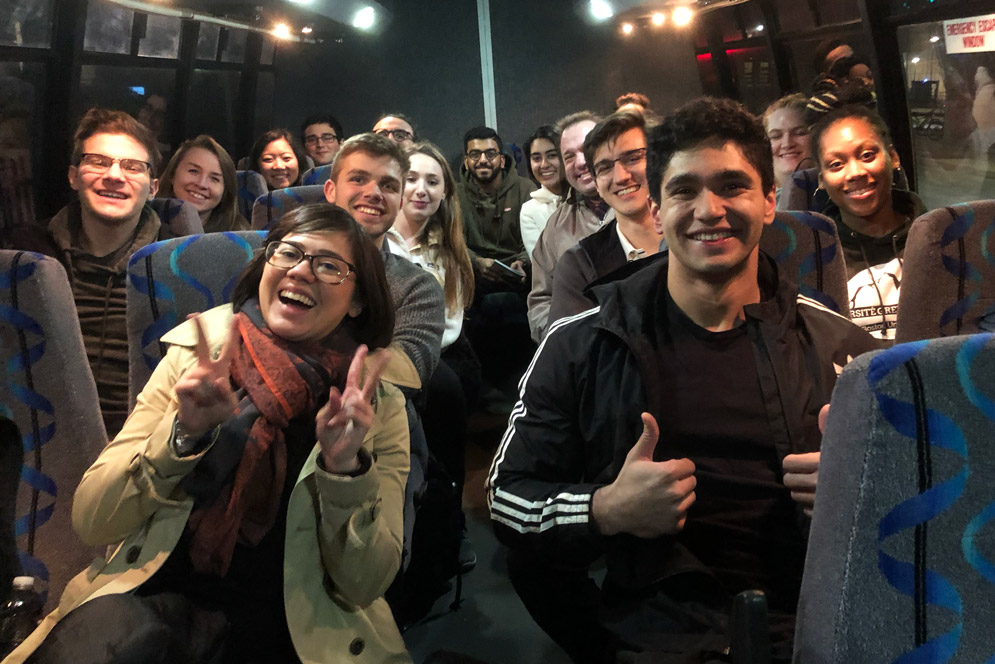
Students in Questrom’s Global Management Experience en route to Logan March 1. They are spending the week visiting start-ups, US multinational companies, and native publicly traded and privately held corporations in Shanghai and Bangkok to learn about business practices in Asia. Photo courtesy of Greg Stoller.
For the third consecutive year, Gregory Stoller, a Questrom senior lecturer in strategy and innovation, is leading a group of undergrads from across the University to Asia as part of the course Global Management Experience. The course goal, he says, “is to give students a boots-on-the-ground experiential learning opportunity to see how business is actually practiced in Asia.” Each year, he changes the countries, cities, and companies to keep the curriculum fresh. This year, students are visiting Shanghai and Bangkok.
“We have 10 company visits scheduled, which are a combination of entrepreneurial start-ups, US multinationals, and native publicly traded and privately held corporations, as well as BU alumni events in both cities,” Stoller says. Another trip goal is to leverage the company visits to create summer internships and permanent job opportunities.
Also again this year, Sargent College lecturer Adrian Wright-Fitzgerald is leading 13 undergraduate and graduate students on a nine-day service-learning trip to Guatemala. They will partner with Origins of Food, on an agroecology project addressing the social, environmental, and economic factors at play behind the country’s high malnutrition rate, traveling through Antigua, San Juan La Laguna, San Lucas Toliman, and Guatemala City. Among the trip highlights are tours of a food market and an organic farm in Antigua.
The opportunity to be part of trips that provide hands-on experience can be invaluable, says Willis Wang, associate provost for global programs.
“Not all students are able to participate in a traditional semester-long study abroad program,” Wang notes. “A well-planned short-term experiential opportunity, especially one that engages students in critical thinking, problem-solving, or decision-making, could spark a greater sense of curiosity about a culture or location, strengthen an individual’s passion to learn more about a particular topic, expose one to different views, encourage a student to study abroad, or enhance a feeling of independence and confidence—and these all would be wonderful results.”
BU Today would like to hear how you’re spending spring break. Email a photo to today@bu.edu, by Friday, March 9, and it could appear as a BU Today “Close-Up” the following week. Be sure to include your name, the school you’re enrolled in and graduation year, and a short caption to run with your photo; you should also identify any students (name, school enrolled in, and anticipated graduation year) or faculty (school and position) in your photo.
Author, Mara Sassoon can be reached at msassoon@bu.edu.
Teaching’s Diversity Problem
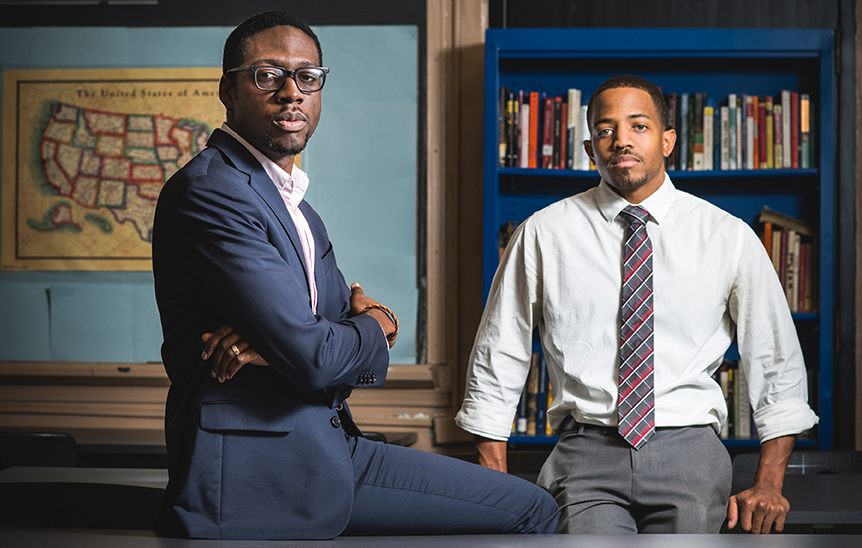 FACULTY EXPERT
Teaching's Diversity Problem
BU Professor Travis Bristol is working to keep male teachers of color in public schools.
Find out how
 ON THE CHARLES RIVER
Former UN Secretary-General Kicks Off BU Think Tank
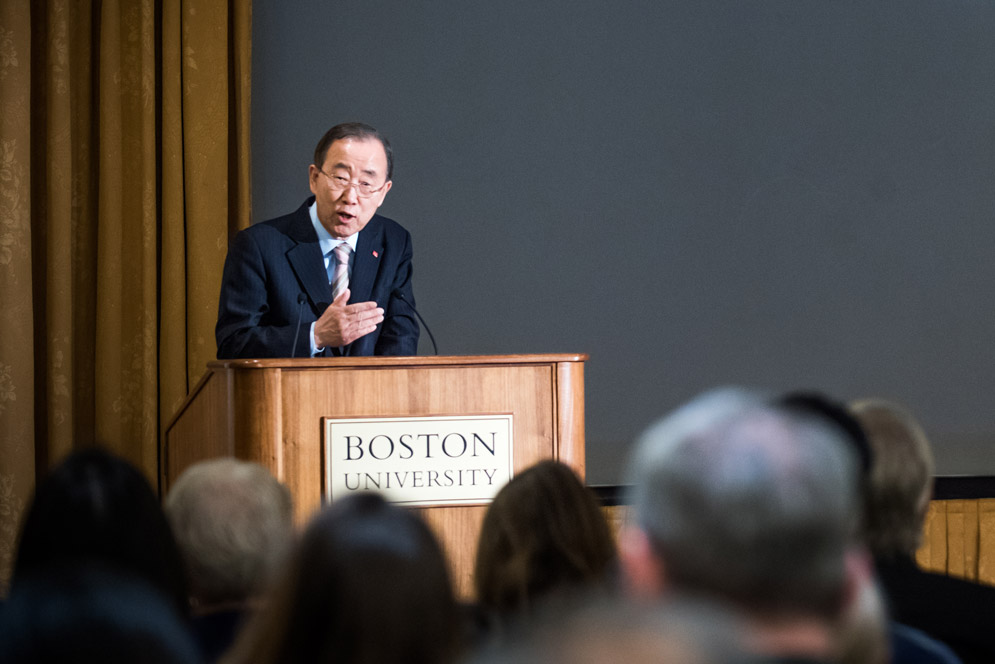
Ban Ki-moon discusses sustainable development and global citizenship at the opening of the BU Global Development Policy Center. Learn more
 RESEARCH HIGHLIGHT
Farmers & Forests
BU economist and geographer Rachael Garrett wants to save Brazil's rain-forest, while helping farmers and ranchers thrive. Take a look
IN CASE YOU MISSED IT...
The Hill reported that Boston University applicants would not be penalized if they participate in peaceful protest... Michael Siegel of the BU School of Public Health wrote about how the firearms industry influences U.S. gun culture in The Conversation... Christopher Chen of the BU College of Engineering is working on patches that can be implanted onto blood vessels... Faculty from the BU Initiative on Cities discovered that very few mayors from large cities choose to run for higher office... Stephen Prothero of the BU College of Arts & Sciences spoke with WBUR about Reverend Billy Graham's legacy.
Committee Examines Harassment in Science
BU IN DC
Dean Sandro Galea of the School of Public Health spoke at the National Academy of Medicine Leadership Consortium for a Value and Science-Driven Health System on February 26. He also participated in a meeting of the National Advisory Council on Minority Health and Health Disparities, of which he is a member, on February 27.
Brian Poznanski and Aya Al-Namee of Admissions participated in the National Association of College Admissions Counselors Annual Advocacy Day on February 25 and 26.
COMMITTEE EXAMINES HARASSMENT IN SCIENCE
The House Subcommittee on Science, Space, and Technology's Subcommittee on Research and Technology held a hearing on Tuesday to examine sexual harassment and misconduct in science. Lawmakers expressed concern that harassment was causing women to leave science careers, and asked the witnesses to explain how universities and the federal government could curb unacceptable behavior. During the hearing, Dr. Rhonda Davis of the National Science Foundation (NSF) touted the agency's forthcoming policy that will require institutions to alert NSF if they discover NSF-funded researchers have committed sexual harassment. Davis said the new policy was based in part on "lessons [NSF] learned" during an interaction with Boston University.
BUDGET OVERHAUL COMMITTEE TAKES SHAPE
Congressional leaders from both political parties recently appointed members to a new budget reform committee tasked with rethinking the Congressional budget and appropriations process. The Joint Select Committee on Budget and Appropriations Process Reform is required by law to hold five public meetings before voting on a report to recommend legislation to redesign how Congress will determine federal agency budgets. While lawmakers recognize their failure to produce timely appropriations bills has led to disarray within the federal government for many years, it is unclear whether the new committee will be able to reach agreement on meaningful budget reform.
REPORT URGES INVESTMENT IN RESEARCH
As part of its strategic planning process, the Government Accountability Office has issued a paper identifying the need for United States to invest in research in order to advance the nation's well-being. The paper cites "genome editing, artificial intelligence and automation, quantum information science, brain-computer interfaces and augmented reality, and blockchain and cryptocurrencies" as key areas ripe for technological revolution. It goes on to say that, "In an environment of increasingly constrained resources, particularly at the federal level, investing in R&D efforts in a strategic and coordinated way will be critical."
Former UN Secretary-General Kicks Off BU Think Tank
Ban Ki-moon encourages students to think globally

Ban Ki-moon, eighth Secretary-General of the United Nations, gave the keynote speech kicking off the opening of BU's new Global Development Policy Center. Photo by Jackie Ricciardi.
Former secretary-general of the United Nations Ban Ki-moon told a standing-room only crowd at BU’s Metcalf Trustee Center on Wednesday that global partnerships will be the key to solving the planet’s biggest social, economic, and environmental problems.
The South Korean diplomat said the need for such partnerships makes it troubling for him to see US leaders backing away from the Paris Climate Accord, one of his proudest achievements as secretary-general.
“That’s a problem,” Ban said. “I’m afraid the US people may stand on the wrong side of history if they do not return to this [agreement] as soon as possible.”
Ban’s speech kicked off the opening of BU’s new Global Development Policy (GDP) Center at the Frederick S. Pardee School of Global Studies.
In opening remarks, Robert A. Brown, president of BU, told the students, academics, and staff in attendance that the center will bring together scholars seeking to actively engage in research and dialogue related to policy.
Center director Kevin P. Gallagher, a Pardee School professor of global development policy, explained the center’s work to those attending, saying that it will cut across disciplines to seek solutions to global challenges. Initiatives may involve the study of consumerism and deforestation in the Amazon, the creation of global development banks in struggling economies, or China’s outsize role in the global economy.
“The GDP Center’s mission is to advance policy-oriented research on financial stability, human well-being, and environmental sustainability across the globe,” Gallagher said. “If there is one leader that embodies all these qualities in our mission, it is Secretary General Ban.”
Ban, who served two consecutive terms as secretary-general, from 2007 to 2016, worked on ways to lessen the effects of the 2009 global financial crisis. He was instrumental in the creation of the UN’s sustainable development goals, a collection of 17 global objectives that aim to address a host of issues, including poverty, hunger, health, education, and gender equality.
In his talk, titled Sustainable Development Goals and Global Citizenship, Ban encouraged the students attending, many of whom plan to work in public health–related jobs, research, or diplomacy, to think of both the planet and humanity beyond national boundaries.
He told the audience that the UN and its members cannot bear the responsibility for making partnerships alone in an era where technology is reshaping the landscape, creating both uncertainty and new possibilities. “I humbly ask you to work together,” he said. “This world is heavily divided, society is divided. It seems like it would be quite difficult to forge partnerships. But there are refugees, there are people who need support.”
Ban acknowledged that extreme global poverty has dropped, but said that this was largely because of China’s soaring economy and rising middle class. He noted that there are still 700 million people in the world who go to bed hungry, 1.2 billion people who lack safe drinking water, and 1.4 billion people who have no electricity and live primarily by candlelight. Inequality is also growing between nations, he said: 50 percent of increasing global wealth benefits the top one percent of the population.
“This is purely unjust and unequal,” Ban said, adding that inequality is one of the reasons the UN created the sustainable development goals.
Such work must also foster peace and security, he said, because without it, people cannot engage in a productive society. Conflicts continue, but the 2018 Olympic Winter Games in PyeongChang, South Korea, with both North and South Korea appearing under the same flag, offer an example of a path toward progress. Such efforts help create an opportunity for a dialogue with North Korea on its policies and nuclear escalation.
“At this time, it would be extremely important to…engage in more meaningful dialogue,” Ban said. “This is my wish as a former UN secretary-general and a Korean citizen.” The United States, China, Japan, and other nations can also be influential by joining such a dialogue.
Ban said he has been encouraged by the #wearestillin pledge by hundreds of US mayors, big business, and others promising to continue efforts to address climate change. And he said he looks to young people under the age of 25 and women as a force for global change because together they are 75 percent of the global population.
Academic institutions are also essential partners, said Ban, who earned a bachelor’s degree in international relations from Seoul National University in 1970 and a master’s degree in public administration at Harvard University’s Kennedy School of Government in 1985. “They are launch pads for the solutions to the seemingly insurmountable problems that we face,” he said.
Such statements resonated with Nalim “Jasmin” Choi (SSW’18, SPH’18), a School of Public Health research assistant, who wants to one day work in the public health field helping refugees. Choi was among many South Korean students in attendance, and said she has long been a fan of Ban’s initiatives.
“As soon as I heard he was coming, I booked it,” she said. “He’s done a lot for the refugee crisis in the Middle East, as well as looking at maternal health equity issues. His work is so timely.”
Nabeel Nissar (CGS’14, CAS’18, GRS’18), whose family is from the impoverished and disputed Kashmir region north of India and Pakistan, said he was inspired by Ban’s message. He said he wants to better understand ways he can have a global impact in his science studies. “It’s easy to get sad about all the conflicts all around us,” he said. “But it’s important to recognize the responsibility we have to help.
“I thought it was an empowering speech.”
Author, Megan Woolhouse can be reached at megwj@bu.edu
WBUR Breaks Ground on New Cultural Venue CitySpace
Project supported in part by record $5 million gift

WBUR and BU officials and key donors at a ceremonial groundbreaking February 28 for BU’s NPR station’s new cultural events venue CitySpace, partially funded by $5 million from Jonathan and Jeannie Lavine, WBUR’s largest gift ever. Photo by Maddie Malhotra (COM’19).
WBUR, Boston University’s National Public Radio station, celebrated the groundbreaking Wednesday evening of a new cultural events space, funded in part by the largest gift in the station’s history, a $5 million commitment from Jonathan Lavine, a co–managing partner of Bain Capital, and his wife, Jeannie. The venue, called CitySpace, is being built on the site of what had been Landry’s Bicycles, on the corner of Commonwealth Avenue and St. Paul Street (Landry’s recently moved up the street), and will host live radio broadcasts, political debates, and performances.
WBUR general manager Charlie Kravetz says the 7,500-square-foot space, which will have at least 240 seats and is expected to serve an estimated 30,000 people a year, will focus on discourse. “CitySpace is the logical extension of WBUR’s role in Boston,” says Kravetz. “WBUR is no longer just a radio station. It’s a multiplatform media organization that reaches people on air, online, on demand, and on stage.”
CitySpace, scheduled to open early next year, will produce up to 200 programs a year, including debates, interviews, readings, theatrical performances, and family programming, with all events streamed live and archived for on-demand access. Designed by the architectural firm CambridgeSeven, CitySpace will include a hydraulic stage that can be raised or lowered, robotic cameras and lights, and a 9-by-16-foot LED screen that will show documentaries and films. Floor-to-ceiling glass windows will allow passersby to watch the events inside, and the station plans to install benches and speakers outside the building.
“This will be the most technologically advanced convening space in Boston,” Kravetz predicts. “It will be beautiful in design and operationally efficient.”
WBUR has raised $16 million so far toward its goal of $20 million for the cultural events center. In addition to the $5 million commitment from Jonathan and Jeannie Lavine, the project received $2 million from the Barr Foundation in December, then the largest gift to WBUR.
Kravetz says Boston University has provided support for the project from the outset, noting that Robert A. Brown, BU president, embraced the idea of CitySpace five years ago when the two first discussed it.
He says the station is committed to partnering with Boston’s scientific, academic, business, cultural, and civic organizations. “We plan to harness the talent and brainpower in this city,” he says. “We hope to bring all that to its citizens.”
Original article by BU Today staff.
STH Students Travel to US-Mexico Border to Learn Migrant Ministry
Travel seminar trip an education in the miseries facing immigrants

Students in STH's Arizona/Mexico Border Seminar spent more than a week in Arizona and Mexico in January immersing themselves in the existence of migrants and those who minister to them. A second group will do the same next week over spring break.
- STH students travel to Arizona for immigration ministry study
- Desert hike, processing center visit expose them to migrant experience
- Second spring break trip coincides with DACA expiration
Among the many sad memories she took away from the Arizona desert, the saddest for Bailey Brawner were the “rape trees.”
During a 10-mile hike in the Arizona desert in January, along a route strewn with clothing left by Mexican migrants who’d risked this journey, Brawner (STH’18) learned from her guide about “rape trees,” hung with bras and undergarments: monuments to the many women who are sexually attacked on their journey across the border.
“Many times, they are hiking for three or more days at a time, with much less preparation and supplies than we had,” Brawner says. Many who challenge the summer temperatures of 100 degrees and higher wind up dead, “mostly from dehydration.”
Perhaps you’ve noticed that the country is having a dustup over immigration. Brawner certainly noticed, which is why she and eight other School of Theology students trekked the desert as part of STH’s Arizona/Mexico Border Seminar. A second group of 10 will participate in the seminar trip next week over spring break, immersing themselves to the extent possible in the existence of migrants and those who minister to them, via a weeklong stay in Arizona and one overnight at a Mexican nonprofit assisting poor women and children.

Mexican migrants “are hiking three or more days at a time with much less preparation and supplies than we had,” says Bailey Brawner (STH’18).
Next week’s trip comes the same month as the expiration of protection for immigrants brought here illegally as children—people, known as Dreamers, most Americans want to keep in the country. So the course, which has had to turn away student applicants since its inception in January 2015, has had even more interest than usual this year, requiring two sessions.
“I believe that has to do with the political climate and the conversation around immigration,” says Laura Rambikur (STH’17, SSW’17), the STH adjunct instructor who developed and leads the class. (While deportations remain below their peak under President Obama, arrests have surged.)
“The issue of immigration is front and center now, not just in American life but American religious life, especially for progressive Christians,” agrees Bryan Stone, E. Stanley Jones Professor of Evangelism and STH associate dean for academic affairs. “People are being mistreated because of their immigrant status.”
Besides the desert hike, students meet with operators of nonprofit groups that house immigrants in churches, as well as speak with Border Patrol agents about their work. The stop in Mexico includes visiting the wall on that side of the border, overnighting at an organization that offers meals and education to poor Mexican children, and visiting a shelter for the recently deported.
Brawner says that at the latter site, “I got to talk with Jorge, a 30-year-old father of four who had moved to Phoenix with his parents when he was just a teenager.” After 14 years in the States, immigration officials had picked him up just two days before, because he couldn’t afford to renew his work permit—an example, she says, “of many people who are abused by the incredibly broken immigration system.”
Micah Norman Pace (STH’18) was struck by the deportees’ stories of how much the cartels ferrying the undocumented into the United States charge migrants, who are “simply a commodity,” he says.
“The men we were speaking with said crossing can cost anywhere from $6,000 to $9,000, and that all of them were going to begin immediately preparing to cross again,” he says. “I asked them why it was such a no-brainer to come back, and the responses were simple: family and opportunity.”
Although Rambikur grew up in Arizona, it wasn’t until she went to Honduras before beginning graduate studies at BU that she truly appreciated the plight of immigrants. Working for a nonprofit there, she learned how policies at the US border affected Honduran colleagues trying to cross it, versus her own ease of travel because of what she dubs her “privilege cards”—white, born in the United States, able to vote.”
While still a graduate student, she pitched a new course that includes the travel seminar to Stone and the powers that be at STH, and it was approved. The first group made the trip in January 2015. Rambikur graduated last year, and this year became the course instructor.
She says the seminar has four themes to impart to students: “how race, power, and colonization continue to play a central role in border politics; how people’s lives”—including undocumented families, border patrol agents, and deported migrants—”are deeply impacted by the border; the reality of the desert; and finally, I want students to be able to wrestle with why theology matters” in this discussion.
Why does it? Borders “remind us that we live in a world that still places value on nation state–building and colonization,” says Rambikur. “As faith leaders, it forces us to ask the question: who is my neighbor, and why does it matter?”
The trip is one of several to other nations STH has run for almost a decade to introduce students to particular types of ministry, Stone says.
Author, Rich Barlow can be reached at barlowr@bu.edu.
New, Improved Digs in Store for Goldman School of Dental Medicine
Striking architecture, state-of-the-art clinics, modern student spaces

A rendering of the completed Henry M. Goldman School of Dental Medicine. Images courtesy of SmithGroupJJR.
- The Henry M. Goldman School of Dental Medicine is about to undergo a three-year, $112 million renovation
- The building facade will be redone, and its interior mostly gutted and reconfigured
- No disruption to classes or patient care is expected
A major three-year, $112 million renovation of Boston University’s Henry M. Goldman School of Dental Medicine is expected to begin shortly, and when it’s complete, the school will look almost unrecognizable.
Contemporary sheathing and new windows will freshen up the building’s exterior, while the interior will be mostly gutted and reconfigured to draw in natural light and create more open spaces. A seven-story addition will be built along the west and north sides of the building. Patient treatment areas will be designed to accommodate cutting-edge technology, and a large new auditorium is in the works. During the renovation, classes will be held as scheduled and patients will continue to be seen, although some departments and offices will be moved to temporary spaces while the work is being done.
“The Medical Campus is delighted that the dental school will now begin the construction of the building that they have been planning for a decade,” says Karen Antman, dean of the School of Medicine and provost of the Medical Campus. “The architecture is striking, the clinics will be state-of-the-art, and the students will have modern student study and relaxation space.”
When the school moved to its present home at 100 East Newton Street in 1970, the building was only three stories high. In 1973, four stories were added, and today the building is “maxed out,” says Jeffrey Hutter, Spencer N. Frankl Professor in Dental Medicine and dean of SDM. Formally known as the Lawrence J. and Anne Cable Rubenstein Building, it’s home to more than 800 students and 300 faculty, as well as staff and volunteers. Some 33,000 patients receive care there every year.

The building’s light-filled teaching and clinical areas will increase by 60 percent and will be more comfortable.
“It’s clearly something we need,” Hutter says. “This facility has served the school well, but we have grown out of it. It’s going to right-size our building.”
When the conversation about a renovation first began, he says, architectural firm SmithGroupJJR surveyed peer dental schools and found BU at the bottom in terms of square footage per students and faculty. “I tell the students, ‘This will add value to your diploma,’” he says.
When completed, the four-phase project will have added an additional 48,000 square feet to the building without substantially expanding its footprint. Since space is hard to come by on the Medical Campus, this way of expanding makes the most sense, Hutter says. Before the project began, the school held multiple town hall meetings for the community. “The goal is to put the least amount of disruption on the patients, students, and residents,” he says.

Infographic by Meaghan Glendon.
Phase I, which began with site mobilization on February 24, will see a new first floor student and resident lounge and study area as well as a new patient entrance on the corner of East Newton and Albany Streets. Hutter says he’s excited about the school’s gaining a more visible “front door” on Albany Street, in the heart of the South End. The expanded building will almost abut a new 1.6-million-square-foot life science and technology office complex called Exchange South End, which was announced last fall by Boston developer Abbey Group. The existing SDM entrance at 100 East Newton Street will remain open for students, residents, faculty, and staff.
Patients using the new Albany Street entrance will be greeted by receptionists and proceed to a new patient elevator bank, with two elevators. Previously, everyone in the dental school relied on just two elevators (which will also be renovated, bringing the total to four). The first floor will be home to a new lounge and collaborative study space for students and residents, along with a new main patient waiting area.
Upstairs, teaching and clinical space is expected to increase by 60 percent, and classrooms and labs will expand by 14 percent. An existing cafeteria is being transformed into a 140-seat auditorium and the school’s Simulation Learning Center will be moved from across the street (650 Albany Street) to the third floor of the Rubenstein Building.

The first-floor student lounge and study area should be finished by October.
The school teaches and uses the Group Practice Model, meaning teams of dentists and specialists practice and collaborate to treat patients. The building’s 10 new group practice spaces, made up of 10 patient treatment rooms each, are slated to become more comfortable and flexible. “One thing we stressed—any patient who comes into the school, we treat like they were walking into the best private office in the city of Boston,” Hutter says. “Now you can look outside, there are larger spaces, it’s the whole experience.”
The building will receive a terra-cotta cladding that will cover the existing concrete exterior, with a large expanse of glass added at the entry level. The seven-story addition will tie seamlessly to the existing structure with brick of a similar color and a glass curtain wall.
Despite the short-term headaches that come with a renovation of this size, students are eagerly anticipating the new space. “My classmates can’t wait,” says class president Sloane Kaminski-Ditzel (SDM’18). “Nowadays, everything in dentistry is becoming digital, and BU is leading the way in dental education and adapting this modern technology.
“It’s really nice that the building will be catching up.”
Author, Amy Laskowski can be reached at amlaskow@bu.edu.