Toward a Circular Economy: A Mapping Review of State Compost, Soil and Health Policy
Background
Soil health is crucial to the maintenance and sustainability of the modern food system. However, current agricultural practices in the U.S.—including monocropping, excessive chemical use, and intensive tillage—are eroding this vital resource. Regenerative practices such as composting, cover cropping, grazing, and conservation tillage have been empirically recognized as efficient mechanisms to support environmental goals and provide nutrition for crops. Yet, they are currently underutilized within the context of persistent sustainability challenges.
Over one-third of all food produced in the U.S. is never eaten while a majority of surplus food— worth about $380 billion—ends up in landfills. Food waste has become the primary material in municipal landfills, accounting for 24% of the waste stream. This food waste carries a significant financial toll: in 2025, the average U.S. consumer wasted approximately $728 annually, or about 11% of their weekly food expenditures, on uneaten food. It also generates substantial environmental costs. Beyond resource losses, including water and fertilizers, this waste directly generates greenhouse gasses (GHGs), including methane and carbon dioxide, during decomposition. Among the top solutions to resolve these issues is creating centralized composting facilities to more efficiently recycle organic waste.
Composting
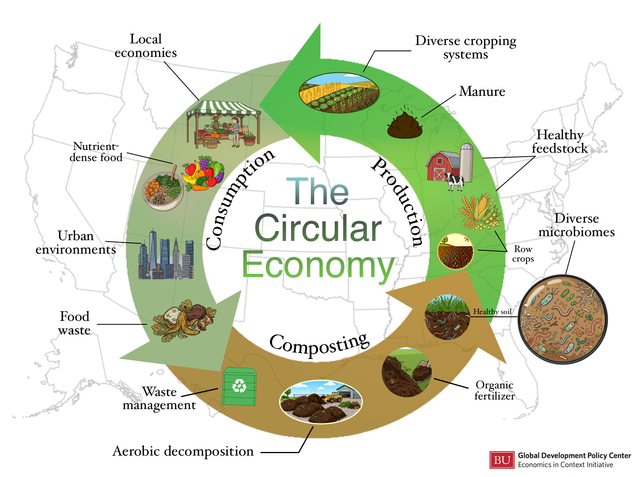
Composting is a classic example of circular economics—using the outputs of agricultural practices (food) as inputs to sustain those very practices. Amidst rising synthetic fertilizer costs and the pollution of soil ecosystems via widespread nitrogen runoff, composting of biosolids and food waste offers an affordable alternative to support crop nutrition. The US Environmental Protection Agency highlights composting as an effective mechanism to ensure domestic agricultural productivity, ensure healthier soils, and reduce food waste-associated GHG emissions. Beyond emissions reductions, incorporating compost into soil helps mitigate erosion, revitalizes physically disturbed ecosystems, and prevents nutrient losses.
The One Health framework identifies strategies for supporting the health of humans, animals, and ecosystems by synthesizing information from a variety of disciplines and domains to inform more holistic scientific practices and policies. Composting is a significant application of One Health—utilizing diverse microbial life to support soil health and human health via reductions in GHG emissions and food waste. In response to the emerging evidence, state and local governments have begun recognizing the importance of composting and waste-recycling infrastructure, yet policy gaps remain across regions and economic contexts.
Project Overview

There is a dearth of publicly available data regarding the scope of state-level policies that aim to promote healthy soils practices like composting. This project aims to assess the breadth of regenerative-aligned policies such as organic amendments and compost-specific legislation to analyze trends in the upscaling of infrastructure and the adoption of composting practices. A One Health framework will be used to contextualize how the interactions between humans and microbes affect broader trends in soil and economic systems and policy. This project will help to provide researchers, policymakers, and the public with evidence regarding the connection being made between soil health and compost and public health policy, supporting policies that improve sustainability of food production.
Highlighting the diversity of cropping systems is one of the primary objectives of this U.S.-focused mapping review. There is no single policy that will support the specific needs of farmers across the nation simultaneously, as there is immense variation in climate, soil structure, and state economies. This project will help to illustrate the horizontal policy diffusion of healthy soils legislation in all 50 states since 2020.
[See soil-health policy map at healthysoilspolicy.org]
To understand the diversity of local policy initiatives, the Economics in Context Initiative (ECI) is partnering with the People, Food, and Land Foundation, based in California, to understand how composting policies meet the needs of local stakeholders and help build a circular bioeconomy.
Policy Briefs
The following documents discuss the economic, ecological, and health benefits of incorporating regenerative farming practices into American agriculture. As research progresses, these documents aim to simplify the complexity of the U.S. agricultural system and provide the context necessary to see how composting can positively impact local economies and the broader environment.
Policy Brief #1: Regenerative Agriculture Policy Brief No. 1 April 2026
Fertilizer Overuse and the Case for Legume Cover Crops: A One Health Approach
Policy Brief #2: Regenerative Agriculture Policy Brief No. 2 August 2026
A One Health Circular Bioeconomy: The Case for Composting Amid a Protein Transition
For examples of previous policy briefs on regenerative agriculture, please see:
Policy Briefs and Conferences on Regenerative Agriculture at Tufts University Global Development and Environment Institute.
Blogs
See earlier blog pieces by Eric Christine on Regenerating the Soil Economy and An Economic Assessment of U.S. Meat Production.