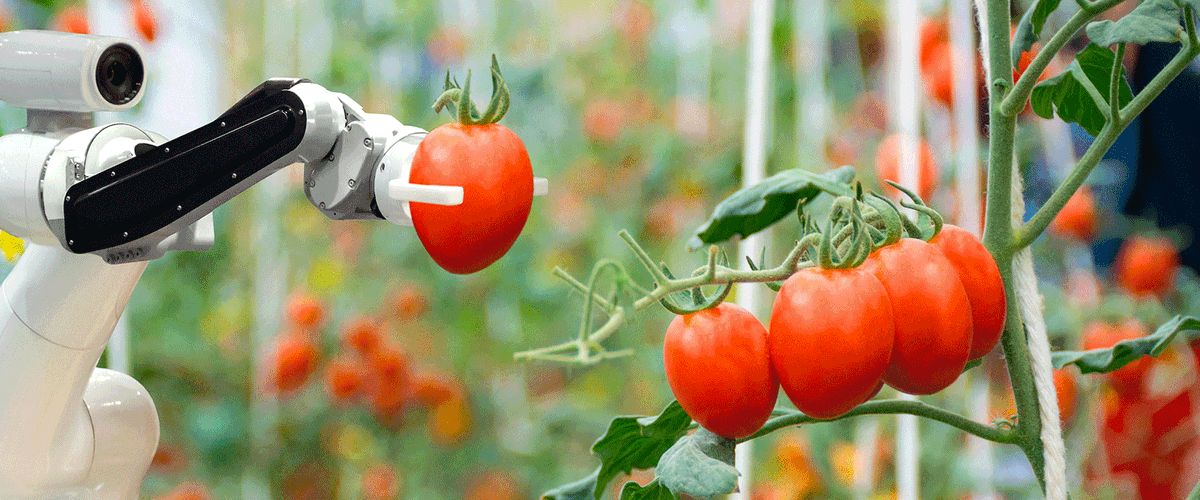
Robotics & Multi-Agent Systems
Robotics and Multi-Agent Systems involves the concepting, building, and
implementation of robots, as well as the collaborative programming of multiple robots, to perform certain tasks.
How Gentle Is Gentle Enough? Building Robots That Know Where to Stop
Imagine handing a surgeon a scalpel. You don’t need to place it in an exact spot down to the centimeter—you would just need to get it close and, above all, not stab anyone by accident. That distinction between precision and safety sits at the center of CISE Faculty Affiliate and Assistant Professor (ME, SE) Andrew […]
CISE Faculty Affiliate Tommaso Ranzani Awarded 2026 BU Ignition Award
Adapted from a story by Andrew Thurston for The Brink CISE faculty affiliate Tommaso Ranzani is one of Boston University’s 2026 Ignition Award winners! He is leading a project to develop bio-inspired jet propulsion technology that can power underwater robots and vehicles. This could make operations quieter, longer-lasting, and lower-maintenance, particularly for acoustic-sensitive missions such […]
Engineering a Less Invasive Path to Earlier Lung Cancer Detection
Cancer remains one of the leading causes of death in the US, making interdisciplinary approaches to combating it increasingly important. That is what one PhD candidate at Boston University is devoting his time to. Chae Woo Lim, a PhD student in Mechanical Engineering working under Dr. Sheila Russo at BU’s Material Robotics Laboratory, works with […]
How CMOS Sensors and AI Are Making Fermentation Smarter
In recent years, social media users have found themselves amid many sourdough accounts and kombucha channels, all heavily focused on fermentation. But what many don’t realize is that fermentation isn’t limited to cooking. In the world of science, fermentation technology is widely used to produce medicines, fuels, foods, and specialty chemicals. Professor Rabia Yazicigil Kirby, […]
Making the Cloud More Reliable: How LLMs Can Improve Latency and Reliability
When a car is booked in a rideshare app, a seemingly simple request triggers thousands of messages sent across a distributed system that must be executed with near-perfect reliability. Distributed systems are the invisible engine of today’s economy. Its full integration into our daily routines makes its reliability essential. But what can we do when […]
How a Low-Cost Soft Robot Is Learning to Perform Surgery Inside a Beating Heart
In a leap for minimally invasive medicine, a soft robot is learning to perform delicate procedures inside a living, beating heart—something no human hand could ever achieve. For Assistant Professor Tommaso Ranzani (ME, MSE, BME), who leads this project, it’s the culmination of years of design and experimentation. His team’s latest breakthrough marks one of […]
“Build-Teach-Learn” Workspace: How RASTIC has become a hub for robotics innovation among students
At the end of the spring 2025 semester, the Robotics & Autonomous Systems Teaching and Innovation Center (RASTIC) did not close for six days straight. “We were open 24/7, [and it was] as nonstop as it gets, because there was just so much energy and excitement and so many things going on,” said Dr. Kenneth […]
CISE Student, Akua Kodie Dickson, Featured by BU College of Engineering for Autonomy Research
CISE student Akua Kodie Dickson (SE Ph.D. candidate) is working to advance safety and trust in robotics. During her Ph.D., Dickson began working with robotic controllers and motion planning. This led her to find a passion for safe autonomy — robots doing autonomous tasks and helping humans solve problems in a safe way. “One of […]
CISE Faculty Recognized for Groundbreaking AI Research with AIRR Awards
Recognized for their cutting-edge research in artificial intelligence, 11 CISE faculty affiliates have been honored with AI Research Resource (AIRR) awards. This Hariri Institute program supports AI research at Boston University by giving researchers access to the New England Research Cloud (NERC), a regional computing infrastructure that provides cloud-based resources tailored to academic research. A […]
CAREER: Physically-Aware Accelerator Design Flows for Motion Planning
A focus of modern computer engineering is designing customized computer processors (accelerators) in order to meet the timing and power needs of emerging applications, and one critical application space that can benefit from customized accelerators is autonomous systems, e.g., robots that can walk and grasp objects. Robots must complete heavy computational workloads fast enough to […]