Learning in Action: Boston Public School Students Explore Research at CBR
November 7th, 2025
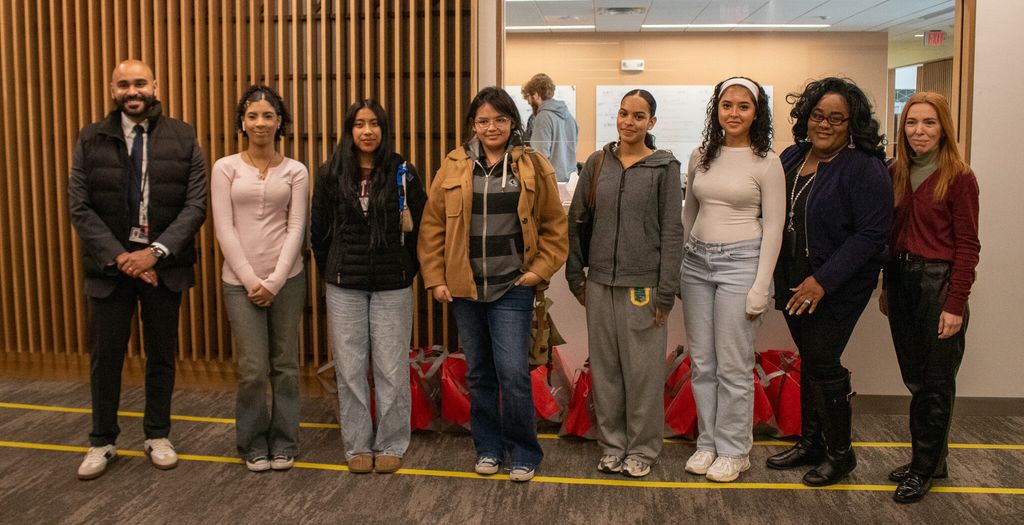
On Friday, November 7th, the BU Center for Brain Recovery (CBR) welcomed a group of juniors and seniors from various local Boston Public Schools (BPS). In an effort coordinated by BU’s Office of Government & Community Affairs in partnership with BU Admissions, BPS students visited Boston University’s campus, explored BU spaces, and engaged with faculty, staff, and students.
While visiting the Center for Brain Recovery, BPS students learned about four distinct research project methodologies, guided by CBR team members.
Erin Carpenter (PhD Candidate) showcased the fNIRS-EEG cap, a non-invasive method of neuroimaging used to collect real-time brain activity. Erin utilizes this technology in her research, and BPS students were able to see what the data collection process looks like in practice and how it works.
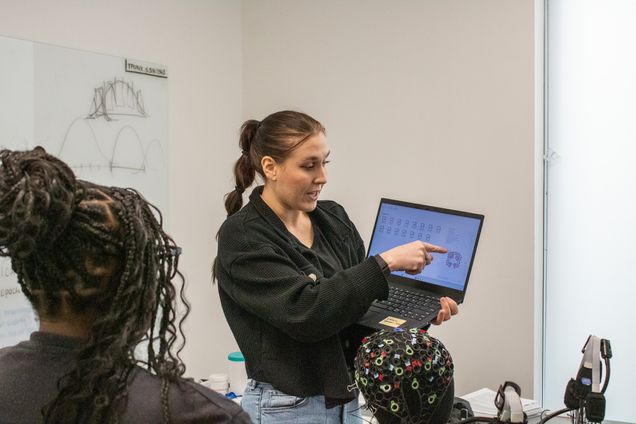
Erie Shivers (Research Assistant) spoke with BPS students about aphasia— explaining what it is, what can cause it, and how clinicians can assess its severity. Erie demonstrated components of the Western Aphasia Battery (WAB), a comprehensive standardized test used in the field of speech language pathology and at the Center for Brain Recovery to assess language capability.
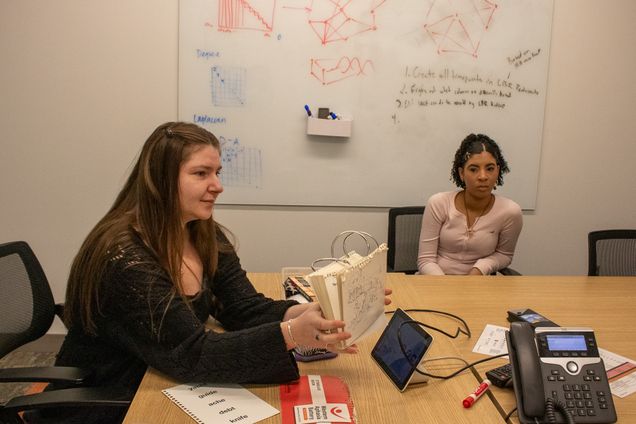
Maria Varkanitsa (Assistant Scientific Director) and Michael Scimeca (PhD Candidate) highlighted how the Center for Brain Recovery uses eye-tracking equipment to conduct reading comprehension studies and explained to BPS students how the technology works.
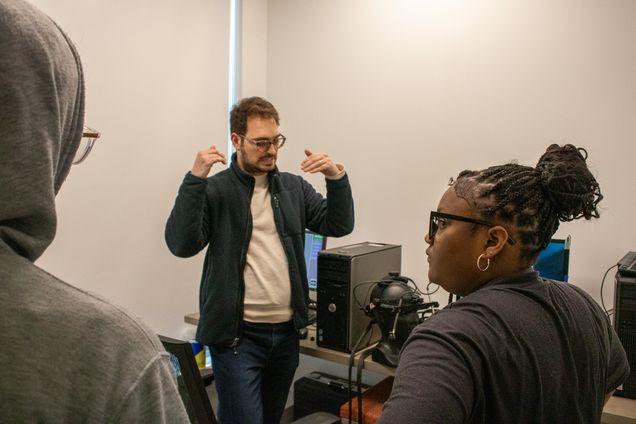
Sharon Wang (PhD Student) and Cassie Lee (NLP Research Engineer) presented their current research leveraging artificial intelligence to create a pipeline that automatically generates linguistic features from audio samples of participants. They shared about their progress using machine learning to train models that classify audio samples belonging to aphasia patients, dementia patients, and control participants, with the goal of this work eventually becoming an early, non-invasive diagnostic tool.
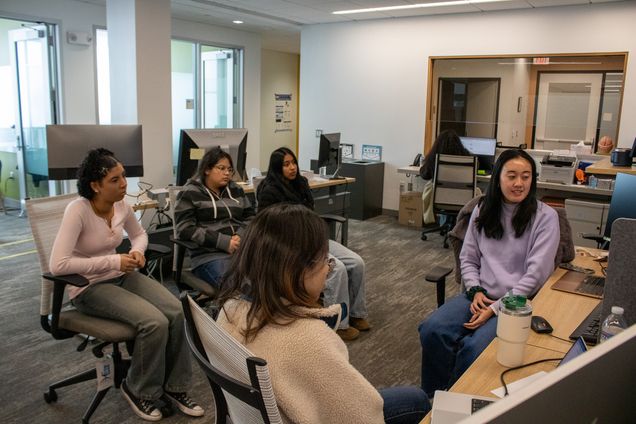
The CBR team was excited to be able to share an inside look at how our research is conducted and the impact that it has with the students.
If you would like to learn more about the Center for Brain Recovery’s research and mission, connect with us and subscribe to our newsletter.