Meeting Rembrandt at the MFA Boston
BU students collaborate with faculty and museum professionals to present an exhibition that highlights the artist’s diverse 17th-century neighborhood
BU students collaborate with faculty and museum professionals to present an exhibition that highlights the artist’s diverse 17th-century neighborhood
In a remarkable life twist they could never have seen coming, 13 Boston University students will soon share a museum gallery with the Dutch master, Rembrandt van Rijn.
In the fall 2025 semester, these history of art and architecture students and students from other areas of study had the unique opportunity to help create and design a poignant year-long exhibition at the Museum of Fine Arts, Boston (MFA).


“Reality and Imagination: Rembrandt and the Jews in the Dutch Republic” opens in the MFA Center for Netherlandish Art’s William A. Coolidge Gallery on December 12, 2025, and will be on display through December 1, 2026. The exhibition explores the interconnectedness of the artist to his vibrant and diverse Jewish neighborhood in Amsterdam, its impact on his artistic practice, and how his experiences with neighbors shaped his worldview just as much in the 17th century as it did his interpretation of the imagined Biblical past.
Rembrandt’s street and the surrounding area were the epicenter of the city’s Jewish community, including wealthy merchants who collected art and patronized artists, coexisting with a small group of free black Africans and other Dutch neighbors. These rich ethnic and religious influences come through in surprising ways in the prints, portraits, objects exhibited from the MFA permanent collections of Dutch Art and Judaica, and in several key works on loan.
“Reality and Imagination” represents the fruits of a years-long partnership between BU and the MFA, and is led by Michael Zell, professor of Baroque and 18th-century European art, and MFA colleagues Simona Di Nepi, Charles and Lynn Schusterman Curator of Judaica, and Christopher Atkins, Van Otterloo-Weatherbie Director of the Center for Netherlandish Art (CNA). BU alum Allen H. Pachtman (CAS‘75) contributed generously to the exhibition.
The MFA’s Dutch and Judaica collections combined in new ways to create the show, which tells its story using works ranging from Rembrandt’s 1637 etching of Abraham casting out Hagar and Ismael into the wilderness to Judaica like the gleaming 1649 silver Torah rimonim—the decorative finials that top the sacred scrolls—which are among the oldest surviving Dutch examples of that style and were undoubtedly admired by many of the members of the Jewish community connected to the artist.
Framing the show, Zell, who has authored and edited multiple books about the artist, explains, “It’s conceptualizing how Rembrandt might be understood to be at the center of a diverse neighborhood and how that directly shapes his art.”

Although this collaboration is the fifth between the CNA and groups of university or high school students, this is the first time an academic and an MFA curator have teamed up. In the fall, Di Nepi and Zell cotaught AH 521: Curatorship to undergraduate and graduate students of art history and museum studies.
“We are opening doors for students into this world,” Zell says. “Our students were able to understand the process of conceiving and curating an exhibition differently than if they’d just gotten to see the show after it was installed.” They learned first-hand about provenance, curation, conservation, collection management, logistics, and design from MFA staff. The project exposed them to multiple career paths in the museum world.
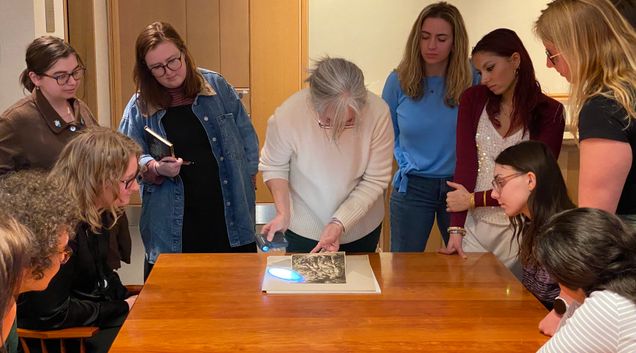
They also navigated the real-life constraints and realities of the field. For example, they learned about balancing budgets and juggling timelines, how to request loans, in this case, from The Leiden Collection in New York City and Harvard Art Museums, and the importance of limiting light exposure on works on paper.
“As a student, having the opportunity to be involved in the curatorial process and to have real input into an exhibition is invaluable,” says Bailey Pekar (GRS’24,’29), a PhD student who took the course. “Working with real objects that have real demands cements learning in a way you can’t with a book.”
Curators challenged Pekar and her classmates to hone their writing skills, tasking them with not only researching pieces but writing the wall texts that accompany the exhibition and make it come alive to visitors.
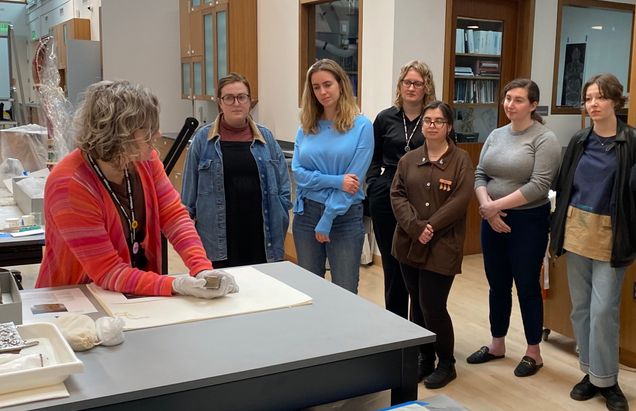
Di Nepi explains, “That type of writing requires shrinking down what you want to say concisely and focusing on the work visually, then going through rounds of edits before publication.” Pairs of students were responsible for researching a set of works or objects from the show, composing corresponding wall texts and also writing a related essay for CNA Studies, a digital publication of the MFA Boston.
Atkins says that while the students benefit from the experience, the museum does too. “We are interested in training the next generation of museum professionals. It energizes the collection when we open it up to external scholars and students who can help us show these works to broader audiences. The way that the students think about and share the art will connect us to their peers in new ways.”

Visitors to the exhibition will first encounter a large-scale map of Rembrandt’s neighborhood that shows the proximity of his home and studio to other artists, craftspeople, merchants, art dealers, patrons, Sephardi (or Spanish and Portuguese) Jews, Ashkenazi (Central and Eastern European) Jews, and free Black Africans. Then they encounter work that depicts or references some of these leading personalities of the day, their beliefs, and customs.


For example, Rembrandt’s 1647 etching of a neighbor, the art patron and physician Ephraim Bonus. He is seen coming down a wooden stairwell, not gazing directly at the artist and not dressed in any way that distinguishes his religious identity. “Sephardi Jews of this day embraced the fashions and cultural practices of Christians,” Zell says. “This portrait gives us a sense of how Rembrandt would portray someone in his neighborhood,” likely a figure he regularly passed informally on the street.


Other images of Jews, notably the print called in the 17th century, “Pharisees in the Temple,” are arguably less honorific. “It’s not the most positive or sympathetic portrayal,” Zell recognizes. “That’s part of the story which we also have to acknowledge.”
It’s clear that the artist also interacted with the free Black Africans—some of whom had complicated ties to the Sephardi community. In a print depicting Christ as a child in the synagogue, Rembrandt placed an African man in a turban alongside scholars and doctors.
The artist’s blurring of these Biblical and 17th-century eras, cultures, and people lies at the heart of the show and fascinated the BU students who helped to shape it. “Seeing Rembrandt’s prints assured me of how valuable it is to see these works in person to really understand their artistic and historic value,” says Jenna Wendler (GRS’29), a PhD student in history of art and architecture who studies 17th-century Dutch art.
And for Di Nepi, sharing those works created an unforgettable teaching moment. “What I’ve taken from this experience is that the collection that I care for and that I built speaks to young people who study art history across its many disciplines,” she says.
Zell returns to the longstanding relationship between BU and the MFA, from undergraduate museum visits to coteaching partnerships: “BU art history graduates are all over the museum. It’s a confirmation of our deepening collaboration with the MFA Boston,” he says.
The 13 students who met Rembrandt this semester at the MFA will take the unforgettable experiential learning and professional development opportunities that the semester offered and apply that knowledge to their future roles in museums all over the world.