Experiential Learning Like No Other
On annual trips to Belize, marine science students study ocean biodiversity amid the world’s second-largest barrier reef
On annual trips to Belize, marine science students study ocean biodiversity amid the world’s second-largest barrier reef
Midway through the hour-long boat trip from Belize City, Belize, to Calabash Caye, the captain stops the boat and turns off the engine at the edge of one of the many reefs in the Turneffe Atoll. Twenty-four students from Boston University Marine Program (BUMP) run to the edge of the boat and peer into the shallow, blue-green water. With the sun setting to their west, the students excitedly point at and call out the names of a seemingly endless number of corals, fish, and rays.
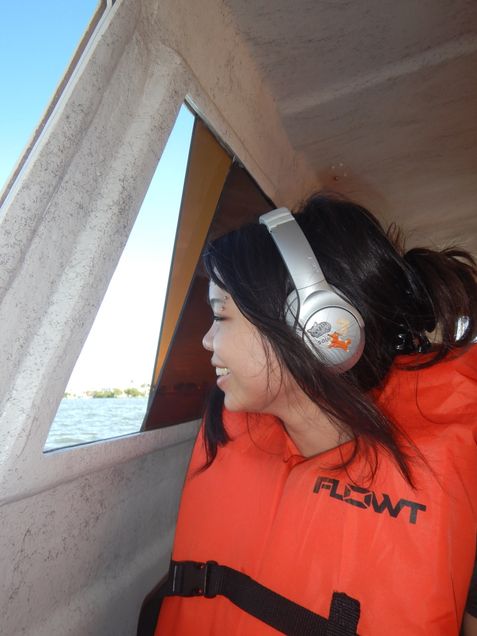
“The water was so still, and we saw a giant eagle ray,” says Mira Demeterio, a marine science major from Briarcliff Manor, N.Y., as she recalls the memorable boat trip from mainland Belize to Calabash Caye. “It was just so beautiful to see the biodiversity.”
For Demeterio (CAS’27) and most of the students on BUMP’s Belize trip—a 12-day field experience off the coast of the small Central American nation—it’s the first time seeing wild reefs, and the life teeming around them, up close. Demeterio says she’s wanted to be a marine biologist as long as she remembers, and she heard about the Belize trip from a high school teacher, who is an alumna. “I came to BU for the Belize trip,” Demeterio says. “It was my end goal for coming here when I applied. I wrote about it in my supplemental essay.”
For Demeterio, the experience—which was Nov. 6–16, 2025—did not disappoint.
“The Belize trip was actually one of the most incredible things I’ve experienced in my life,” says Demeterio, whose ambitions include either pursuing a master’s in marine science or going to medical school. “There’s an unbelievable sense of community I never would have fathomed with the people we were with in Belize. We’re all there for one ultimate goal: We all love marine science. We love the ocean. We love exploring.”

A typical day in Belize starts with an early breakfast, followed by morning snorkeling and data collection among the reefs surrounding Calabash Caye—with a short break for lunch. Students have some free time after lunch to rest, fish, play volleyball, or explore the island’s littoral forest, before returning to the water for more data collection. After dinner, students spend time updating their field journals from the day’s research—focused on an area of study they’ve picked themselves.

For her group’s Belize project, Isabella Cruz observed the behavior of damselfish, some of which are known for gardening a preferred type of algae. Cruz (CAS’27) and her group partners would find a damselfish in the reef, observe it for a period of time and record its behaviors, noting how much algae was growing nearby—the percent cover. “If there was green turf algae,” she says, “we would measure that and then see how [the damselfish’s] behavior correlates with that percent cover.”
Cruz and Demeterio say it rained most days they were in the water, as early November typically marks the end of the rainy season off the coast of Belize. “I have to say, it was a little bit harrowing at times, because you have to be okay being uncomfortable,” says Demeterio, whose group studied spatial variation of stoplight parrot fish. “There is sand everywhere. The bathroom situation is not what you’re used to in the states. The bugs are crazy. But even then, I would do it again 100 times over.”
Cruz adds: “Everyone was enjoying it so much, because it’s one of those opportunities you’re not going to get again.”

Offered every fall since 1985, BUMP’s trip to Belize highlights a semester-long dive into field work for undergraduate marine science majors, many of them juniors. For the first part of their Marine Semester, students take field-based classes that utilize New England’s marine environment. “We run two classes each year that get students on research vessels out of Massachusetts or New Hampshire, a scientific diving course in Massachusetts and Maine, a class that takes them to beaches all over New England, several classes that look at New England estuaries and salt marsh environments, and one that looks at the urban marine environment of Boston,” Kurtz says. “While Belize is often students’ first time snorkeling and working in the tropics, they’ve got some good experience as field scientists by the time they get there.”
In November and December, they join one of two trips to Belize, donning snorkels and flippers to research the tropical corals, seagrasses, fish, and geology along the world’s second-largest barrier reef. Their home base throughout is the Calabash Caye Field Station, operated by the University of Belize Environmental Research Institute. Andrew Kurtz, an associate professor of Earth and environment, became the director of BUMP in 2025. He says he’s not aware of any other university that runs a field program like the Marine Semester.
“During the one semester that the students are involved with the Marine Semester, taking four different classes in different areas—that’s just a super important developmental experience for young scientists,” Kurtz says. “And it’s a valuable showpiece for the college, showing just what you can do with experiential learning—if you’re willing to invest in it.”

See more photos from the Fall 2025 Boston University Marine Program Belize trip in BU Today.