Seminars

The GSC coordinates a series of seminar hosted in both the Fall and Spring semesters for the benefit of the graduate student community. In the Fall the speaker series is hosted by the GSC and is known as the Distinguished BME Lecture — the full schedule of speakers can be found here. In the Spring the speaker series is hosted by the BME Department as part of its Faculty Search Lectures — the full schedule of speakers can be found on BME GSC Calendar. In addition to Department Seminars, the GSC also coordinates Student Seminars as a venue to practice presentation skills and bounce ideas off peers.
BME Department Seminar: John O. Dabiri, PhD. Stanford University

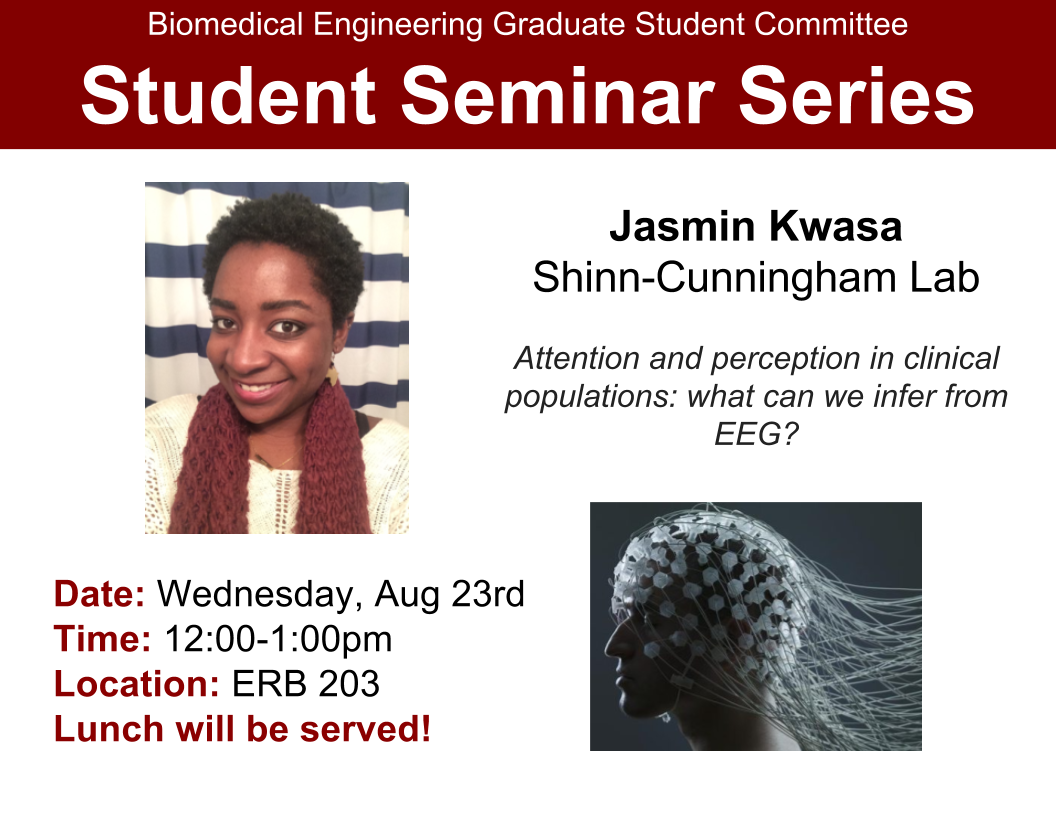
Student Seminar with Jasmine Kwasa
Student Seminar Series with Raeef Istfan

BME Seminar: Georges Goetz, PhD. Stanford University

BME Seminar with Jay Keasling

August Grad Student Seminar
Please join us on Tuesday, August 23 at 12:00pm in ERB 203 for our next BME Student Seminar. Our goal is to create a laid-back environment where BME grad students can share their research and get feedback from their peers. David Bernstein will be presenting "Studying Microbial Interactions to Gain an Ecological Perspective on Microbial Communities." Come by to learn about his work, provide feedback, and (of course) enjoy lunch with your peers!
When: Tuesday, August 23, 12:00-1:00pm
Where: ERB 203
David Bernstein, Segre Lab
Studying Microbial Interactions to Gain an Ecological Perspective on Microbial Communities
Microbial communities are ubiquitous in nature and have broad influences on processes ranging from biogeochemical cycles to human health. Metagenomic sequencing of such communities has generated vast amounts of data on the various microbes present in different habitats. This information has inspired an ecological perspective on microbiology which has led to significant breakthroughs in science and medicine such as cultivating previously uncultivated organisms and curing recurrent infections via fecal matter transplants. Despite these successes, the mechanistic details behind them are relatively obscure. Engineering microbial communities will require detailed mechanistic understanding of the interactions underlying their ecology. We propose several approaches to this end: 1) a computational framework to predict microbial interactions based on metabolism, 2) an experimental device to facilitate the observation of microbial interactions, and 3) an investigation of a global parameter driving microbial interaction. Through these aims we hope to further understand the interactions underlying microbial community structure in order to help transition the field from a descriptive to a predictive science.
If you are interested in presenting at a later seminar, please fill out this quick form!
BME Student Seminar, Wednesday, June 8, 12pm
Please join us on Wednesday, June 8 at 12:00pm in ERB 203 for our next BME Student Seminar. Our goal is to create a laid-back environment where BME grad students can share their research and get feedback from their peers. Meghan Thommes will be presenting "Controlling Microbial Growth Dynamics through Environmental Manipulation." Come by to learn about her work, provide feedback, and (of course) enjoy lunch with your peers!
February Grad Student Seminar

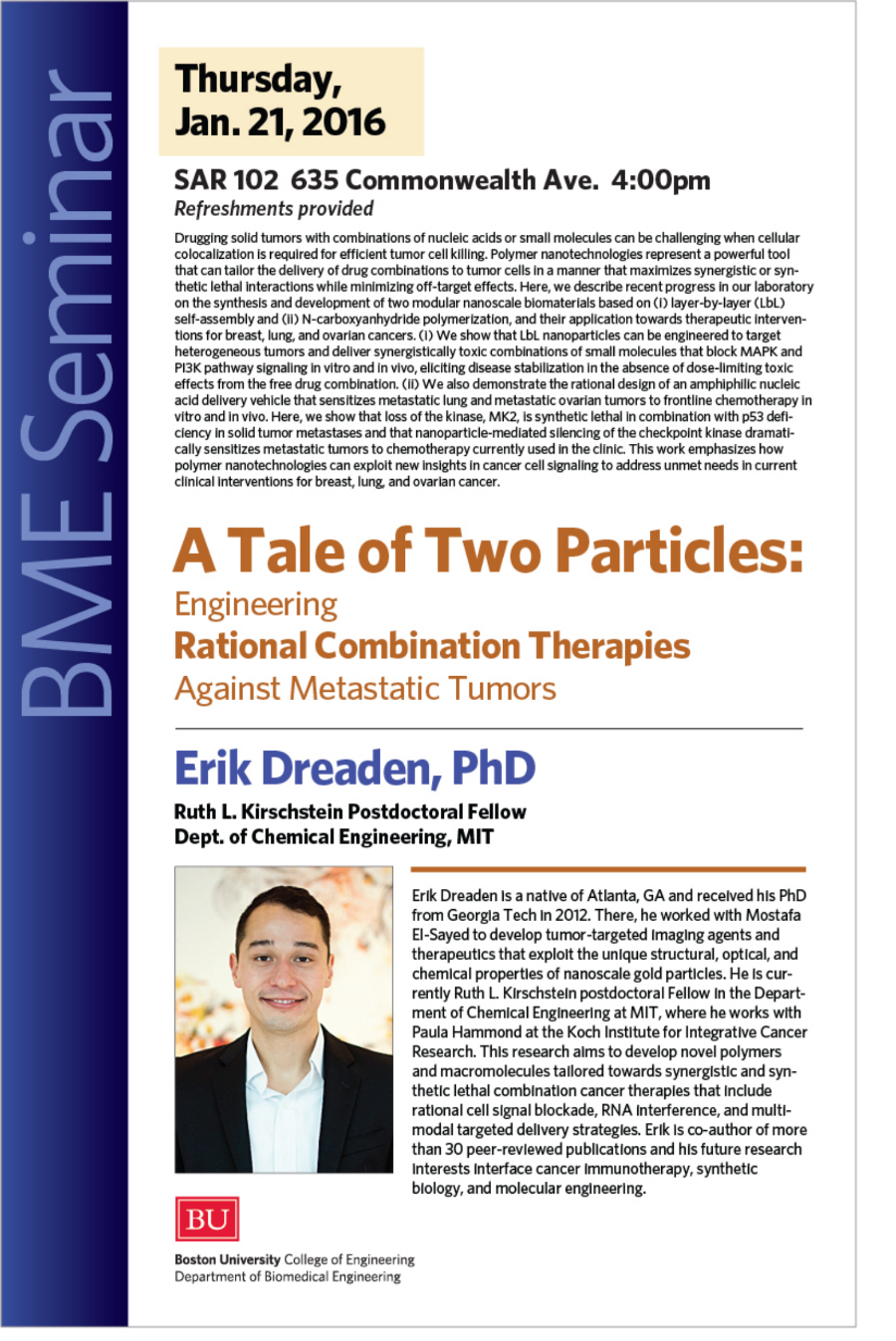
BME Seminar with Dr. Erik Dreaden