Seminars

The GSC coordinates a series of seminar hosted in both the Fall and Spring semesters for the benefit of the graduate student community. In the Fall the speaker series is hosted by the GSC and is known as the Distinguished BME Lecture — the full schedule of speakers can be found here. In the Spring the speaker series is hosted by the BME Department as part of its Faculty Search Lectures — the full schedule of speakers can be found on BME GSC Calendar. In addition to Department Seminars, the GSC also coordinates Student Seminars as a venue to practice presentation skills and bounce ideas off peers.
Department Seminar with Chris B.Schaffer, PhD, Cornell University

BME Departmental Seminar with Kapil Bharti, PhD

November Grad Student Seminar

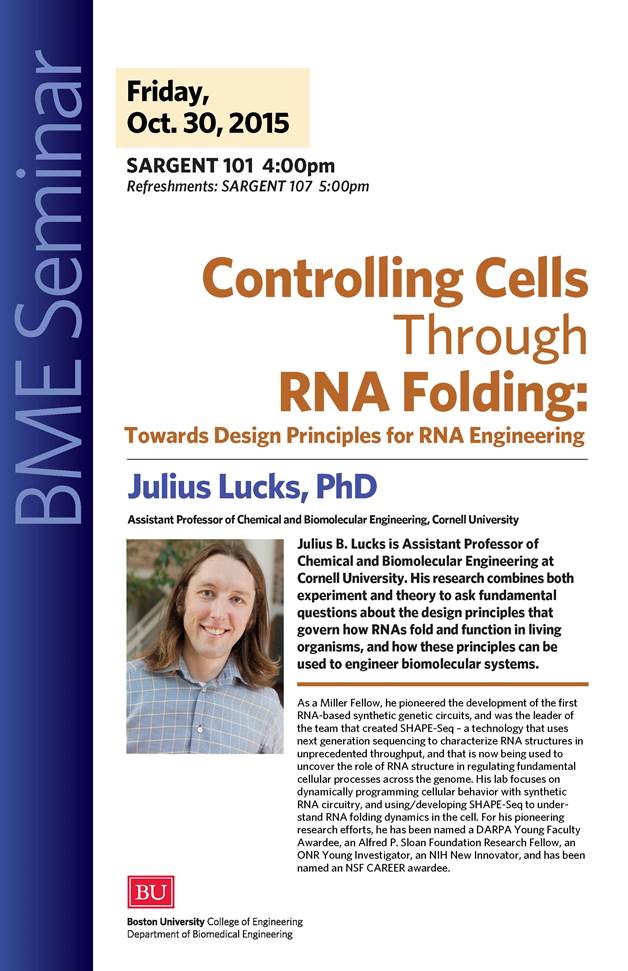
BME Seminar: Julius Lucks, PhD
BME seminar: Rebecca Richards-Kortum, Ph.D. Rice University
Please join us for our second talk in this year's BME Seminar Series. We''ll be hearing from

Dr. Rebecca Richards-Kortum, Ph.D. Rice University
Friday, October 9, 2015
PHO 206 at 3 pm
Followed by reception
Rebecca Richards-Kortum has been elected a fellow of the American Academy of Arts and Sciences, one of the nation’s foremost scholarly honors.
Richards-Kortum is Rice’s Stanley C. Moore Professor of Bioengineering, professor of electrical and computer engineering and director Rice 360°: Institute for Global Health Technologies.
For two decades, Richards-Kortum has focused on translating research in nanotechnology, molecular imaging and microfabrication to develop optical imaging systems that are inexpensive, portable and provide point-of-care diagnoses for diseases ranging from cancer to malaria. Her research has produced 29 patents, more than 230 research papers, 11 book chapters and the textbook Biomedical Engineering for Global Health.
She is a member of the National Academy of Engineering and an inaugural member of the National Advisory Council for Biomedical Imaging and Bioengineering for the National Institutes of Health. Richards-Kortum also is a fellow of the Optical Society of America, the American Institute for Medical and Biological Engineering, the American Association for the Advancement of Science, the Biomedical Engineering Society and the National Academy of Inventors.
Her many awards and honors include the 2013 Lemelson-MIT Award for Global Innovation, the 2014 Michael S. Feld Biophotonics Award from the Optical Society of America, Rice’s George R. Brown Award for Superior Teaching and the 2007 Chester F. Carlson Award from the American Society for Engineering Education. She was named a professor of the Howard Hughes Medical Institute in 2002 and 2006.
October Student Seminar
Please join us Thursday, October 15 at noon in ERB 203 for the second BME Student Seminar of the fall semester. Our goal is to create a laid-back environment where BME grad students can share their research and get feedback from their peers. Samer Bou Jawde will be presenting "A Lumped Parameter Model of Fiber Recruitment in the Extracellular Matrix." Come by to learn about his work, provide feedback, and (of course) enjoy lunch with your peers.
When: Thursday, October 15, 12:00-1:00pm
Where: ERB 203
Fall 2015 Schedule:
Tuesday, November 3: Nitinun Bell Varongchayakul, Amit Mellar Lab
December TBA: Sign up!
Samer Bou Jawde, Bela Suki Lab
A Lumped Parameter Model of Fiber Recruitment in the Extracellular Matrix
The biomechanical properties of biological tissues play important roles in the normal functioning of tissues and organs. These biomechanical properties at the macroscopic scale are characterized by the stress-strain relation which is invariably nonlinear as is the case for fibers embedded in the extracellular matrix (ECM). Previous computational models have attributed the nonlinear behavior to the recruitment of collagen fibers. While such models can simulate microscopic alignment of fibers within the ECM, to our knowledge, their complexity does not allow fitting these models to estimate the microscale properties of the tissue. To this end, a lumped parameter analytical model of tissue stress-strain behavior has been developed that incorporates the alignment of linearly elastic fibers in the elastic ECM. Using simulations, it is demonstrated that this model captures the observed nonlinearity of the stress-strain curve. These results can shed light on the importance and contribution of various microscale properties of the fibers and ECM to macroscale nonlinearity. The simplicity of the approach allows us to fit the model to data and hence extract microscale tissue parameters from macroscale experimental data.
1st BME Seminar is this Friday!

Fall Department Seminar Lineup
We are honored to host several outstanding members of the scientific community throughout the fall semester. Please join us in hearing from those who are at the pinnacle of their fields.
All seminars this Fall will be held on Fridays from 3-4 pm, followed by a social reception with food and drinks (including beer & wine) from 4-5 pm.


September Grad Student Seminar
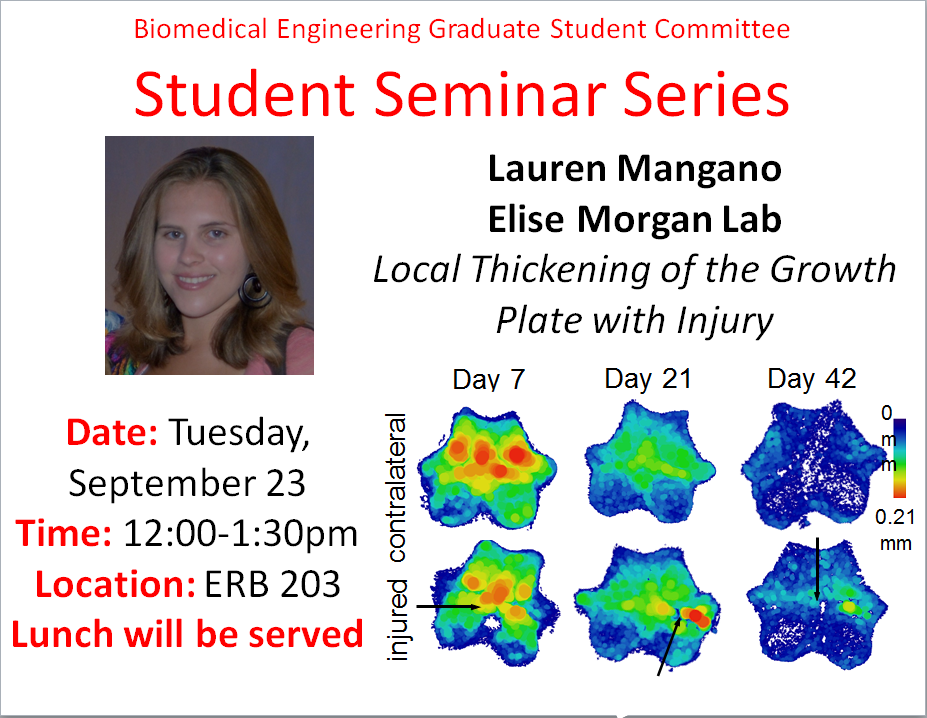
Please join us on September 22 at noon in ERB 203 for the first BME Student Seminar of the fall semester. Our goal is to create a laid-back environment where BME grad students can share their research and get feedback from their peers. Lauren Mangano will present "Local Thickening of the Growth Plate with Injury." Come by to learn about her work, provide feedback, and (of course) enjoy lunch with your peers.
When: Tuesday, September 22, 12:00-1:30pm
Where: ERB 203
RSVP so we can order enough food
Presenter: Lauren Mangano, Elise Morgan Lab
Local Thickening of the Growth Plate with Injury
Injury to the growth plate is associated with premature growth arrest and growth disturbance, including shortening of the injured limb and angular deformities. Developing successful, less invasive treatments for growth plate injury has been impeded by incomplete understanding of the features of the injury response that cause these growth problems. Radiographic evidence indicates that the growth disturbances are associated with formation of bony bridges at the injury site; however, conflicting reports exists as to how these bony bridges form. Histological evidence has revealed disorganized chondrocyte columns and increased growth plate thickness in the region of the growth plate adjacent to the injury site, suggesting that local changes in cellular activity is may contribute to angular deformities. Using contrast-enhanced micro-computed tomography (CECT) for cartilage imaging, local changes in the cartilaginous and osseous tissues in the healing growth plate can be examined robustly with quantitive, three-dimensional measurement.
The goal of this study was to quantify spatial changes in the morphology and composition of the growth plate that occur in response to injury. The specific objectives were: 1) to quantify local changes in growth plate thickness and CECT attenuation (indicative of glycosaminonglycan (GAG) content (cite)) adjacent to the injury site; 2) to quantify the amount of bone formed within the growth plate following injury.
Fall 2015 Schedule:
Thursday, October 15: Samer Bou Jawde, Bela Suki Lab
Tuesday, November 3: Nitinun Bell Varongchayakul, Amit Mellar Lab
December TBA: Sign up!