News & Media
Newsletter
Stay connected with the latest breakthroughs in biological design with The Biodesign Bulletin. This recurring digest highlights new research, major publications, center updates, and upcoming opportunities.

Current Edition

From the Lab to Your Life
Tiny rings that stop chronic pain. A molecule that targets deadly lung cancer. Robotic hands that can pluck even the most delicate fruit. These are just a few of the innovations under development by Boston University faculty this year—and each of them may be the starting point for new commercial ventures thanks to the BU Ignition Awards. More

The Quest for a Heart Attack Cure
Heart disease is one of the world’s most deadly and insidious killers. In the United States alone, it causes one in every four deaths nationwide—that’s a staggering 659,000 people each year, or roughly equivalent to the entire population of Portland, Ore. More

The Line Between Biology and Technology Has Blurred—There’s No Going Back
Have you used Waze to route you from point A to point B as quickly as possible? Have you asked Alexa or Siri to suggest some music, or has autocorrect improved spelling in your texts or emails? Do you ever stop to think about the influence these technologies have over your decisions and behaviors, or have these technologies simply blended seamlessly into the way you interact with the world? More

Biotech Developing “Tissue Therapeutics” to Treat Diseased Organs Launches from BU and MIT Labs
Greater Boston has become the nation’s biotech hub—the Silicon Valley of life sciences, according to some—and Massachusetts is now reportedly home to more than 1,000 biotech companies, employing more than 80,000 people. One of the newest multimillion-dollar firms helping to drive the boom has its roots in a Boston University lab. More

New Miniature Heart Could Help Speed Heart Disease Cures
There’s no safe way to get a close-up view of the human heart as it goes about its work: you can’t just pop it out, take a look, then slot it back in. Scientists have tried different ways to get around this fundamental problem: they’ve hooked up cadaver hearts to machines to make them pump again, attached lab-grown heart tissues to springs to watch them expand and contract. More

A Simple Test for Viral Detection
Gold-standard lab tests for viruses usually look at several sequences from the virus before determining that a sample is positive, which makes them hard to implement without expensive equipment in centralized facilities. More
Green Garners Award to Develop Cell-Signal Sensor
Assistant Professor Alexander Green (BME) and a colleague at Yale University have earned a Scialog Collaborative Innovation Award to develop a new type of sensor capable of detecting heretofore hidden signals within a cell, with potential applications both diagnostic and therapeutic. More

Ambitious Effort to Develop Lab-Grown Lungs Wins Paul G. Allen Frontiers Group Funding
A bold early-stage project aiming to develop lab-grown lungs—which could bring fresh hope to people with pulmonary diseases such as asthma and lung cancer—has been awarded $1.5 million over three years from the Paul G. Allen Frontiers Group. The effort will be led by researchers at Boston University’s College of Engineering and School of Medicine. More

Five Studies Pushing the Limits of Science
In 2018, BU trustee Rajen Kilachand (Questrom’74, Hon.’14) made a historic gift of $115 million to Boston University, $100 million of which established the Rajen Kilachand Fund for Integrated Life Sciences and Engineering, supporting interdisciplinary research and solutions to some of today’s biggest challenges in the life sciences. More
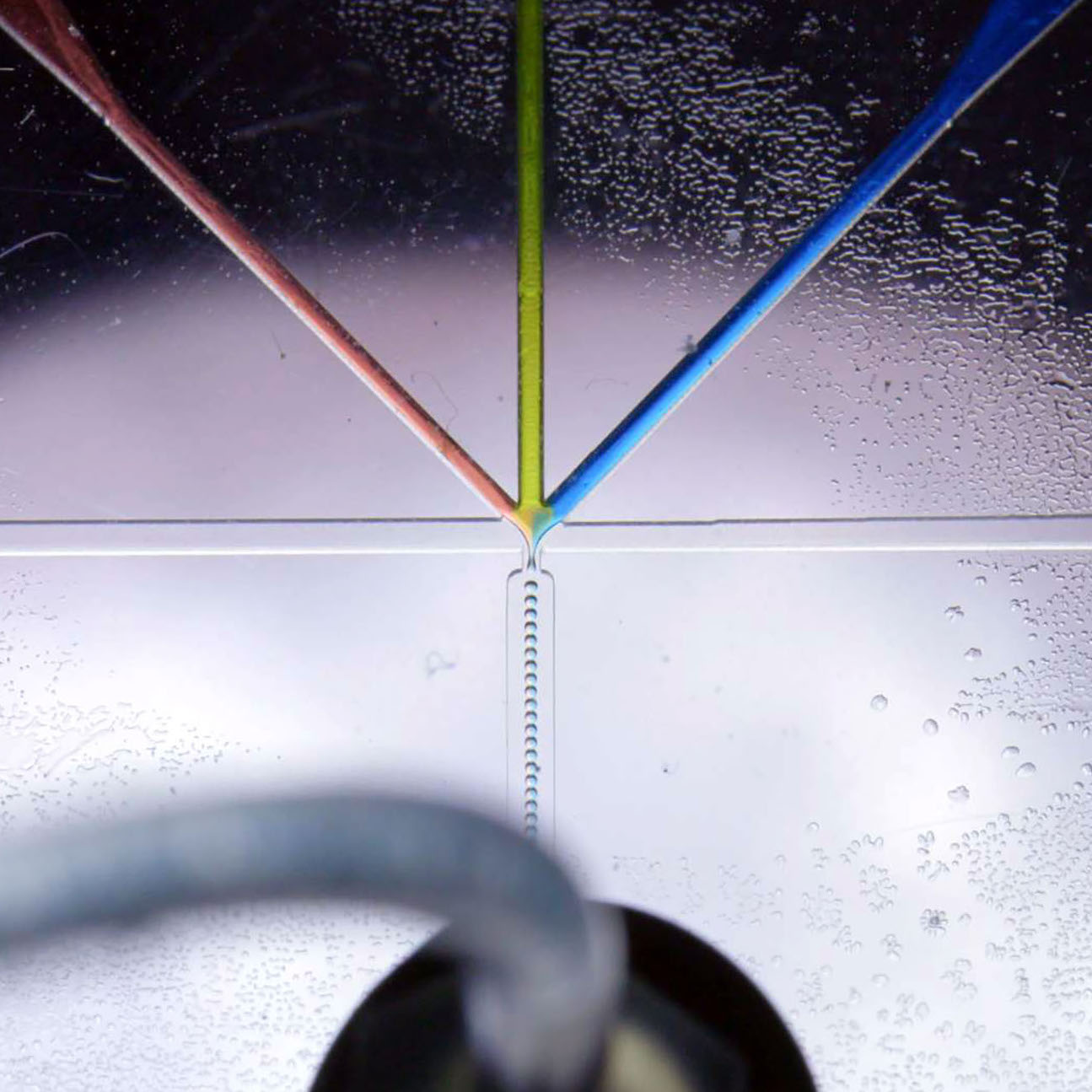
Microfluidic Devices: Synthetic Biology’s Secret Weapon
In this video, we see different colored liquids containing chemicals and biological molecules race down three separate channels to a junction point, where they flow together and create an army of tiny marching bubbles ready for analysis. This plastic chip crisscrossed with microscopic channels and electronic sensors is a microfluidic device—and each of those bubbles created inside of it represents an advancement in biotechnology research that yesterday’s scientists could only dream of More