Stone Gallery Show Explores What It Means to Be Not from Here, Not from There
At turns joyous and powerful, Ni de Aquí, Ni de Alla is a collision of media, identities, narratives
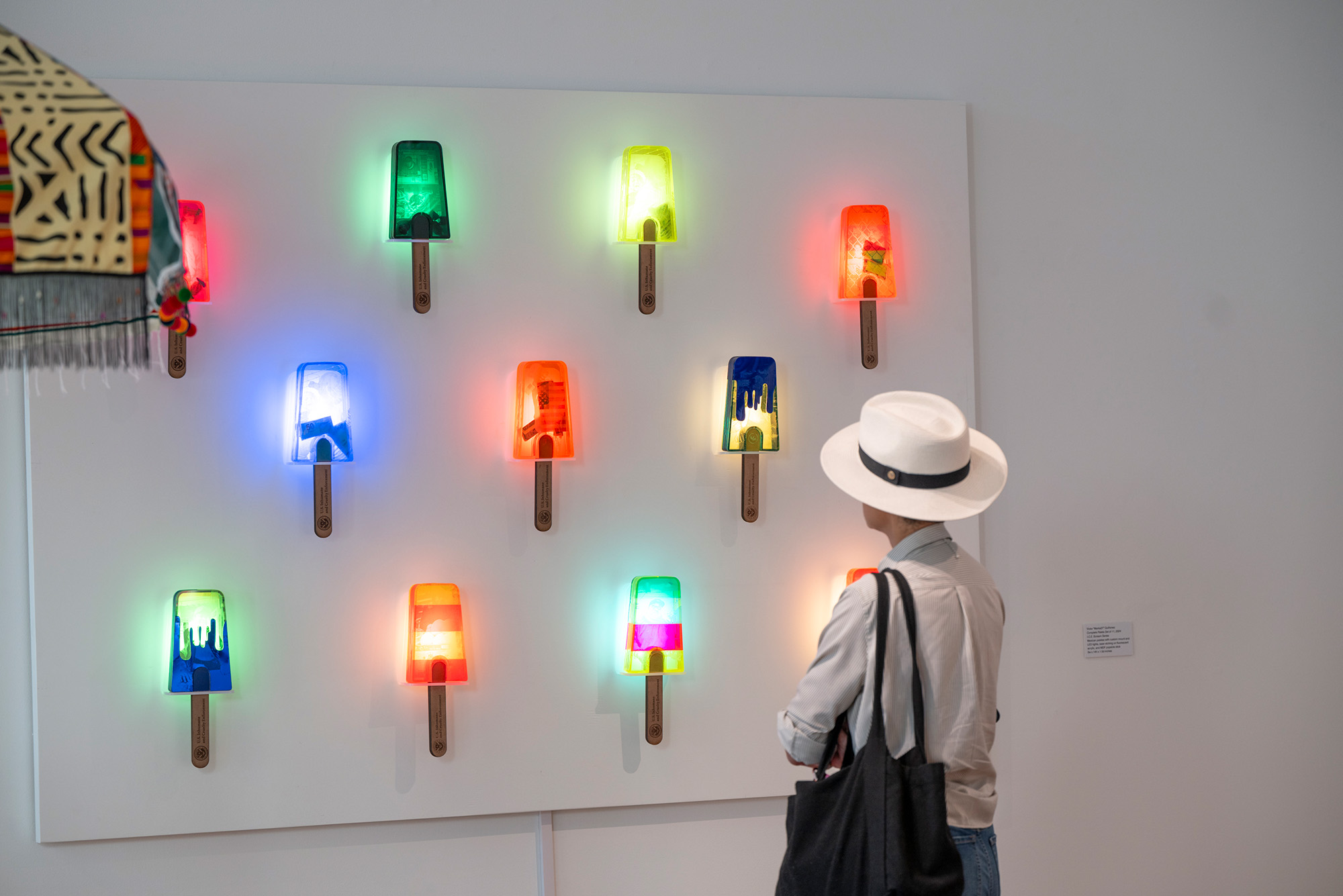
A display in Victor “Marka27” Quiñonez’s I.C.E. SCREAM series, part of Ni de Aquí, Ni de Alla (Not from Here, Not from There) at BU’s Faye G., Jo, and James Stone Gallery through December 10.
Stone Gallery Show Explores What It Means to Be Not from Here, Not from There
At turns joyous and powerful, Ni de Aquí, Ni de Alla is a collision of media, identities, narratives
What does it mean to be not from here and not from there? This conundrum—the intersection of opposing cultures, languages, and experiences—is at the heart of Victor Quiñonez’s creative vision. Works by the multihyphenate artist, known by the moniker Marka27, are on view at Ni de Aquí, Ni de Alla, at Boston University’s Faye G., Jo, and James Stone Gallery through December 10, inviting viewers on a journey of riotous colors, media, and narrative.
“Ni de Aquí has been three years in the making, and seeing it finally installed is beyond what I imagined,” says Lissa Cramer (MET’18), director of BU Art Galleries. “Victor’s attention to detail is remarkable. He’s so intentional with every choice. The show is stunning, and he’s an absolute dream collaborator.”
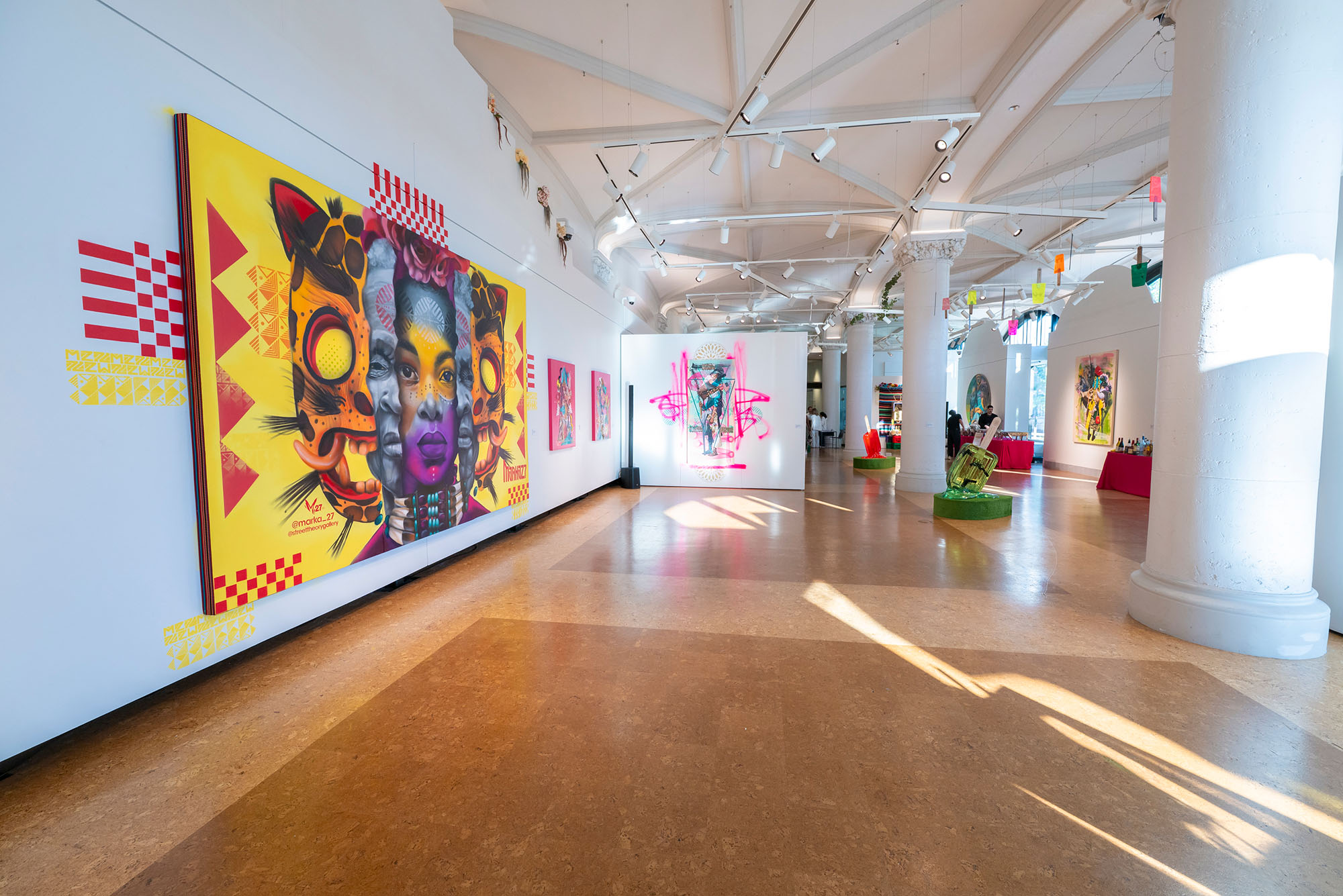
Born in Ciudad Juárez, Mexico, and raised in East Dallas, Texas, Quiñonez began his artistic career as a graffiti artist, for which he was incarcerated. The aesthetics of street culture—itself a cacophony of sights, sounds, histories, and experiences—has never left his work, which can be seen from Boston to Denver to the new World Trade Center complex in New York. Now an award-winning exhibiting artist, designer, gallerist, and community activist, he maintains a connection to street aesthetics by incorporating spray paint, mural, and references to urban life in his art.
Painted works in the exhibition rely on a visual language, where Speedy Gonzalez can be found nestled among blooming hibiscus and Maya jaguars. Generations communicate through the serape and the baseball cap, the trumpet and the boombox, the rosary clutched by long acrylic fingernails, the feathered serpent, and the luchador.
Quiñonez refers to his distinct visual imprint as a “neo-Indigenous” style. “Neo-Indigenous came from wanting to pay homage to my culture, wishing to incorporate images of Mayas, Aztecs, and more, while recreating them in a way—hence, they are translatable to our times,” he told Art Currently. “When I moved from Texas to the East Coast, I was around the Afro-Latino communities. This encounter inspired me to incorporate people from the Caribbean, the Dominican Republic, and everywhere, because I want to decolonize the thoughts regarding skin color.”
Through his work, Quiñonez invites viewers into a vibrant space where heritage and modernity coexist. No stranger to making space for street art within the white-wall gallery, he believes that seeming contradiction has always had a place in Mexican artistic tradition. He draws inspiration from the Mexican Masters—Diego Rivera, David Alfaro Siqueiros, and José Clemente Orozco—artists whose place in the canon is cemented by their blend of folk aesthetics and modern techniques, the international art world, and the local street corner.

Quiñonez revels in their vision, then expands upon it—bringing the conversation outside the gallery and into the realm of activism and advocacy work. Since he and his wife, Liza Quiñonez (who curated Cey Adams: Departure at the Stone Gallery in 2022), founded Street Theory—a Brooklyn-based gallery, collective, and creative agency—his mission has been to empower underrepresented artists through work that informs, challenges, and inspires. Their projects run the gamut from curatorial services to brand consultancy to large-scale mural projects, such as 2020’s No Weapon Formed Against Thee Shall Prosper, a tribute to Breonna Taylor, George Floyd, and other BIPOC victims of police brutality.
“We merged forces to create this moment of activism through art, speak about equity in museums, and promote more respect for BIPOC artists,” Quiñonez told Art Currently.
Ni de Aquí is not only a reference to the bicultural, bilingual experience in America. It also speaks to his evolution as a multimedia studio artist, from graffiti and mural art to studio painting, sculpture, textile art, and installation—a highlight of the show.
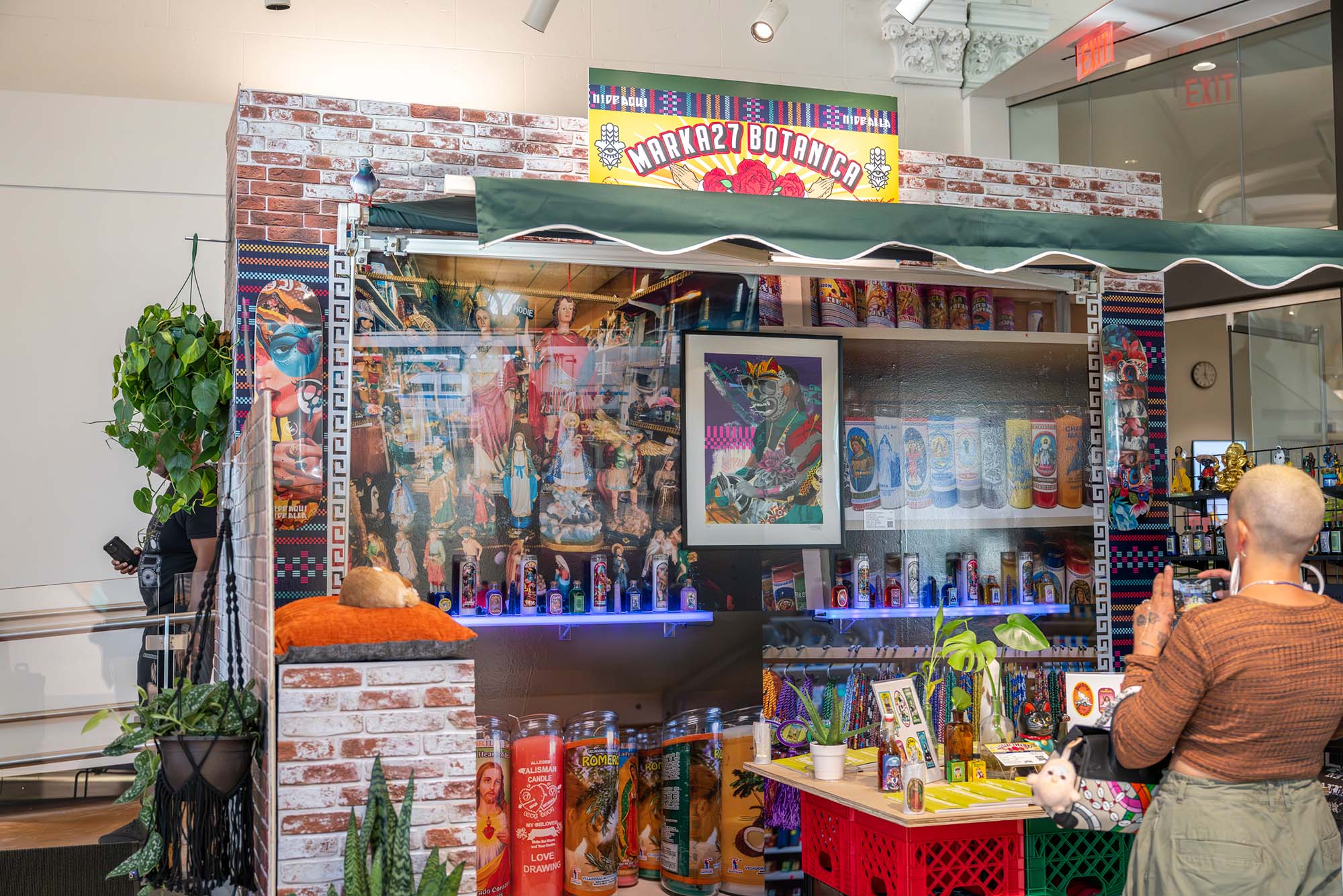
Marka27 Botaníca, installed at the far end of the gallery, is the room’s gravitational center. A large-scale, interactive installation made to look like a botaníca—a religious goods store that sells sacred herbs, devotional candles, and incense—it uses every available surface, like bottles and candles with custom-printed labels (“Gentrification Protection,” “Instafame! One Million Followers!”), as a creative canvas. Viewers can walk through the tight space as they would in real life, maneuvering around a counter with its ubiquitous waving cat figurine.
Quiñonez’s studio works in three dimensions reflect a restlessly experimental mind, unbound by the rigidity of a city wall. While all works in Ni de Aquí engage the viewer, his sculptures and installations are the best examples of his emotional range, swinging from irreverent to nostalgic, joyous to deadly serious, in a single piece.
At the surface, his I.C.E. Scream series of vinyl sculptures is a literal pop-art confection: a collection of acid-colored paletas, or fruity ice pops. A closer inspection reveals each laser-etched with images—the smiling face of an old man or a woman with a baby—while the sticks bear a government seal and the phrase “U.S. Inhumane and Cruelty Enforcement.” The series “plays on the contrast between childhood innocence and the brutality of detention, deportation, and family separation,” his website says.
“Art gave me a voice when systems tried to silence it,” Quiñonez says. “This exhibition is about reclaiming power, about honoring where I come from while challenging the systems that try to define where I belong.”
Ni de Aquí, Ni de Alla is on view at CFA’s Faye G., Jo, and James Stone Gallery, 855 Commonwealth Ave., through December 10. The gallery is open from 11 am to 5 pm Tuesday through Saturday; it’s free to enter and open to the public.