Music Education Is Everything to Her: Now She’s Sharing It with Others

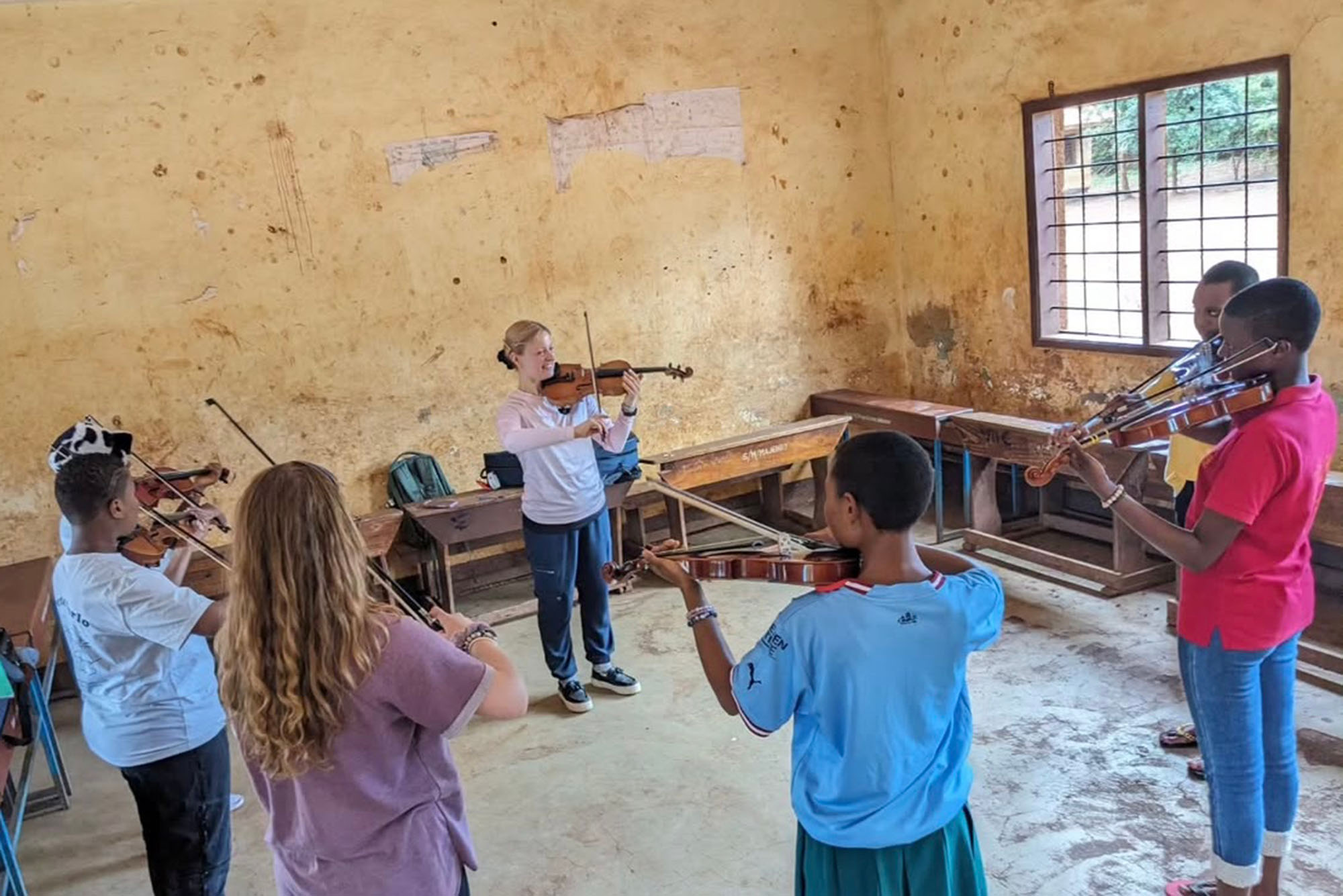
Aija Reke with some of her violin students in Moshi, Tanzania. Photos courtesy of Reke
Music Education Is Everything to Her: Now She’s Sharing It with Others
CFA student traveled to Tanzania to teach students in joint music/conservation education program
When Aija Reke was young, education enabled her to escape poverty. Now a violin teacher, she wants to give the same gift to others.
Reke (CFA’15,’26) grew up in Latvia, in a house with no heat or running water, and her education in music has helped her create a new life for herself, she says. Now pursuing a Doctor of Musical Arts degree at Boston University College of Fine Arts, she says she’s always dreamed of passing on the gift of education.
Thanks to a scholarship from the Boston University Women’s Guild, Reke realized her dream this summer. She traveled to Moshi, Tanzania, near Mount Kilimanjaro, where she volunteered for three weeks, teaching beginner and advanced violin at a local school. Her students ranged from complete beginners to relatively experienced violin players.
“My dream came true,” she says. “It was a bridge of education between different continents.”
Reke has taught violin since earning a master’s degree at CFA in 2015. She says she’s always wanted to teach in an area dealing with severe economic hardship because she knows firsthand the difference it can make in a young person’s life.
In Tanzania, she worked with the Daraja Music Initiative, an interdisciplinary program that combines music education and conservation education.
Through teaching violin, she sought to build critical thinking skills and confidence among her students and give them a foundation in violin performance so they could continue to learn. The program, now in its 15th year, includes a number of older students who are working to become teachers themselves.
“It was an incredible experience to teach local students,” Reke says. “They are very eager to learn and they progress very fast.”
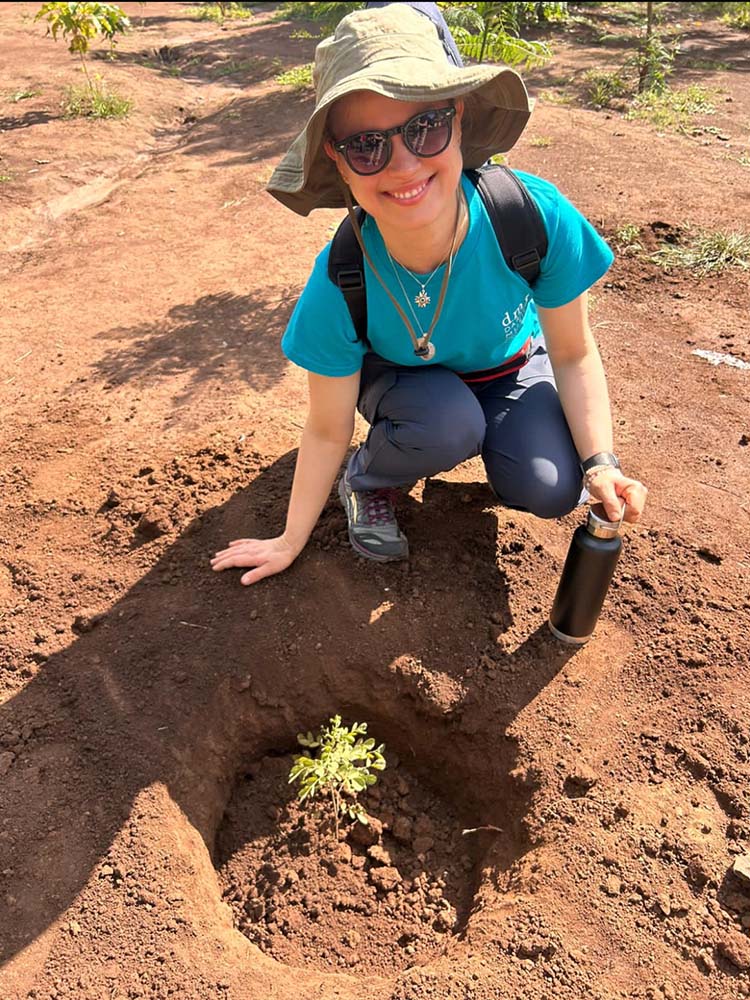
Her summer wasn’t all about music. The program bridges music and conservation, so in addition to teaching beginner and advanced violin classes, she also led conservation classes and planted and pruned mpingo trees, also known as African blackwood, the national tree of Tanzania. African blackwoods are used to make clarinets, oboe and violin fingerboards, pegs, and chin rests, but they’ve been overharvested in the country. Students in the Daraja Music program are taught about the trees’ environmental and economic importance.
One of the highlights of her trip was an opportunity to take a short safari to Mkomazi National Park with her students, where they saw Tanzanian wildlife up close: elephants, giraffes, zebras, wildebeests, and more.
Reke and other volunteers in the program also performed at local venues in Moshi, including Courage Cafe, which supports women who have been victims of sexual abuse and trafficking by selling their handicrafts.
“In Tanzania, for women, it’s a very difficult country,” Reke says. “We also want to empower women [to realize] that they can have an education, so they are able to sustain themselves.”

Because Reke grew up in a house without heat and all her clothes were provided by the American Red Cross, she could appreciate, and adjust to, the challenges her students face. In Tanzania, one of the poorest countries in the world, there is limited access to clean water and medication, and schools have few basic supplies.
“Public schools lack basics such as desks and chairs,” she says. “The classrooms don’t have any glass in the windows and there are no air conditioners in the summer, when the temperature can reach 109 degrees… Seeing the daily challenges in other parts of the world makes me appreciate simple things.”
But Reke learned as much from her students as they did from her, she says.
“It helped me to open my eyes to different parts of the world. I learned so much about hospitality and kindness.”

Now back at BU, she’s grateful for the BU Women’s Guild scholarship that made her travel possible. “It really benefited a lot of students who learned how to play violin,” she says.
A newlywed, Reke says she hopes to continue focusing her work on the environment, justice, and economic development in places that need it. One possibility: opening a music school with her husband that would work with nonprofits to offer instruction to children who otherwise couldn’t afford it. Another is teaching at a university, where she could incorporate her passion for music and conservation.
“I think in this world, we just need to create a lot of beauty and positivity, and we can do that through teaching music, through planting trees, creating a positive environment,” Reke says. “We all need hope for a better future and for our world and planet.”
Comments & Discussion
Boston University moderates comments to facilitate an informed, substantive, civil conversation. Abusive, profane, self-promotional, misleading, incoherent or off-topic comments will be rejected. Moderators are staffed during regular business hours (EST) and can only accept comments written in English. Statistics or facts must include a citation or a link to the citation.