Skip to Main Content
Boston University
  • Bostonia
  • BU Today
  • The Brink
  • University Publications

    • Bostonia
    • BU Today
    • The Brink
  • School & College Publications

    • The Record
Other Publications
BU Today
  • Sections
News, Research, Community

Lessons to Lessen Drug Abuse

New SSW center measures success of community rehab programs
February 6, 2007
  • Catherine Santore
Twitter Facebook
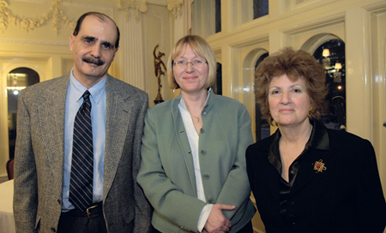
Lena Lundgren, director of BU’s Center for Addictions Research and Services (center), with codirectors Melvin Delgado and Maryann Amodeo, all School of Social Work faculty, at a reception for the new center last month. Photo by Kalman Zabarsky

Faculty from the School of Social Work who specialize in addiction research have long served as a resource for community health-care agencies that treat substance abusers. Now these agencies, which need to know whether their programs are working, can find help more easily through a new center at the school. The Center for Addictions Research and Services (CARS), which brings together 13 SSW professors, collects and analyzes data on program effectiveness and trains staff based on the findings.

“The center will enable the School of Social Work to partner effectively with community organizations and with other disciplines within and outside of BU to produce cutting-edge research, training, and services,” says Gail Steketee, SSW dean ad interim.

“A major thrust right now is research and program evaluation,” says Maryann Amodeo, CARS codirector and an SSW associate professor of clinical practice. With more federal and local support for addiction services comes increased interest in measuring how effective these services and organizations are. 

“Organizations are interested in making use of those funds, but they generally don’t have the staff who understand research,” says Amodeo. “So they look to the School of Social Work to understand what data need to be gathered and how to interpret that data.”

The new center will make it easier for community agencies to find the help they need. Previously, they would call the school’s receptionist to ask which professor specialized in staff training or research plan development. “The receptionist wouldn’t know who to refer the caller to because we each do some of those activities,” says Lena Lundgren, director of CARS and an SSW associate professor of social welfare policy. “This way we’ve centralized our activities more.”

The center’s faculty focus on substance abuse issues affecting individuals, families, and communities. Areas of research include the role of substance abuse treatment in preventing HIV/AIDS, the services that substance abusers use, the factors affecting access to substance abuse treatment, the ways parental substance abuse affects children, the racial and ethnic disparities in substance abuse treatment, and the effectiveness of substance abuse training.

“What makes us unique is our capacity to work effectively with the community and to bring in large grants to the community,” says Lundgren. For example, she is working with Boston-based Casa Esperanza to enhance its residential drug treatment programs and to study the services’ effectiveness. As a result of the collaboration with CARS, according to Lundgren, Casa Esperanza has received more than $1 million in grants to provide trauma counseling and substance abuse services to area Latinos.

Other recent grants have enabled SSW professors to train local employees in quantitative, evidence-based practices. With funds from the National Institute on Drug Abuse, Amodeo helped staff at four addiction treatment programs identify areas that needed improvement and work on a plan for change.

“Some staff may have a resistance to gathering data on clients,” says Amodeo. “We help the agency to understand the purpose of research — that it won’t harm clients and that it will benefit the organization in the long run.”

Lundgren hopes the new center will strengthen ties among SSW professors and give them more opportunities to mentor students and junior faculty on substance abuse methodology and to work with federal grant-makers.

“As a group we have been effective in writing and publishing on addiction, HIV, and substance abuse treatments,” says Lundgren. “The center will make sure that research and publications reach a broader audience, because we can be more systematic in how we disseminate information. We can be more effective in grant-making because we can draw on each other’s expertise.”
 
Catherine Santore can be reached at csantore@bu.edu.

Explore Related Topics:

  • Drugs
  • Local
  • Share this story

Share

Lessons to Lessen Drug Abuse

Share

  • Twitter
  • Facebook
  • Reddit
  • LinkedIn
  • Email

Latest from BU Today

  • WORLD CUP CALLOUT

    Is Your Country Playing in the World Cup? Tell Us!

  • SUPER BOWL LX

    Super Bowl Sunday: Where to Watch, What to Know

  • Campus Life

    Terriers Show Their School Pride for BU’s First Spirit Day

  • Organizational Behavior

    The Patriots Went from Worst to First. Can Businesses and Organizations Turn Around Too?

  • University News

    A Peek Inside What’s Happening at Warren Towers

  • Student Life

    From Boston to Vichy: BU Wheelock Launches New Study Abroad Program

  • Things-to-do

    This Weekend @ BU: February 5 to 8

  • Food

    Five Easy Snacks to Make for Your 2026 Super Bowl Party

  • University News

    Boston University Ranks 41st in Time’s Inaugural Ranking of World’s Top Universities

  • Books

    BU’s 2026 Ha Jin Lecturer, Award-Winning Novelist Garth Greenwell, on How Singing, Poetry Have Shaped His Fiction

  • Varsity Sports

    Men’s Beanpot Semifinal Recap 2026

  • Tips for students

    A Guide for CGS Students: How to Kick-Start Your BU Experience

  • Terrier Spirit Days

    First Terrier Spirit Day Is February 5—Wear Your BU Gear

  • Lady Gaga, Mister Rogers Revive Memories of Iconic BU Commencement Moment

  • Varsity Sports

    Men’s Hockey Terriers Out to Defend Their Reigning Beanpot Title

  • Religion

    BU Chaplains Panel to Discuss Fasting for Lent and Ramadan

  • Student Life

    Accounting vs Finance: What Is the Difference Between These Two Majors?

  • Campus Life

    Are You a Terrier Married to a Terrier? Tell Us About Your Wedding Proposal

  • Things-to-do

    This Weekend @ BU: January 29 to February 1

  • University News

    BU Launches New Faculty Development Office

Section navigation

  • Sections
  • Must Reads
  • Videos
  • Series
  • Close ups
  • Archives
  • About + Contact
Get Our Email

Explore Our Publications

Bostonia

Boston University’s Alumni Magazine

BU Today

News, Research, Community

The Brink

Pioneering Research from Boston University

  • Twitter
  • Facebook
  • Youtube
  • LinkedIn
  • Instagram
  • Weibo
  • TikTok
© Boston University. All rights reserved. www.bu.edu
© 2026 Trustees of Boston UniversityPrivacy StatementAccessibility
Boston University
Notice of Non-Discrimination: Boston University prohibits discrimination and harassment on the basis of race, color, natural or protective hairstyle, religion, sex or gender, age, national origin, ethnicity, shared ancestry and ethnic characteristics, physical or mental disability, sexual orientation, gender identity and/or expression, genetic information, pregnancy or pregnancy-related condition, military service, marital, parental, veteran status, or any other legally protected status in any and all educational programs or activities operated by Boston University. Retaliation is also prohibited. Please refer questions or concerns about Title IX, discrimination based on any other status protected by law or BU policy, or retaliation to Boston University’s Executive Director of Equal Opportunity/Title IX Coordinator, at titleix@bu.edu or (617) 358-1796. Read Boston University’s full Notice of Nondiscrimination.
Search
Boston University Masterplate
loading Cancel
Post was not sent - check your email addresses!
Email check failed, please try again
Sorry, your blog cannot share posts by email.
Lessons to Lessen Drug Abuse
0
share this