Where stars are born
BU astronomers probe the origins of the galaxy
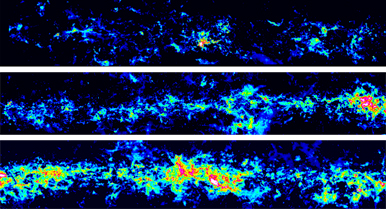
When it comes to discovering new stars, American Idol has nothing on BU astronomers. A team from Boston University’s Institute for Astrophysical Research spent eight years studying the galactic ring, a huge band of dust and gas at the center of the Milky Way containing hundreds of star-producing gas clouds. Their findings, published in the March issue of the Astrophysical Journal Supplement, could reveal secrets about the earliest stages of star birth and could help astronomers more accurately map our home galaxy.
The BU astronomers, led by James Jackson, a College of Arts and Sciences professor and chairman of the astronomy department, were joined by astronomers from UMass-Amherst and the University of Cologne in Germany to undertake the Galactic Ring Survey. The researchers believed that understanding more about the shape and movement of the galactic ring, a prominent and central feature of the galaxy, would help them understand more about the shape of the Milky Way itself, which is difficult to map, says Jackson, because the Earth orbits within the flat disk of the galaxy and doesn’t provide astronomers with a good perspective.

“Ironically, because we’re inside the Milky Way, we know less about our own galaxy than we do about others,” Jackson says. “It’s like trying to map Boston from your office.”
Jackson and his team also hoped to learn more about how stars are born by studying the massive clouds made mostly of dense, molecular hydrogen that hover within the galactic ring and are responsible for most of the galaxy’s new stars. At a certain point, these clouds form denser clumps. Squeezed by gravity, the clumps eventually collapse upon themselves, and a star is born. But exactly how this process works is still a mystery.
“It’s one of the big questions of astrophysics,” says Ronak Shah, a CAS lecturer and a research associate at the Institute for Astrophysical Research, one of the survey astronomers. “[And it can] best be studied in a place where you’re making lots of stars.
To survey the galactic ring, the astronomers used a large radio telescope operated by UMass-Amherst. The telescope sits near the Quabbin Reservoir in western Massachusetts, inside a white, geodesic dome observatory that Jackson likens to “a really big golf ball.” The BU astronomers and their undergraduate research assistants controlled the telescope remotely from Boston, telling it where to look via the Internet.
They were able to look deep into the gas clouds by focusing on a trace element within them, a rare form of carbon monoxide. This enhanced view led to an amazing discovery. The astronomers found that some clouds were opaque, even when viewed in infrared, indicating that these clouds were “really cold, really dense, and really thick,” according to Jackson. The team surmised that these “infrared dark clouds” were extremely young stars, so young that the nuclear fusion that produces a star’s heat and light (and makes it visible from Earth) had yet to begin.
“We haven’t found time zero with these clouds, [but] we think we’re really pushing the clock back on the biggest stars and that’s an exciting finding,” says Shah. “This finding has basically spawned a small industry [among astronomers] here at BU. People are now using every telescope they can get their hands on to look at these things and find out what’s going on in the middle of them.”
For now, the astronomers are busy cataloguing the hundreds of gas clouds they observed, with the results to be made available for other researchers. They’ll also continue analyzing their data to see what other secrets of the galaxy they may reveal.
“The big question is, what’s the shape of the Milky Way, and we’ll be working on that for the next year or two,” says Jackson. “I also have a grad student who’s going to work on the infrared dark clouds and another grad student studying how the internal structure of clouds can predict the size of star they create.”
Such discoveries about star birth could also offer clues to how galaxies themselves come into being. “There’s a tendency for stars to form in big groups, and that dynamic pattern seems to be what gives galaxies their shape,” explains Shah. “This fits into a bigger, macro picture of the life cycle of galaxies.”