Skip to Main Content
Boston University
  • Bostonia
  • BU Today
  • The Brink
  • University Publications

    • Bostonia
    • BU Today
    • The Brink
  • School & College Publications

    • The Record
Other Publications
BU Today
  • Sections
News, Research, Community

Vibrating insoles improve balance in stroke and diabetic patients
December 7, 2005
  • Mike Seele
Twitter Facebook
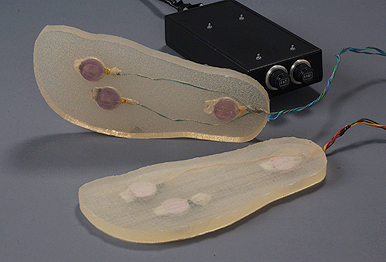
Vibrating insoles help improve balance of stroke victims and people suffering from diabetic neuropathy.

Sending imperceptible vibrations through the feet of diabetics and stroke patients significantly improves their balance, according to a study coauthored by James Collins, a College of Engineering professor of biomedical engineering. The study will be published in the January 2006 issue of the American Neurological Association’s Annals of Neurology. Its results have implications for reducing the risk of falls in such patients.

Collins, also a UNI professor and winner of the University’s 2000 Metcalf Cup and Prize for Excellence in Teaching, says the results are similar to those obtained during a prior study of healthy elderly people, but this study is the first to observe balance improvement in diabetics and stroke patients using this method.

Half of the study subjects were stroke patients and the other half people with diabetic neuropathy. In the case of stroke, patients’ ability to process information transmitted by foot neurons was impaired, while the diabetics had an abnormally high threshold for neuron stimulation. Regardless of the cause, Collins’ team found that introducing the vibrations’ “white noise” increased the subjects’ use of sensory information transmitted through their feet and improved their balance.

The researchers used viscoelastic silicone gel insoles fitted with three quarter-sized vibration pads located under the heel and forefoot. They conducted 10 tests on each subject; half using a low-frequency vibration that could not be felt by the subject, and half no vibration. Subjects were not told when the vibrations were applied. Visual markers were placed on the subjects and video cameras recorded the markers’ movement, or sway.

When the vibrating insoles were activated, the subjects’ sway was, in general, reduced. The study found that the larger the patient’s baseline sway, the greater the reduction achieved by the vibrations.

“These findings have implications for people with impaired balance control, who are at increased risk for falls that can result in debilitating injuries,” says Collins. “We have designed and constructed insoles for in-shoe use and are planning to use them in the next round of studies investigating locomotion and other activities.”

The paper, “Noise-Enhanced Balance Control in Patients with Diabetes and Patients with Stroke,” was coauthored with researchers from Harvard Medical School, Spaulding Rehabilitation Hospital, Joslin Diabetes Center, Beth Israel Deaconess Medical Center, and other health-care and research organizations. The complete article is available online at www.interscience.wiley.com through the Annals of Neurology “Early View” link.

Collins recently was named to Scientific American magazine’s list of the top 50 leaders in science and technology for 2005. In 2003, he received a MacArthur Fellowship in recognition of his groundbreaking research into biodynamics.

Explore Related Topics:

  • Faculty
  • Share this story

Share

Vibrating insoles improve balance in stroke and diabetic patients

Share

  • Twitter
  • Facebook
  • Reddit
  • LinkedIn
  • Email

Latest from BU Today

  • University News

    Suggestions for 2027 BU Honorary Degrees Welcome

  • University News

    BU Welcomes Inaugural Class of Davis United World College Scholars

  • Class of 2030

    Seven Things to Know about Freshman Alaiza Roth (CAS’30)

  • University News

    Boston University Trustees Elect Five New Members

  • Varsity Sports

    Field Hockey Looks to Defend Patriot League Title Under New Leadership

  • Things-to-do

    This Weekend @ BU: October 1 to 4

  • Arts & Culture

    Extra, Extra: New Exhibit at Stone Gallery Finds Inspiration in Fading Presence of Newspapers

  • Student Health Services

    Ask Anything—Anonymously—at Student Health Services’ Sex in the Dark Event

  • Hillel

    Adam Weingarten, BU Hillel’s Pioneering First Music Director, Wants Campus to Sing

  • Student Life

    BU Medical School Students Spent their Summer Volunteering in Malawi and Ghana

  • Things-to-do

    Getting to Know Your Neighborhood: Coolidge Corner

  • This Weekend @ BU: September 24 to 27

  • Class of 2030

    Class of 2030: Nicole Treviño Begins Her BU Journey

  • University News

    William Fairfield Warren Distinguished Professorships Awarded to Five Senior Faculty

  • University News

    Annual Safety Fest to Take Place This Week on Medical, Charles River Campuses

  • Engineering

    College of Engineering’s 2026 Catalyst Summit Focused on Decoding Everyday Health

  • Rankings

    Boston University Achieves Its Highest-Ever Ranking from U.S. News & World Report

  • Watch Now

    Video: Leaders Among Us—President Gilliam in Conversation with Yvette Cozier

  • Student Life

    Want to Take a Walk with Bean?

  • BUPD

    New BUPD Deputy Chief Brings Community-Centered Policing to the Forefront

Section navigation

  • Sections
  • Must Reads
  • Videos
  • Series
  • Close ups
  • Archives
  • About + Contact
Get Our Email

Explore Our Publications

Bostonia

Boston University’s Alumni Magazine

BU Today

News, Research, Community

The Brink

Pioneering Research from Boston University

  • Twitter
  • Facebook
  • Youtube
  • LinkedIn
  • Instagram
  • Weibo
  • TikTok
© Boston University. All rights reserved. www.bu.edu
© 2026 Trustees of Boston UniversityPrivacy StatementAccessibility
Boston University
Notice of Non-Discrimination: Boston University prohibits discrimination and harassment on the basis of race, color, natural or protective hairstyle, religion, sex or gender, age, national origin, ethnicity, shared ancestry and ethnic characteristics, physical or mental disability, sexual orientation, gender identity and/or expression, genetic information, pregnancy or pregnancy-related condition, military service, marital, parental, veteran status, or any other legally protected status in any and all educational programs or activities operated by Boston University. Retaliation is also prohibited. Please refer questions or concerns about Title IX, discrimination based on any other status protected by law or BU policy, or retaliation to Boston University’s Executive Director of Equal Opportunity/Title IX Coordinator, at titleix@bu.edu or (617) 358-1796. Read Boston University’s full Notice of Nondiscrimination.
Search
Boston University Masterplate
loading Cancel
Post was not sent - check your email addresses!
Email check failed, please try again
Sorry, your blog cannot share posts by email.
Vibrating insoles improve balance in stroke and diabetic patients
0
share this