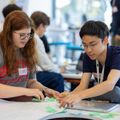
The fall 2025 First-Year Innovation Fellowship wrapped up with 20 first-year students presenting ideas ranging from AI-powered meal planning to self-healing suture pads. Representing seven countries and a variety of BU schools, this cohort tackled problems in sustainability, healthcare access, digital literacy, and beyond.
While FYIF has been around for more than five years, this was the first time a cohort was a single semester, rather than a full academic year, increasing the intensity and engagement for the participants.
Here’s a closer look at each fellow and the work they developed throughout the semester.
Ananyah Amaram
Ananyah Amaram (ENG’29) is a computer engineering major from Petersburg, Virginia, who set out to address the environmental and personal costs of fast fashion. Her research led her to a core insight: busy people who care about how they present themselves need a more efficient way to manage their wardrobes in a manner that saves time, suits the weather, aligns with their personal style, and reduces textile waste.
Ananyah’s solution is a digital wardrobe system that allows users to capture daily outfits in seconds and organize them into a searchable closet. The platform helps users rewear what they already own, making the act of getting dressed faster, easier, and more intentional while supporting sustainable habits without sacrificing convenience.
What were you most proud of during your time in FYIF? How much work I was able to get done even though my schedule was really busy. I was proud of how much I accomplished in the semester.
What’s one thing you learned about yourself this year? I learned that I can balance a lot more things than I thought I could.
What surprised you most about being part of FYIF? That I got a personal mentor who was able to help me a lot. She helped me connect with a lot of good people.
Is there a skill you developed that you didn’t expect to gain? I was not the best person at reaching out to others and being proactive about that, but I had to for interviews. So I think that’s a skill I developed.
Michelle Aponte
Michelle Aponte (CAS’29) is a biology and economics major from Ridgewood, Queens. She loves meeting and connecting with others and enjoys reading, journaling, and playing sports. Michelle is certain she wants to work in healthcare to give back to her community.
Michelle’s fellowship research found that 66% of students surveyed had a mentor figure when applying to college and experienced a smoother process as a result. For the remaining 34%, resources should be more easily accessible. Her solution is a nonprofit organization designed for middle-class students, offering mentorship through high school and continuing into college with a focus on professional development. The program would involve weekend and summer commitments, and mentorship would be volunteer-based. Michelle hopes to become an FYIF experience mentor.
What were you most proud of during your time in FYIF? The connections I made. Having Zoe and Nana as advisors was really great. They were so welcoming—you don’t have to have an idea, you don’t have to be an entrepreneur just yet. I felt supported throughout the whole process.
What’s one thing you learned about yourself this year? I learned that I care deeply about everything I do, and I’m glad to see that followed through into college. The reality of this program exceeded my expectations by so much. I would recommend it to everybody, whether you have an idea or not.
What surprised you most about being part of FYIF? How collaborative it was. Everyone who was here wanted to be here, and they showed that every week. It was really nice to be around people so different from me, but we could all come together for an hour once a week to collaborate.
Is there a particular conversation or connection that stuck with you? My first one-on-one with Nana. She told me I belong here because I was having imposter syndrome. She said she chooses people based on their character. That really resonated with me because I’m very hard on myself, but Nana told me to give myself grace.
What’s one thing you’re excited to try next because of the program? Just trying new things. I came into this space not feeling confident about why I was here. Now I’m open to doing things I thought I didn’t like and reassessing. That’s when I might find what career I really want to go into.
Virginia Beinke
Virginia Beinke (ENG’29) is a biomedical engineering major from Austin, Texas, who is involved in research at BU. She spends her free time drawing, reading sci-fi, and listening to history podcasts or movie and musical soundtracks. After graduation, she plans to pursue a PhD.
Virginia addressed a two-sided problem: people need help navigating access to medical care, and medical providers need more data on medication side effects and disease presentation across different demographics. Her solution, Medkit, aims to increase data quantity and trial patient diversity while providing a method of contact between primary care providers and patients and a symptom tracker. Virginia wants to stay in the Innovate@BU ecosystem and may be found working at the front desk next semester.
What were you most proud of during your time in FYIF? Being able to uplift and encourage my fellow fellows. I was really proud of getting to see that.
What’s one thing you learned about yourself this year? It’s easier to learn new things than you think. In your brain, you make it seem like it’s going to be really difficult, but when you start doing it, it never ends up being that bad.
What surprised you most about being part of FYIF? Definitely the community. Going into this, I knew I’d get to meet people, but honestly, these guys are awesome. It was great to hang out with them.
Is there a conversation or connection that stuck with you? Charles. We have a mutual friend, and we’re always seeing each other at Marciano Commons for some reason.
What’s one skill you developed that you didn’t expect to gain? The ability to approach things from lots of different angles—not necessarily to think of new solutions, but to critique a solution and see why it wouldn’t work or what you might be giving up by doing it one way rather than another.
Anshi Bhatt
Anshi Bhatt (CAS’29) is a political science and philosophy major on the pre-law track from Virginia Beach, Virginia. Beyond her coursework, Anshi runs Frontlines Foundations, a digital literacy nonprofit currently operating in 15 countries. Her work in the fellowship extended that interest in technology’s impact on young people.
Anshi identified that guardians of children need to be more present in regulating AI usage for minors to protect them online. Her solution, Trust Line, is an app designed to detect real-time AI risks in a way that’s interpretable for parents, preserves privacy, integrates across platforms, and provides developmentally appropriate insights. Looking ahead, Anshi plans to apply for grants through the New Venture Competition and explore partnerships to advance the idea.
What were you most proud of during your time in FYIF? My final pitch. It was a good culmination of all the things I’d been working toward this semester.
What’s one thing you learned about yourself? That I’m really passionate about helping other people. I was contemplating different ventures, and I just loved the ones that had the most impact.
What surprised you most about being part of FYIF? I didn’t expect to learn so much. I didn’t know that innovation was so multifaceted. I was really grateful to learn that.
How has your definition of innovation or entrepreneurship changed? It’s become a lot more broad. Before, I would think of it as startups and computer science people. But now I see that it’s involved in everything.
Faiza Bin Hammam
Faiza Bin Hammam (ENG’29) is a biomedical engineering major who grew up in Portland, Oregon, though she recently moved abroad to Saudi Arabia. A fun fact: she lived in three different countries this past year—the US, Saudi Arabia, and Yemen.
Faiza developed a concept for an after-school program called Anchor, designed to support teens with parents facing chronic illness. She recognized that these teens often experience emotional distress, isolation, and the pressure to take on adult responsibilities before they’re ready. Her program would provide a space for community bonding, light snacks, homework help, and creative expression through art, writing, and crafts. Sessions would also cover emotional management strategies. The goal is to create a safe environment where teenagers can form a support system with others who understand their experiences.
What were you most proud of during your time in FYIF? Being able to get over constantly changing my idea and not knowing what I was doing. There were times I wondered if I should go for an easier idea that I knew would work. But I stuck with my second idea and finished.
What’s one thing you learned about yourself? That I’m kind of a perfectionist, which was very hard in the beginning. Nothing is perfect and nothing will ever be perfect. I found myself focusing on small details when I should have moved past them to complete the whole idea.
What surprised you most about being part of FYIF? Going in, I assumed I had to have an idea and just go through with it. But FYIF showed me that ideas change a lot throughout the process. You’re constantly testing and reevaluating. I also came in thinking you had to be a business or engineering major, but FYIF taught me that none of that matters—it’s just about making an impact.
Is there anything you now feel confident doing that you used to be intimidated by? Speaking about my ideas and sharing them with others. There’s always a sense of insecurity that maybe my idea isn’t good enough or people won’t receive it well. But through FYIF, I learned to talk about my ideas to different people and validate them through interviews and talking to customers.
Davide Bonn
Davide Bonn (CAS’29) is a computer science major from Trento, Italy, with experience in robotics and artificial intelligence. He observed that even when nutritious food is available on campus, students often struggle to make choices aligned with their health goals due to limited time, lack of guidance, and overwhelming options.
Davide’s solution is Bitewise, an AI-powered meal coach that draws on real dining hall menus, personal goals, dietary restrictions, schedules, and real-time food availability to help students eat better. The platform also provides dining halls with predictive demand signals to optimize preparation and reduce waste. His next steps include building a minimum viable product and launching an official pilot with BU Dining.
What were you most proud of during your time in FYIF? Really understanding what the problem was and going from the start to an idea I could turn into something real.
What’s one thing you learned about yourself this year? That I can do so many things. I can learn a new method and put myself into something without knowing anything at the start.
What surprised you most about being part of FYIF? How much help they gave us. The coaches and staff—the meetings weren’t just lessons or lectures. They were real moments where we could understand what we could improve and learn at the same time.
Could you describe a moment when you felt like an entrepreneur or innovator? At the start, when I was talking to people and understanding the problem. That was new to me—really trying to understand the problem rather than jumping straight to the solution.
Emma Chuo
Emma Chuo (Questrom’29) is studying business administration and comes from Taipei, Taiwan. Her interests span innovation, entrepreneurship, and law, and she’s curious about how different facets of sustainability—economic, environmental, and political—intersect. Outside of Innovate@BU, Emma plays in a rock band and enjoys taking random walks around campus.
Emma’s research led her to focus on local businesses that struggle to continuously engage customers after increasing their initial visibility. Her solution, EatTicket, ties an e-receipt to customer spending at local businesses and lets users swipe on establishments to find their perfect match. When a user matches with a business, the app provides direct instructions and information for visiting. Business owners and workers can also post questions to one another, creating a network. Emma plans to continue developing her idea through the Innovation Pathway and reach out to more entrepreneurs and organizations.
What were you most proud of during your time in FYIF? Seeing how my idea changed throughout. I came in without an idea—just broad interest areas I wanted to explore but didn’t know how. Through mentor meetings, I learned to narrow a big concept down to concrete ideas. Being able to reach out to people and let my answers from interviews lead me to the next question was a process I’m really proud of. I’m also super happy about the friends I’ve made—I hope we all get Insomnia Cookies together sometime.
What’s one thing you learned about yourself this year? I’m more curious than I assumed. In high school, a lot of my research was driven by pressure to find out more things, not genuine interest. At FYIF, with the freedom to explore anything I want and robust resources to support me, I realized there are communities I’m passionate about helping—and I want to know how to do that.
What surprised you most about being part of FYIF? The connections I’ve made. I heard that previous year-long programs had more social events, so I was worried I wouldn’t make deep or long-lasting connections. But looking at everyone playing card games together, I’m confident I’ll keep these people around and we can all hang out in the future.
How has your definition of innovation or entrepreneurship changed? I used to think innovation had to be something completely new—a physical prototype, a new product. But through talking to Nana, who does a lot of work in the nonprofit service sector, I learned innovation isn’t one-dimensional. Looking at everyone’s projects and how they evolved, I realized innovation has a lot more definitions than I expected. It’s really inspiring to see.
Cyril Coumans
Cyril Coumans (CAS’29) is a neuroscience major from Lynnfield, Massachusetts, with a minor in French. His passion for research that yields tangible solutions led him to examine a problem at the intersection of medical education and materials science.
Cyril noted that basic suturing proficiency is a universal requirement across healthcare training, yet current practice kits are either realistic but expensive and short-lived, or cheap but unrealistic. His proposed solution is a tri-layer, self-healing polymer suture pad designed to mimic skin, dermis, and subcutis. The pad targets at least 200 practice cycles through self-healing elastomer layers that close needle tracks and incisions, realistic mechanics, and lower total cost of ownership. Cyril plans to 3D print a mold casing using the printers available at EPIC and is building a website to document his prototyping process.
What were you most proud of during your time in FYIF? The social aspect—socializing with people, developing new friends, and building a totally new network at the beginning of the school year.
What’s one thing you learned about yourself this year? The best way for me to get work done and be happier is to do things through action and with friends. Working with other people gets things done quicker.
What surprised you most about being part of FYIF? The social aspect. I wasn’t expecting it to be such a collaborative space. There was a huge emphasis on community, which I really liked.
Is there anything you now feel confident doing that you used to be intimidated by? Reaching out to strangers. It was a requirement to talk to completely new people, some considerably older than us. Now I’m comfortable with connecting to people I don’t know and developing initial connections.
Gianella Fano
Gianella Fano (CAS’29) is an economics major from Flanders, New Jersey, who founded an English learning club in high school. She’s bilingual in English and Spanish and holds a strong interest in making English learning opportunities more accessible.
Gianella’s fellowship work addressed the barriers first-generation students face when pursuing a four-year degree, particularly the lack of mentorship on the hidden curriculum of college. Her solution, First-Gen Now Mentorship, is a website that serves as a hub for resources and matches prospective first-gen students with mentors who can help them navigate the college process. The site features an FAQ section covering topics like finding a community, connecting with other students, managing homesickness, and understanding the application process. Gianella plans to pitch to BU departments for potential partnership with Upward Bound and explore the Innovation Pathway or Enlight Fellowship.
What were you most proud of during your time in FYIF? Building a solution for the problem I was focused on and really coming to understand how that problem evolved throughout the semester.
What’s one thing you learned about yourself? That it’s okay for ideas to shift and normal to get stuck. At first, I was unsure what to do when I got stuck on a problem. But I learned through FYIF that it’s okay—it’s part of the process, and it leads to great results.
What surprised you most about being part of FYIF? The immense support. I knew I would have support from peers, mentors, and coaches, but the extended support was really impactful. My coach was amazing, and Nana and Zoe were really helpful throughout the entire process of thinking through ideas and moving them forward.
Is there anything you now feel confident doing that you used to be intimidated by? Not having a linear path. I now understand the importance of focusing on the problem, not the solution. At first, I didn’t have that. But through the program, I learned it’s important to think of the people and focus on that community—then build a solution around that. I’m also more confident articulating ideas and presenting them to an audience.
Michelle Jiang
Michelle Jiang (CAS’29) is a biochemistry and molecular biology major from Ringgold, Georgia, a small town just outside Chattanooga, Tennessee. Her interests span the intersection of science and the humanities, and she’s dabbled in painting, watercolor, digital design, animation, pottery, origami, musical productions, and flute.
Michelle identified decision fatigue around food choices as a common problem for young people in urban areas. Her solution, Tastebuds, is an app that shows restaurant results based on selected “vibes” or randomly generates an option from a pre-existing group of saved favorites. Features are inspired by Google Maps, Instagram, Beli, and Grubhub, allowing users to search, pin locations, and follow friends. Michelle’s next steps include learning app development and applying her skills to other subjects.
What were you most proud of during your time in FYIF? Definitely the growth I had mentally. I came into it with an entirely different mindset. FYIF really challenged me to think outside the box in a business context.
What’s one thing you learned about yourself this year? I’m a lot more indecisive about ideas than I thought. I came in with a bunch and ended with a bunch of ideas I could have worked on.
What surprised you most about being part of FYIF? The people. I came in really scared because it was marketed as super serious. But I’m friends with a lot of people in my cohort now, and we’re a lot more similar than I thought we’d be.
Is there anything you’re excited to try next because of this program? I’d like to expand the business thinking and customer-oriented mindset to other aspects of my life, not just in a business context.
Is there anything you now feel confident doing that you were intimidated by before? Definitely interviewing people. I had some experience, but this solidified my confidence in it.
Manya Katiyar
Manya Katiyar (CAS’29) is an international student from India majoring in economics and data science. She’s a MUNer and TEDx speaker who loves to dance and play table tennis. After graduation, Manya hopes to explore international relations, work as an economic consultant, and help solve global issues through more thoughtful and innovative economic policies.
Manya participated in the fellowship to develop her entrepreneurial mindset and build leadership skills alongside a community of first-year students.
Caitlin Lee
Caitlin Lee (CAS’29) hails from Saratoga, California, and is still exploring her major. She enjoys coding games in her free time and hopes to become a businesswoman after graduation.
During the fellowship, Caitlin focused on the challenge young and working adults face when trying to find recipes that are healthy, enjoyable, cost-effective, and fit busy schedules. Her solution, Sauteed, is a social media-style recipe app where users can see what works for their friends, quickly filter recipes by ingredients, find options suited to their specific dietary needs, and interact with others on a single platform. Her next step is to build a functioning app prototype.
What were you most proud of during your time in FYIF? The moment I pitched. I could really see all the progress I made and everything I learned throughout the whole program—especially making a working prototype at the end, which is something I didn’t think I could do before.
What’s one thing you learned about yourself this semester? I really enjoy understanding what other people need in their lives to fix and how people perceive similar problems. That pertains to the customer interview process, which was one of my favorite parts of my journey.
What surprised you most about being part of FYIF? How much inspiration you gain from the people around you. Being around other cohort members from different majors—some tackling similar problem areas, others very different ones—and seeing how much you could relate to people forming entirely different types of solutions.
What’s something you now feel confident doing that used to intimidate you? My presentation skills and just putting myself out there in general.
Kate Lee
Kate Lee (CAS’29) is a statistics and computer science major from Daegu, South Korea. She codes games for fun and hopes to become a successful businesswoman after graduation.
Kate focused on the challenge of deepfakes and AI-generated content that college students and young adults encounter online. She observed that many people lack clear, accessible tools to verify whether digital content is real, which can lead to manipulation of opinions and public perception. Her solution, RealCheck, is a deepfake-detection platform that allows users to upload a video or link, analyzes facial cues, audio sync, and visual artifacts, provides a confidence score, and explains why the video may be suspicious. Kate’s next steps include improving prototype accuracy, conducting usability testing with more students, and exploring new ways to develop the project as a venture or research initiative.
What were you most proud of during your time in FYIF? I was able to make my prototype. I always had an idea but didn’t know how to make it or take it to market. During FYIF, I got to learn all of that.
What’s one thing you learned about yourself this year? I learned how to become more creative with ideas. Talking with my peers, I learned things I’d never worked on before, like entrepreneurship and ventures. I always had an app idea but didn’t know how to bring it to market.
What surprised you most about being part of FYIF? That I could make my ideas real. I’ve always had a bunch of ideas, but I wasn’t sure how to turn them into a product. After making my prototype, that’s what made the experience so amazing.
Could you describe a moment when you felt like an entrepreneur or innovator? Thanks to my mentors, I learned how to take my app to market. That was really valuable because I didn’t know much about business before.
Maliha Qandil
Maliha Qandil (CAS’29) is a double major in philosophy and political science from North Attleboro, Massachusetts. A black belt who practiced martial arts for seven years, Maliha hopes to take a gap year after graduation to volunteer with UNICEF before attending law school to focus on humanitarian aid and refugee protection.
During the fellowship, Maliha addressed the need for unbiased information when college students and intellectuals make decisions about voter preference or academic assignments. She developed a conceptual prototype for a platform that aggregates non-biased news sources, helping users find trustworthy evidence and navigate the challenge of determining what information to believe.
Justin Rotaru
Justin Rotaru (Questrom’29) is studying finance and data science and hails from Northborough, Massachusetts. He loves the beach, hiking, traveling, and playing chess, and dreams of one day living in Hawaii while running a fintech or AI startup.
Justin developed ReWeek, an AI-powered automated journaling app that integrates with existing tools like Notes, Messages, Location, Google Calendar, and Spotify. The app compiles user activity and generates a clean, insightful weekly report of everything that happened, helping busy professionals synthesize their fragmented digital data into meaningful reflections without the mental overhead of manual journaling. Justin is applying to Innovate@BU’s Summer Accelerator to move from prototype to user testing and real-world validation.
What were you most proud of during your time in FYIF? Really conceptualizing my idea into an actual prototype. I always had ideas in the past, but putting myself to create a prototype and put my ideas into physical form showed me I could turn something from my head into something real.
What’s one thing you learned about yourself this year? When it comes to starting an idea or a business, there are many iterations before you come to a final product. Even now, I haven’t reached the full idea I wanted. It’s important to think about failures and use them as stepping stones to move forward.
What surprised you most about being part of FYIF? The people. It was unique to find multiple people who thought similarly about entrepreneurship—going beyond just working a job and thinking about ideas at a bigger scope, seeing how you can make an impact on both a local and global scale.
How has your definition of innovation or entrepreneurship changed? It doesn’t always have to be a startup business. It could be bringing in communities, having a nonprofit. It’s multiple sectors—not just what most people think of, like an AI startup. There are really different groups you can affect in areas like health and beyond.
Grace Ryan
Grace Ryan (CAS’29) is an environmental analysis and policy major from Los Angeles who describes herself as an avid environmentalist and activist. In her free time, she travels, scuba dives, thrifts, and plays beach volleyball.
Grace tackled the problem of single-use coffee cups from two angles: coffee drinkers need a sustainable and convenient system for reusable to-go cups, and coffee shops need an inexpensive, operationally feasible alternative to disposable cups. Her solution, CupCycle, makes reusable to-go options accessible to customers and operationally practical for coffee shops. The system also reduces costs for shops by decreasing or eliminating the need to purchase disposable cups. Grace plans to continue testing and adapting her solution through the Innovation Pathway and Enlight Fellowship.
What were you most proud of during your time in FYIF? How I was able to take an idea and problem I was already concerned about, expand on it in a new marketplace, and create a more tangible, hopefully successful solution.
What’s one thing you learned about yourself this year? I’m a lot more courageous than I give myself credit for. If I give myself the opportunity, I rise to the occasion. That was something I was able to watch myself do.
What surprised you most about being part of FYIF? The breadth of majors in this program. I’m not a business or econ major, and it was really cool to see the variety of interests—a little bit of everyone.
What skill did you develop that you didn’t expect to gain? Viewing myself as a functioning person in the world—as an adult who can make an impact. I’m not a high schooler who has to work within other programs. If I want to create something, I can.
Is there anything you’re excited to try next because of this program? Hopefully keep developing my project and join the Innovation Pathway.
Miazaly Sipaque
Miazaly Sipaque (CAS’29) is a computer science major from Somerset, New Jersey, with Guatemalan and Puerto Rican heritage. In high school, she led the Hackathon Committee, served as secretary of her NHS chapter, and was state Consul of the New Jersey Junior Classical League, earning multiple state and national awards. She’s also a nationally ranked Splatoon 3 player.
Miazaly addressed the anxiety many high school students feel about the college application process due to a lack of resources and information. Her solution, Base, is a free, centralized hub for college data that provides students with the convenience of finding desired information without extensive searching. While available to all students, Base is designed especially for those who may not have access to college preparation programs or who need support beyond school counselors. Miazaly plans to continue developing her idea through the Innovation Pathway and enroll in BU Spark! courses.
What were you most proud of during your time in FYIF? How much I got to develop my idea and work through the whole innovation process. I learned a lot through FYIF and appreciate all my time here.
What’s one thing you learned about yourself this year? That I really can accomplish whatever I put my mind to.
What surprised you most about being part of FYIF? How diverse the cohort was. I got to meet people from so many different colleges, majors, and demographics. Everyone’s from a different place. It was a good representation of how diverse BU is.
Was there a particular connection that stood out to you this semester? My connection with my coach. It was really useful in developing my idea.
How do you plan to use what you learned here in the future? I want to do a dual degree in computer science and business, so having this experience developing a business model will really assist me—whether it’s developing my own apps or websites or continuing along that path.
Yurou (Ellie) Wang
Ellie Wang (CAS’29) is an undeclared major from Tianjin, China, with strong interests in philosophy and sociology. Outside of academics, she trades cryptocurrency and studies strategies to increase resilience and adaptability in life.
Ellie focused on the high rates of sedentary behavior among students on campus and its impact on wellbeing. Her solution, MoveMinute @ BU, is a program that helps students quickly restore physical comfort and cognitive focus during long study sessions without needing extra time, equipment, or space. The conceptual prototype includes a user experience design, visual identity, digital platform structure, and motivational features that together create an accessible and engaging micro-movement experience for BU students.
What were you most proud of during your time in FYIF? Attending all the sessions and making lots of friends here.
What’s one thing you learned about yourself this year? I never stop trying new ideas. If your original idea doesn’t work, it doesn’t matter—just start over. It’s never too late to start again.
What surprised you most about being part of FYIF? How professional we are. I was so glad to meet so many talented people. I’m impressed by everyone’s research and delivery skills—that’s something I want to learn from them.
Is there a conversation or connection that stood out to you? My conversations with Nana. She really encouraged me a lot, both in academic and social aspects. I really appreciate it.
How has your definition of innovation or entrepreneurship changed? Before FYIF, my ideas about innovation and entrepreneurship were quite shallow—just vague ideas about changing the world. Now I know how to actually do it: conduct interviews, find a problem, build a prototype, and solve the problem. My understanding of the whole process has become more solid.
Charles Yang
Charles Yang (CAS’29) is a data science major from the Philadelphia suburbs who brings a background in programming video games, Model UN, and competition math—his party trick is squaring three-digit numbers in his head. An avid chess player and aspiring environmental activist, Charles tackled the problem of underutilized urban space.
He observed that urban college students in need of affordable, convenient spaces with a positive ambience often find themselves surrounded by dead spaces such as unused parking lots. His proposed solution involves transforming these neglected areas into mini parks that provide a reprieve from college life and improve mental wellbeing. Charles developed conceptual blueprints and renderings to illustrate how parking infrastructure could be reimagined as green community space.
What were you most proud of during your time in FYIF? The work I did for the immersion. I had to go around all the spots on campus, spending about ten minutes in each area noticing how people interacted at different times of day. I revisited areas to make sure I wasn’t biased by the times I picked. It took a lot of time, but it was worth it when I got to synthesize all the information I gathered.
What’s one thing you learned about yourself this year? Being able to bounce ideas off people and synthesize ideas in a friendly environment filled with like-minded people was a great opportunity. I came in knowing the idea I wanted to pitch and mostly stuck with it, so I didn’t discover anything profoundly new. But I got to discover more about the intricacies of the topic and how I related to it.
What surprised you most about being part of FYIF? I’m not big in the innovation sphere—there are technocratic things I don’t agree with, like generative AI. That was a hang-up for me. But I discovered that even though some things may be more harmful than good, you can use innovation as a tool to create things that are actually good. It gave me a way to see there’s more to what innovation in today’s society is.
What’s one thing you’re excited to try next year because of this program? My presentation was about engaging with urbanism and building better cities. I’d done research but never direct action. FYIF let me dip my toes into crafting actual solutions. Going into next year, I’m excited to use that knowledge—maybe not in my own company, but within another institution—to do something actionable for urbanism.
Samuel Yeboah-Asi
Sam Yeboah-Asi (ENG’29) is a computer engineering major who has called New York home for the past seven years, though he’s originally from Ghana. He enjoys designing interfaces, building programming tools, watching soccer (Forza Milan!), gaming, and viewing thought-provoking video essays.
Samuel set out to design a workspace that adapts to how users think. Instead of typing into a chatbox or sorting endless notes, users work visually with an AI that understands their context, ideas, and process. His solution, Memento, is a context engine that eliminates time wasted searching and restarting by maintaining continuity across a user’s work. Samuel’s next steps include developing deeper integrations and conducting closed pilots with target users.
What were you most proud of during your time in FYIF? Following the process of designing and prototyping. I’m a very technical person—I like to jump to just making stuff. So being able to stick to the plan was something I’m proud of.
What’s one thing you learned about yourself this year? That it’s okay to fail and to fail fast. I also learned to ground myself in the product and explain things in a way that end consumers understand.
What surprised you most about being part of FYIF? How interdisciplinary it is. There are people from science and all different fields. It’s really interesting and uplifting to see that you can apply entrepreneurial ideas to all branches of society.
How will you use what you learned here in the future? Definitely with design thinking—maybe in internships or software engineering. Being able to make plans for sure.