Can Artificial Intelligence Help Emergency Responders Save Children?

BU researchers simulated a childhood medical emergency, and how technology might improve care, with New Haven, Conn., first responders (from left) Stephanie Jones, Jacob Strickland, and Aaron West, and Yale pediatrics professor Mark Cicero. Photo courtesy of Tehnaz Boyle/Yale University/American Medical Response
Can Artificial Intelligence Help Emergency Responders Save Children?
Boston University computer scientist and pediatrician researching potential of AI-powered assistance for ambulance crews
It’s a tense scene.
The aunt had called for help after her baby nephew suffered an apparent seizure. She told the emergency responders that, after waking from a shockingly long, eight-hour nap, he had started shaking.
The boy now lies on a gurney in the ambulance, his aunt watching by the open door. As a responder fits a breathing tube into the baby’s nostrils, its arms begin shaking.
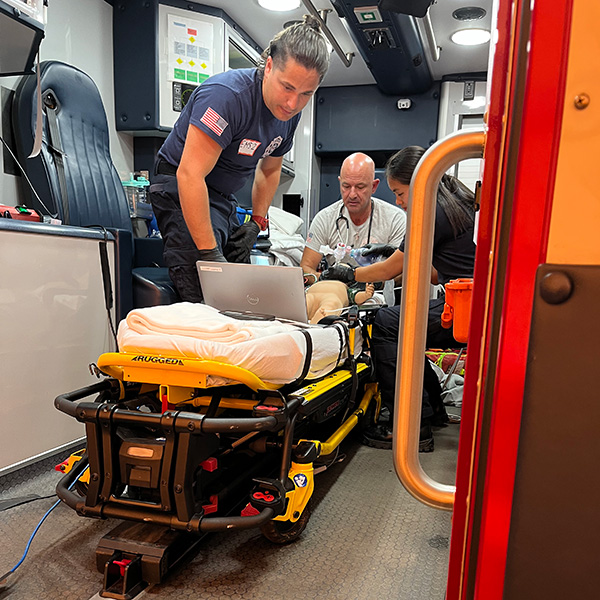
Via iPad, paramedic Khanzada-Marie Kurbanova video calls a doctor at Boston Medical Center, Boston University’s primary teaching hospital. “We’re going to initiate IV and dextrose,” Kurbanova says. The doctor suggests dextrose, a sugar solution, “should be the priority, because that’s going to fix the problem, more likely.” Paramedic Rachel Miller raises an extendable pole on the gurney and attaches an IV bag.
“OK, this case has ended,” announces the “aunt”—who’s not really an aunt, but Tehnaz Boyle, a BU Chobanian & Avedisian School of Medicine associate professor of pediatrics and emergency medicine. The team halts work on the “baby”: a mannequin tethered by black-and-white cables to a computer monitor and SimPad, a touchscreen device controlling the mannequin’s simulated vitals and those shakes.
Boyle has been video recording the responders in the garage of Pro EMS, a Cambridge, Mass., ambulance service. She is gathering data on how, and how quickly, they address timed, simulated, pediatric emergencies involving sudden heart or lung failure. For the next two years, Boyle will run more than 500 similar observations at EMS agencies across Massachusetts and in eight other states.
Short term, the goal is to see if video calls to a physician help responders treat emergencies in the field. The longer-term quest, in collaboration with BU computer scientist Deepti Ghadiyaram, is to use artificial intelligence (AI) to enhance emergency care outside hospitals and save more lives.
Boyle, who is also a pediatric emergency physician at BMC, and Ghadiyaram, a BU College of Arts & Sciences assistant professor of computer science, will use video recordings like these to train AI models for responders to take with them on calls—perhaps on a phone or laptop—for use in assessing and treating very sick or injured children more rapidly than humans can do on their own.
With the mannequin simulations, “We collect a range of outcomes related to safety and quality of care,” Boyle says, including “time [required] to critical interventions, procedural skill, and appropriateness of medication choice and dosing.” She debriefs responders on how the computer technology they tested in their simulations affected their teamwork, communication, and efficiency, while collecting any feedback they offer about ways that the tech might be improved.
“We don’t know if there’ll be benefits” from equipping responders with technology, be it videoconferencing with physicians or AI, Boyle says. “That’s what we’re trying to see.” If the research shows promise for either approach in pediatric cases, she adds, the tech could be used in responding to adult emergencies as well. (The necessary treatments and instruments used in an emergency differ for child and adult patients, Ghadiyaram notes.) It could also be used on personal smartphones for when people call 911 for help if their child stops breathing or their heart stops suddenly.
Ghadiyaram imagines a promising hypothetical use of the potential AI tool in pediatric cases: “Consider the scenario where EMS clinicians are trying to give heart compressions [to a child] during CPR.” The hoped-for AI tool would follow, via audio and video, the responders’ efforts and provide guidance on any potential changes in approach. It could tell them, for instance, to compress faster and harder, or fewer and lighter, or remind them to breathe for the child.
Partnering with technology could be especially helpful for responders working alone who are attending to children in medical emergencies.

“Encounters with sick children are uncommon and highly stressful,” Boyle says. “Most EMS clinicians may only encounter one or at most a few in their career. This makes it very difficult to remember all the aspects of care that are unique to children when it matters most. Ultimately, our goal is to expand the EMS tool kit with a digital intervention that gives access to pediatric experts for clinical support in real time.”
Encounters with sick children are uncommon and highly stressful. Most EMS clinicians may only encounter one or at most a few in their career.
One hope, she says, is that this research will help “compel EMS systems, funders, and government agencies to invest in digitally integrated, prehospital systems that improve patient care and outcomes.”
Using a mannequin achieves several ends. It eliminates the problem of paucity of real-life pediatric calls, which would crimp the amount of data. The lack of video footage of children who need emergency care outside hospitals is a major limit on developing AI applications for this purpose. The research also sidesteps privacy concerns surrounding real patients, Ghadiyaram says; mannequins don’t have privacy rights.
If the research yields an AI device, “The hope is Boston Medical Center—because we are working with the in-house physicians and pediatric emergency care folks [there]—will at least try this out,” says Ghadiyaram.
The researchers have five-year funding of $3.7 million from the National Institutes of Health. “One of the strengths of this study,” Boyle says, “is that we will have a better understanding of how care is delivered to critically ill children in different parts of the US in a very granular way, which has never been captured before.”