News
Biden’s Top-Four Priorities, Explained by Leading BU Experts
The president-elect lists COVID-19, racism, climate change, and the economy as his most pressing issues
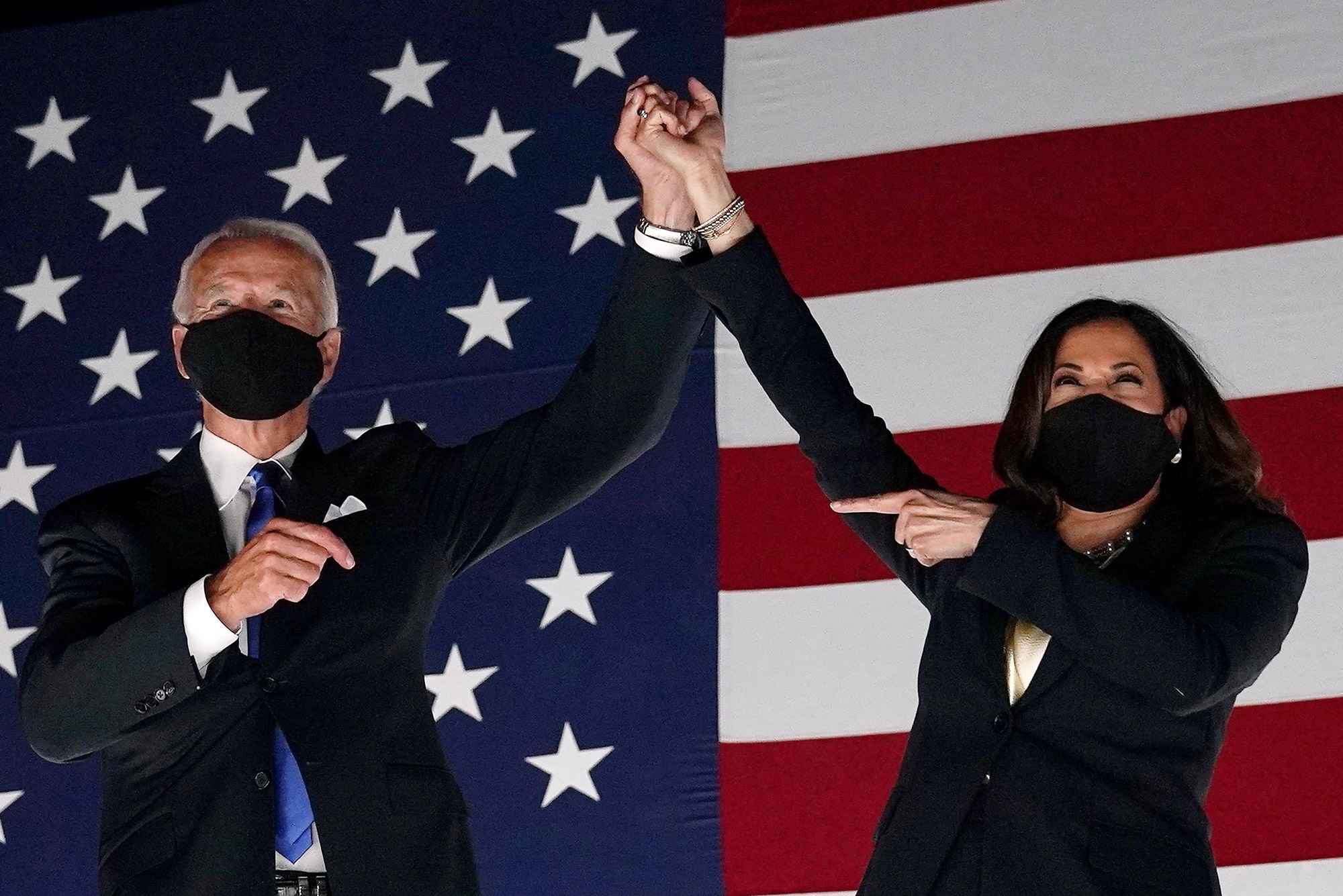
Joe Biden and Kamala Harris, celebrating after being nominated at last summer’s Democratic National Convention, have begun tackling the pandemic, racism, climate change, and economic recovery. Photo by Olivier Douliery/AFP via Getty Images.
Shortly after their November election victory, Joe Biden and Kamala Harris signaled that there were four urgent, out-of-the-gate priorities their administration would address. Their pledges on each are expansive and ambitious. But achievable? Here is what they have said about each:
COVID-19: Free testing for Americans, ramped-up personal protective equipment (PPE) production while ensuring future American manufacturing of PPE, and “equitable” vaccination.
The economy: Aid to states, localities, and businesses; investing in education and healthcare; and making good on an infrastructure upgrade.
Racial equity: Ensuring access for people of color to jobs, homeownership, higher education, retirement savings, and other necessities.
Climate change: Spending on clean energy, building retrofits, and green infrastructure, while helping communities that bear the brunt of pollution.
An ambitious menu, certainly. But are Biden and Harris targeting the best step in addressing each problem? As their administration prepares to take office on January 20, BU Today asked University experts on each priority to evaluate the Biden-Harris approach and offer their thoughts on the issue.
Read the full story on BU Today.
Democrats to Control U.S. Senate
BU IN DC
Steve Ramirez of the College of Arts & Sciences was featured on the NIH Director's Blog on January 5th. The post highlighted the Ramirez lab's image of the physical manifestation of a memory.
DEMOCRATS TO CONTROL U.S. SENATE
BIDEN ANNOUNCES MORE KEY PERSONNEL
President-elect Joseph Biden announced his intention to nominate the following individuals when he assumes office:
- Boston Mayor Marty Walsh as secretary of the U.S. Department of Labor.Walsh, a long-time ally of the labor community, would oversee federal wage and collective bargaining regulations. His appointment will also set off a competitive race to replace him as mayor.
- Judge Merrick Garland as U.S. attorney general. Judge Garland would lead the U.S. Department of Justice, an agency which has taken an active role in affirmative action and free speech matters on college campuses.
- Ambassador Samantha Power as administrator of the U.S. Agency for International Development, which supports global humanitarian aid and research. Power, a member of the Harvard University faculty, previously served as ambassador to the United Nations during the Obama Administration.
BUZZ BITS...
- The Energy Act of 2020, the first comprehensive update to energy policy and Department of Energy (DOE) applied energy research and development programs in 13 years, was signed into law at the end of December. The bill authorizes up to $35 billion in clean-energy investments, expands DOE research and development programs across a range of technologies, and renews the Advanced Research Projects Agency - Energy (ARPA-E).
- The National Institutes of Health (NIH) announced last week it will establish an Office of Nutrition Research within the NIH Office of the Director, upgrading the office in recognition of the impact nutrition has on health and disease. The Office was previously situated in the National Institute of Diabetes and Digestive and Kidney Diseases.
- Last week, Dr. Carrie Castille began a six-year term as director of the National Institute of Food and Agriculture, the research arm of the U.S. Department of Agriculture (USDA). Dr. Castille has served in a variety of USDA roles since 2003.
Angela Onwuachi-Willig among Five Black Women Law Deans Honored for Efforts to Bring Antiracist Reform to Legal Education
Together, they launched a project to engage law schools in fight for racial justice
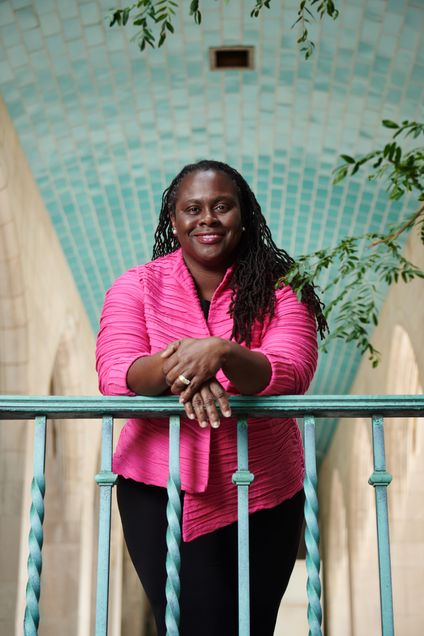 Angela Onwuachi-Willig, BU School of Law dean and professor of law, one of the country’s leading scholars of race and the law, is one of five Black women law deans to receive the Association of American Law Schools’ inaugural Impact Award. Photo (left) by Doug Levy.
Angela Onwuachi-Willig is one of the country’s leading scholars of race and the law, but in a letter addressing her students after the killing of George Floyd, she confessed that she had struggled over what she would say to them. As a Black woman and law school dean—the first dean of color at Boston University’s School of Law and first Black woman to lead a top 20 law school—Onwuachi-Willig wrote that she wondered if she could say anything publicly, “imagining the backlash when certain words come out of my Black mouth.”
“Perhaps surprising to some of you, racism regularly disempowers the seemingly powerful dean,” wrote Onwuachi-Willig, who was appointed as dean, and professor of law, in 2018.
Her letter, in which she spoke of her anguish over the never-ending cycle of state violence against Black people, and of her fears for her two Black sons and one Black daughter whenever they step outside, was only the beginning. She and four other Black women law deans—Danielle M. Conway, Penn State Dickinson Law; Carla D. Pratt, Washburn University School of Law; Danielle Holley-Walker, Howard University School of Law; and Kimberly Mutcherson, Rutgers Law School—had all encouraged each other to come forward. But now they wanted to move beyond public statements, to engage law schools in the fight for racial justice through teaching, scholarship, admissions, faculty hiring, and activism.
Read the full story on BU Today
COVID-19 Relief Package Heads to President
On Monday, Congress quickly introduced and passed the Coronavirus Response and Relief Supplemental Appropriations Act, a long-delayed stimulus package to spur economic recovery from the COVID-19 pandemic. The bill includes $22.7 billion for the Higher Education Emergency Relief Fund, which universities can use to defray expenses associated with COVID-19 and for emergency financial aid for students. The relief bill also provides $1.25 billion to the National Institutes of Health for COVID research and clinical trials, and the Rapid Acceleration of Diagnostics (RAD-X) program. The funding provided is significantly less than the $120 billion in institutional and student aid relief and $26 billion in research relief that the higher education community had sought.
RESEARCH, STUDENT AID BUDGETS SLATED FOR INCREASES
Congress sent the President a massive spending bill on Monday night that will fund every agency in the federal government for fiscal year 2021. The Consolidated Appropriations Act of 2021 will provide modest increases to several research agencies and student aid accounts next year, including:
- National Institutes of Health: $42.9 billion, a 3.0% increase
- National Science Foundation: $8.5 billion, a 2.5% increase
- Department of Defense Basic Research: $2.7 billion, a 2.6% increase
- Department of Energy Office of Science: $7.03 billion, a 0.4% increase
- NASA Science: $7.3 billion, a 2.3% increase
- National Endowments for the Humanities and the Arts: $168 million each, a 3.2% increase
- Institute of Education Sciences: $643 million, a 3.1% increase
- Pell Grants: $6,495 maximum award amount, a 2.4% increase
- Federal Work Study: $1.19 billion, a 0.8% increase
The package also includes legislation to simplify the federal financial aid application, change the formula by which aid is awarded, and restore Pell grant eligibility for incarcerated individuals and people who have previously been convicted of a drug offense. The bill also requires the U.S. Department of Homeland Security to continue its guidance allowing international students to remain in the U.S. during the pandemic even if their institution is solely offering classes online.
BIDEN ANNOUNCES MORE KEY PERSONNEL
President-elect Joseph Biden announced his intention to nominate the following individuals when he assumes office next year:
- Miguel Cardona as secretary of the U.S. Department of Education. Cardona is currently the chief education officer for the state of Connecticut, and was endorsed by the Congressional Hispanic Caucus.
- Jennifer Granholm as secretary of the U.S. Department of Energy. Granholm is a former governor of Michigan whose experience with that state's automobile industry could help accelerate the deployment of electric vehicles.
- Gina McCarthy as national climate advisor, overseeing domestic climate change policy. McCarthy was the former administrator of the Environmental Protection Agency in the Obama Administration. She is a Massachusetts native, and has served as environmental adviser to several of the Commonwealth's governors.
- Michael Regan as administrator of the Environmental Protection Agency. Regan is currently the secretary of the North Carolina Department of Environmental Quality, where he has elevated issues of environmental justice, a priority for the incoming Administration.
Congress Clear Defense Policy Bill
BU IN DC
School of Public Health Dean Sandro Galea addressed the National Institutes of Health Director's Wednesday Afternoon Lunch Series on "The Contagion Next Time: Underlying Socioeconomic and Racial Divides and Our Risk from COVID and Future Pandemics" on December 16th.
CONGRESS CLEARS DEFENSE POLICY BILL
BUZZ BITS...
- The National Science Foundation (NSF) is soliciting input for the NSF's five-year strategic plan. The request asks stakeholders to help shape what the agency's research priorities should be through 2026. Comments are due by January 22, 2021.
- Earlier this month, the U.S. Department of Education announced changes to its College Scorecard that will allow prospective students to compare how much students at a given university earn after graduation, as well as student loan indebtedness for both students and parents.
- A U.S. Department of Homeland Security spokesperson indicated last week that the guidance for international students whose course of study was interrupted by the pandemic would remain unchanged for spring 2021. Universities had asked for clarification that the guidance would remain, as well as additional flexibility to permit newly enrolled students to use distance learning.
WHAT COULD BIDEN MEAN FOR ARTS & HUMANITIES?
As President-elect Joseph Biden and Vice President-elect Kamala Harris prepare to take office in January, Beltway BUzz will occasionally highlight what the higher education community can expect from the new administration.
The Biden-Harris Transition Team for the Arts and Humanities is populated by leaders from museum administration, public television, arts advocacy, and municipal cultural agencies. The incoming administration is expected to reconstitute the President's Committee on the Arts and Humanities, a White House advisory board that lapsed under the Trump Administration. As part of its economic recovery agenda, the Biden Administration is likely to focus on the role the National Endowments for the Arts (NEA) and the Humanities (NEH) can play in spurring economic growth. Beyond the NEA and NEH, a Biden State Department may also utilize American art and artists as a tool of cultural diplomacy.
A Note To Our Readers: Beltway BUzz will bring you the latest developments once Congress passes a fiscal year 2021 appropriations package and COVID-19 relief bill. If a deal is not reached by next week, we will return in the new year. Have a safe and happy holiday!
Meet BU’s COVID-19 Contact Tracing Team
 ON THE CHARLES RIVER
Meet BU’s COVID-19 Contact Tracing Team
Old-fashioned detective work and a custom contact tracing database are quashing the spread of COVID-19. Trace their work
 RESEARCH HIGHLIGHT
Are We Paying for Robots to Take Our Jobs?
BU economist Pascual Restrepo explains how the tax code rewards businesses for automating. What's the solution?
 FACULTY EXPERT
A History of Racial Discrimination and the Fight for Change
BU historian Paula Austin is amplifying the voices of Black teenagers from Jim Crow-era Washington, D.C., and highlighting the parallels to today's Black Lives Matter movement. Read their stories
IN CASE YOU MISSED IT...
The BU Initiative on Cities released its annual Menino Survey of Mayors, with insights on how mayors are addressing COVID-19 recovery, policing and protests, and parks and green spaces... Ed Damiano of the BU College of Engineering explains how National Institutes of Health funding and the Bayh-Dole Act made his innovative bionic pancreas a reality... BU's CARB-X received the Global Health Technologies Coalition's 2020 Partnership award on December 8th... Kristen Goodell of the BU School of Medicine explains how a dramatic increase in medical school applications is due to the "Fauci Effect"... finally, BU Federal Relations wishes you Happy Holidays! Thank you for reading, we will have more stories for you in 2021.
Biden Announces More Personnel
BU IN DC
Kevin Outterson of the School of Law accepted the Global Health Technologies Coalition's 2020 Partnership Award on behalf of CARB-X on December 8th. The coalition also honored Sens. Patty Murray (D- WA) and John Boozman (R-AR).
School of Public Health Dean Sandro Galea addressed a telephone townhall regarding COVID-19 hosted by Rep. Ayanna Pressley (D-MA) on December 9th.
BIDEN ANNOUNCES MORE PERSONNEL
- Xavier Becerra as secretary of the U.S. Department of Health and Human Services. Mr. Becerra is currently California's Attorney General and previously represented East Los Angeles for more than two decades in Congress. If confirmed by the U.S. Senate, he would be the first Latino to lead the Department.
- Dr. Rochelle Walensky as director of the Centers for Disease Control and Prevention. Dr. Walensky is currently chief of the division of infectious diseases at Massachusetts General Hospital.
- General Lloyd Austin as secretary of the Department of Defense (DOD). General Austin will need a waiver from Congress allowing a recent member of the military to lead the agency, rather than a civilian. If confirmed, General Austin will be the first Black DOD chief.
- Ambassador Susan Rice as director of the White House Domestic Policy Council (DPC). The DPC formulates the President's domestic priorities, including higher education policy. Ms. Rice previously held foreign policy roles in the Obama Administration.
BUZZ BITS...
- On Wednesday, U.S. Secretary of State Mike Pompeo criticized American universities for making bad decisions about academic freedom and national security because they are "hooked on Chinese Communist Party cash." In a speech at the Georgia Institute of Technology, Pompeo named several American universities he believes have neither protected American research nor Chinese students studying in the U.S.
- On Tuesday, the U.S. Department of Education (ED) announced the creation of a free speech hotline for the public to report incidents of speech infringement on college campuses. Last month, the Department implemented regulations that could cut federal funding to colleges who violate the First Amendment or their own free speech policies.
- ED also announced that it will extend student loan forbearance due to the coronavirus pandemic through the end of January. Federal student loan payments were suspended in March due to the public health emergency, and borrowers would have needed to resume payments in January absent executive or Congressional action.
WHAT COULD BIDEN MEAN FOR HIGHER ED?
As President-elect Joseph Biden and Vice President-elect Kamala Harris prepare to take office in January, Beltway BUzz will occasionally highlight what the higher education community can expect from the new administration.
The incoming administration is expected to focus its higher education resources on community colleges and minority-serving institutions as a means of addressing the Biden-Harris transition team's economic recovery and racial equity priorities. After campaigning on the issue of debt-free college, Biden is already facing pressure to quickly address student loan debt. The President-elect is also expected to reinstate and expand upon the Obama Administration's rules requiring colleges to demonstrate that their graduates are well-equipped to enter the workforce. As one of the architects of President Obama's approach to addressing sexual misconduct on college campuses, Biden will work to reverse the Trump Administration's significant narrowing of the definition of misconduct under Title IX.
Biden Announces More Personnel
BU IN DC
Associate Provost for Computing & Data Sciences Azer Bestavros participated in a meeting of the National Science Foundation's Computer & Information Science & Engineering Advisory Committee, of which he is a member, on December 2nd and 3rd.
BIDEN ANNOUNCES MORE PERSONNEL
- Neera Tanden as director of the White House Office of Management and Budget (OMB). OMB oversees the President's Budget and all federal regulations. Ms. Tanden leads the liberal Center for American Progress think tank, and Senate Republicans have signaled their opposition to her nomination.
- Former Secretary of State John Kerry as special presidential envoy for climate within the National Security Council. Climate change is one of Biden's four top policy priorities.
- Alejandro Mayorkas as Secretary of the U.S. Department of Homeland Security (DHS). Mayorkas was the architect of the Obama-era program that provided undocumented students with legal status; he is expected to ensure that DHS supports international students.
BUZZ BITS...
- The National Science Foundation (NSF) announced Wednesday that Kendra Sharp will be the next head of the NSF Office of International Science and Engineering. Dr. Sharp is currently a professor of mechanical engineering and senior advisor for global affairs at Oregon State University.
- On Thursday, Representative Rosa DeLauro (D-CT) was chosen as the next chair of the powerful House Appropriations Committee. DeLauro, a cancer survivor, is expected to champion funding for biomedical research, student aid, and New England regional priorities from her perch atop the spending committee.
- President Donald J. Trump announced his intent to appoint two more members to the National Science Board, which oversees the National Science Foundation. Aerospace engineer Scott Stanley and UCLA professor Michael Malkan will fill the last two vacancies on the 24 member council.
GRANTS NEWS YOU CAN USE
The National Science Foundation (NSF) recently issued a Dear Colleague letter drawing attention to its Career Life Balance supplements “to help [NSF-funded] researchers, who are confronted with a short-term increase in dependent care responsibilities, ensure that the research activities supported by an NSF award can continue.” The supplements are part of an ongoing NSF initiative to support and retain graduate students, postdoctoral associates, and researchers at all levels, particularly in the STEM fields.
“This Is the Calling of My Life”
 ADVOCACY RESOURCE
"This Is the Calling of My Life"
In a year of police violence against Black people, a global pandemic, and a growing movement for racial justice, Ibram X. Kendi and BU’s Center for Antiracist Research will help lead the way forward. Learn how
 FACULTY EXPERTS
"We Are in New Territory"
What does the news about COVID-19 vaccines mean? Researchers at BU's National Emerging Infectious Diseases Laboratories weigh in on the announcements and what we know -- and what we don't. See what it means
 RESEARCH HIGHLIGHT
The Cost of Conservation
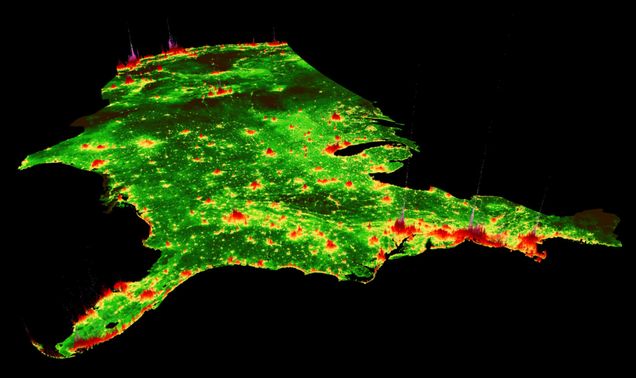
BU environmental scientist Christoph Nolte warns that we are underestimating the cost of protecting natural resources and the biodiversity within our ecosystems. Check out his map
IN CASE YOU MISSED IT...
BU sociologist Heba Gowayed makes the case for abolishing the citizenship exam in Slate... Benjamin Linas of the BU School of Medicine outlines a strategy for safely reopening schools during the pandemic in Vox... Min Ye of the BU Pardee School of Global Studies urges policymakers to reconsider the narrative of "debt entrapment diplomacy" for China in Politico... BU historian and gastronomist Megan Elias predicts the future of the "sad desk lunch" in Quartz... BU sociologist Japonica Brown-Saracino discusses the impact of the pandemic on lesbian bars with CNN.
What Could Biden Mean for Research?
BU IN DC
Kevin Gallagher of the Global Development Policy Center hosted a webinar on China and the international monetary system with Dr. Zhongxia Jin, the executive director for the People’s Republic of China at the International Monetary Fund, on November 12th.
WHAT COULD BIDEN MEAN FOR RESEARCH?
As President-elect Joseph Biden and Vice President-elect Kamala Harris prepare to take office in January, Beltway BUzz will occasionally highlight what the higher education community can expect from the new administration.
The Biden-Harris campaign has made science a cornerstone of its agenda, with the candidates saying they will listen to scientists and take quick action on the coronavirus pandemic, racial justice, and climate change. The Biden Administration is expected to launch new research initiatives on cancer, infectious diseases, and climate science, while maintaining existing federal initiatives on artificial intelligence, biotechnology, and advanced materials. In addition, science agencies are expected to focus on expanding participation in science by underrepresented minorities and women and promoting safe and inclusive research environments. The new administration is also likely to reverse the Trump Administration's limitations on fetal tissue research.
BUZZ BITS...
- On Wednesday, Congresswoman Katherine Clark (D-MA) was elected assistant speaker of the House Democratic Caucus, the fourth highest Democratic leadership position in the chamber. Clark, whose district includes Framingham and Medford, previously served as vice chair of the Caucus. Her ascension in leadership gives the Commonwealth a prominent voice in Washington, D.C.
- The Biden-Harris Transition announced on Tuesday that Annie Tomasini (CAS '02) will serve as director of Oval Office operations when the President-elect assumes office in January 2021. She has previously served in a variety of roles for Biden during his time on the campaign, as Vice President, and in the U.S. Senate.
- The National Institutes of Health (NIH) recently issued its final policy for data management and sharing by NIH grantees, aimed at promoting and standardizing the sharing of data generated from federally-funded biomedical research. Starting in 2023, applicants for NIH extramural funding will have to submit a data plan when submitting a proposal.
EVENTS NEWS YOU CAN USE
Join the Office of Research on December 2nd at 4 pm for a virtual Research on Tap about "Wearables and Biosensors for Environmental and Human Health." Hosted by Professor Catherine Klapperich of the College of Engineering, the session will feature microtalks by BU researchers from an array of disciplines who are exploring how biosensing technologies and data analytics can drive new hypotheses and solutions for better health. Following the talks, members of the BU community can connect with peer researchers working in the field.
A Note to Our Readers: Beltway BUzz will not publish next week due to the Thanksgiving holiday. We wish you a healthy and safe holiday and will resume publication in December.