Skip to Main Content
Boston University
  • Bostonia
  • BU Today
  • The Brink
  • University Publications

    • Bostonia
    • BU Today
    • The Brink
  • School & College Publications

    • The Record
Other Publications
BU Today
  • Sections
News, Research, Community

Elie Wiesel: Anger and doubt can enrich prayer

Judaic Studies building named in honor of Nobel laureate’s parents
December 27, 2005
  • Dave Ekrem
Twitter Facebook
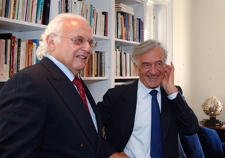
Elie Wiesel (right) with philanthropist Ira Rennert, who made possible the recent refurbishment of the 147 Bay State Road building that houses the Elie Wiesel Center for Judaic Studies. On Monday the building was named in honor of Wiesel’s parents. Photo by Kalman Zabarsky

This story was published in BU Today on September 21.

Speaking before an audience of hundreds at the George Sherman Union’s Metcalf Hall Monday evening, September 19, Elie Wiesel told the story of a man — a religious and observant Holocaust survivor — who finds himself unable to pray.

“Day after day,” said Wiesel, “every time he’s about to say, ‘You have loved us very much, oh Lord, You have given us an excess of charity and compassion,’” the man must stop — every word turns into an obstacle for him.

The prayer evokes painful nostalgia for the man’s childhood innocence, explained Wiesel (Hon.’74), a Nobel laureate, a Holocaust survivor, and BU’s Andrew W. Mellon Professor in the Humanities. The man finds himself in a quandary: the world has changed, he has changed, but the prayer has not; the words are the same, as if the Holocaust had not happened, and the man feels that anything he could say to God would be a lie, a betrayal. At the same time that he feels he must praise God’s mercy for his own survival, he remembers those who perished and his desire is stifled; he feels he must refuse God praise and thanksgiving.

Wiesel’s lecture, entitled Why Pray, was the first of BU’s annual Three Encounters with Elie Wiesel lecture series. Earlier in the day, the building that houses the Elie Wiesel Center for Judaic Studies at 147 Bay State Road was named in honor of Wiesel’s parents, Shlomo, who was murdered at Buchenwald, and Sarah, who along with Wiesel’s sister was killed at Auschwitz. Wiesel survived both camps and chronicled the nightmare in his 1956 book Night. The internationally renowned human rights activist and author won the Nobel Prize for Peace in 1986 and has taught at BU since 1976.

In his lecture, Wiesel asserted that “the prayer from which man’s fate is absent, his anguish ignored, is not called prayer.” Rather, people must bring to prayer the fullness of their experience — including doubt, disappointment, or even anger — in order for their prayers to be meaningful.


Explore Related Topics:

  • Culture
  • Faculty
  • Religion
  • Share this story

Share

Elie Wiesel: Anger and doubt can enrich prayer

Share

  • Twitter
  • Facebook
  • Reddit
  • LinkedIn
  • Email

Latest from BU Today

  • University News

    Gender Wage Gap in Greater Boston Narrows, Research from BU and City Finds

  • MLK Day

    BU and Boston’s Annual MLK Day Observance to Take Inspiration from King’s 1967 Speech

  • University News

    New AI Program Keeps BU School of Law Students on the Cutting Edge

  • Things-to-do

    This Weekend @ BU: January 15 to 19

  • Ice Hockey

    BU Tops Northeastern 2-1 in Overtime of Women’s Beanpot Semifinal

  • Things-to-do

    How to Ring in the New Year in and around Boston

  • Things-to-do

    Your Guide to Boston Holiday Happenings

  • University News

    Review of BU Athletics Offers Recommendations for Improving Program

  • Varsity Sports

    BU Women’s Hockey Heads to Belfast for Inaugural Women’s Friendship Series

  • Social Media

    The Memes That Got Us Through 2025

  • Artificial Intelligence

    Massachusetts Officials Praise Statewide AI Progress at BU Event

  • Students

    25 Tuesdays, 25 Terriers, 25 Inspiring Pieces of Advice

  • Watch Now

    1980 US Olympic Hockey Team, with Four BU Players, Gets Congressional Gold Medal

  • University News

    Video: BU’s Values Told Through Voices from History

  • Photo Essay: A Bird’s-Eye View of BU’s Charles River Campus

  • Holiday Fun

    Where to See Boston’s Best Holiday Lights

  • Things-to-do

    This Weekend @ BU: December 11 to 14

  • Student Life

    Five Quick Tips from a BU Student to Ace Your Final Exams

  • Where to Study

    Best Places to Study for Finals at Boston University

  • Student Life

    More Than 100 Student Projects Take the Stage at Fall 2025 Experiential Learning Expo Thursday

Section navigation

  • Sections
  • Must Reads
  • Videos
  • Series
  • Close ups
  • Archives
  • About + Contact
Get Our Email

Explore Our Publications

Bostonia

Boston University’s Alumni Magazine

BU Today

News, Research, Community

The Brink

Pioneering Research from Boston University

  • Twitter
  • Facebook
  • Youtube
  • LinkedIn
  • Instagram
  • Weibo
  • TikTok
© Boston University. All rights reserved. www.bu.edu
© 2026 Trustees of Boston UniversityPrivacy StatementAccessibility
Boston University
Notice of Non-Discrimination: Boston University prohibits discrimination and harassment on the basis of race, color, natural or protective hairstyle, religion, sex or gender, age, national origin, ethnicity, shared ancestry and ethnic characteristics, physical or mental disability, sexual orientation, gender identity and/or expression, genetic information, pregnancy or pregnancy-related condition, military service, marital, parental, veteran status, or any other legally protected status in any and all educational programs or activities operated by Boston University. Retaliation is also prohibited. Please refer questions or concerns about Title IX, discrimination based on any other status protected by law or BU policy, or retaliation to Boston University’s Executive Director of Equal Opportunity/Title IX Coordinator, at titleix@bu.edu or (617) 358-1796. Read Boston University’s full Notice of Nondiscrimination.
Search
Boston University Masterplate
loading Cancel
Post was not sent - check your email addresses!
Email check failed, please try again
Sorry, your blog cannot share posts by email.
Elie Wiesel: Anger and doubt can enrich prayer
0
share this