
Sparking Conversation Amidst the Anger
By Adrienne Boris
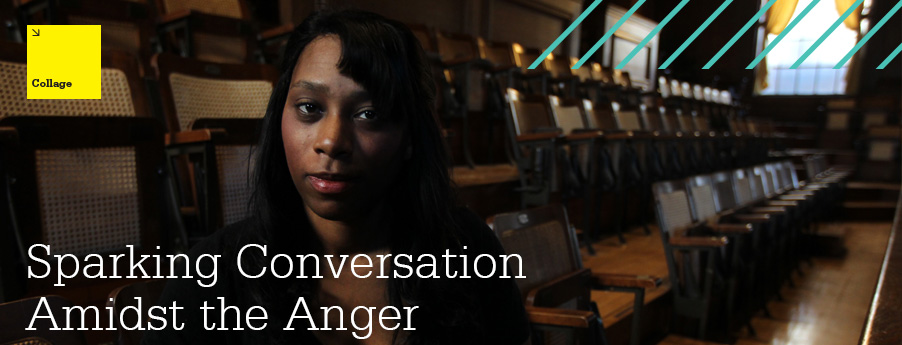
Banner image: Kirsten Greenidge, an assistant professor of playwriting and theatre arts at CFA, tackles issues of race and class in her play Baltimore, which premiered at BU. Photo by Bill Greene/Boston Globe/Getty Images
A college resident assistant navigates a racial incident in Baltimore, a play by Kirsten Greenidge, an assistant professor of playwriting and theatre arts at CFA. Commissioned by the Big Ten Theatre Consortium’s New Play Initiative for female playwrights, Baltimore premiered at BU in a coproduction with New Repertory Theater and traveled to universities throughout the country in 2016. Adrienne Boris (’15), who directed the touring production, spoke with Greenidge about her provocative and timely drama.
Adrienne Boris: Baltimore deals with issues of race and class on a national and on a more intimate scale. What draws you to these kinds of stories?
Kirsten Greenidge: I’m drawn to stories that are historical, which comes from my mission as a playwright, which has always been, since I was 11 or 12 years old, to write stories for people who don’t see themselves on stage very often, and to write roles for actors who don’t always have roles built for themselves on stage. So, I’m constantly looking for stories and roles that female actors of color, in particular, would want to play.
The Big Ten Theatre Consortium is made up of the theater department heads at 10 universities throughout the country. Their New Play Initiative is dedicated to commissioning, producing, and publicizing new plays by American female playwrights that feature strong, age-appropriate roles for women, particularly female artists of color. So it must have been exciting when they approached you?
Yes! I remember getting a phone call from Alan MacVey—I know Alan because he is [a professor and chair of the Theatre Arts Department, and the director of the Division of Performing Arts] at the University of Iowa where I went to grad school. I also learned that [playwright] Naomi Iizuka had begun the first commission, and Naomi was a teacher and mentor of mine at Iowa.
In addition to all that, I knew it was a project I was interested in because its mission is so close to my own as an artist: to create opportunities for female artists and female artists of color.

Jade’ Davis (’16) (front) and Linda Vanessa Perla (’18) (back, from left), Desiré Hinkson (’18), Ami Park (’16), Lexi Jenne (’18), and Kalei Devilly (’18) star in Baltimore. Photo by Kalman Zabarsky
What inspired you to write Baltimore?
Alan MacVey told me a story that had happened to him when he was a resident advisor at Stanford, and I was captivated by it. It struck me as universal because it was a story about a young person who really wanted to do well, but by his own admission, didn’t have the resources to do so. So that was really the jumping-off point for the situation the young protagonist of Baltimore finds herself in.
I was also very interested in how information spreads, through the internet especially, and how to have people talk about a very difficult topic without needing to have solutions. If this play could offer a solution to America’s racial woes then, “Yay!”—we’d spread it all over the place, and we wouldn’t have a problem anymore. But, I think it would be a false hour and a half in the theater if the play were to pretend to be able to do that.
So how do we make the piece worthwhile without offering solutions? How do we get as many voices heard as possible without the play feeling disingenuous and didactic? There’s no intermission for a reason, so we just plow right through this language, this verbiage about the students’ feelings about race, and about the incident.
Boston University, Boston Center for American Performance, and New Repertory Theatre collaborated in a rolling world premiere of Baltimore at universities throughout the country. Can you describe the process of writing the play with development processes in different communities? Did the workshop process at the BU School of Theatre and the University of Maryland Department of Theatre and Dance influence your writing?
Definitely. At the University of Maryland, we had a workshop in May 2015, right after the riots in Baltimore. That was extremely valuable and emotionally difficult. The students were so generous and opened up to me, a complete stranger. They told me really personal things they had not told their advisors or their families, things that are really hard to talk about and that ultimately ended up in the play.
I found that students were eager to understand each other’s stories and were also eager to play roles they didn’t usually get to play on stage—racially charged, contemporary roles that reflected their experience and were age-appropriate. So, for example, for an 18-year-old Asian American student, playing a contemporary Asian American student in Baltimore, versus playing a maid in a classical play, felt drastically different. I think both are valuable experiences, but these students had never gotten to experience the contemporary side.
In the summer, I began working closely with Elaine Vaan Hogue, [program head of Theatre Arts and assistant professor of acting and directing] at Boston University. We scheduled two workshops and cast the reading from whoever was in the room. It was really exciting because there were a lot of people at both of those readings, and I got a lot of great feedback from so many of our students.
Elaine put it really well when she said the play verges on the “un-PC.” It has moments that make us say, “Oh dear. Should we really talk about race like that?” Some of those moments owe themselves to the University of Maryland workshop.
You wrote Baltimore at a pivotal time in American politics, amidst police shootings, the Black Lives Matter movement, and the race riots in Baltimore, among other incidents. How did current events help shape the story?
One of the things that was so difficult about the workshop process at University of Maryland was that it was so soon after the riots. The students expressed what they felt was a reluctance to talk about race in class. One student mentioned trying to bring it up in a history class and being told it was not appropriate. Again and again these students were told, “Don’t bring it up in class, we don’t want to talk about it.”
“I truly believe that in the midst of all the anger (and there should be anger) and sadness, there is also room for actual conversation.”—Kirsten Greenidge
This was the first time I was speaking about race in this play with a generation of students who did not grow up right after the Civil Rights movement. Generally, they felt that some of the tools that had been used for Civil Rights in the 1950s and 1960s weren’t applicable today. Or, the job hadn’t been done; so, “What now?”
What kinds of discussions do you hope the play will spark?
I hope it will spark productive conversations about race. I’ve noticed two prevailing responses to racial issues in America: There’s of course the anger, the vitriol about race, and then there are sentimental stories about negative things that have happened because of race discrimination that are almost untouchable. They can inspire action, but in the moment, as they are being told, the listener can really only feel anger or sadness about them. I truly believe that in the midst of all the anger (and there should be anger) and sadness, there is also room for actual conversation.
What do you think of Boston’s response to the issue of race and gender parity in the theater? What are we doing right and what is still to be done?
Of course I would like to see more roles for women and people of color. However, in particular, I think we need to look at the choices all theaters—not just the large and mid-size ones—make about what they put on their stages. When [gender parity watch-lists such as The Kilroys] come out, we tend to go after the biggies and hold them by the neck and say, “Look what you did!” But smaller theaters and community theaters also have a lot of responsibility. They are doing a lot of quality work, but when they produce a season of only male playwrights or employ only male directors or program plays that only have majority roles for male actors, that sends a message.
I think people are paying more attention to it, but it can always get better. I think it will also take a cultural shift in our appreciation for female directors, playwrights, theater artists, and female leaders in general. There is a lot of work out there, and not being able to find these artists should no longer be an excuse. At this point, it is not an accident when people don’t pay attention.
A version of this article originally appeared in the program for Baltimore.
Comm Ave to the Great White Way
Photos by Kalman Zabarsky
Banner image: Bailie de Lacy ('16) and Jordan Matthew Brown ('16) starred in the 2015 Music Theatre Concentration production of Parade.
The School of Theatre’s new Music Theatre Concentration kicked off in fall 2015 and culminated with a production of Parade, starring Jordan Matthew Brown (’16), now performing in the national tour of The Book of Mormon. The 2014 musical, The Human Comedy, and the 2016 musical, The Cradle Will Rock, are among the annual large-scale musicals made possible by the $750,000 Stewart F. Lane and Bonnie Comley Musical Theatre Fund.
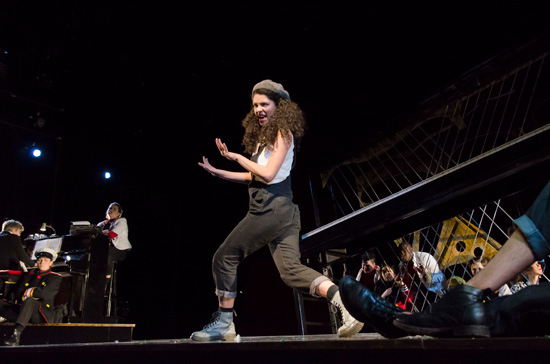
David J. Castillo (’17) starred in the 2016 Music Theatre Concentration production of The Cradle Will Rock.
The Fund builds on CFA’s inherent musical theatre talent; School of Theatre alums are lighting up Broadway in critically acclaimed productions. Andrew Mayer (’11) and Amber Gray (’04) performed in Natasha, Pierre & THE GREAT COMET of 1812. Alex Wyse (’09) appeared in Lysistrata Jones and Spring Awakening and is working on the show Ride the Cyclone. Greg Hildreth (’05), who received the 2015 CFA Inspiring Young Alumni award, appeared in Cinderella, Peter and the Starcatcher, and Bloody Bloody Andrew Jackson. Brad Oscar (’86), winner of the 2006 Distinguished Alumni Award, has been nominated for multiple Tony Awards and stars in Something Rotten.
Thanks, in part, to the Stewart F. Lane and Bonnie Comley Musical Theatre Fund, CFA is becoming a widely recognized feeder for Broadway casts, positioning BU to become the "preeminent musical theatre school in the country," says Lane.
A BUTI-ful 50th
By Susan Seligson | Photos by Natasha Moustache
Banner image: BU Tanglewood Institute, a CFA summer program for gifted high school musicians, celebrated its 50th anniversary August 6, 2016, highlighted by a concert for students and alumni at the Tanglewood Music Center’s Seiji Ozawa Hall.
“It was the best summer of my life.”
“A defining moment in my life that forced me to be better.”
“This place sparks joy.”
“It had the magic of Hogwarts without the evil.”
These were just a few of the tributes and memories shared by alumni of Boston University’s summer program for gifted high school instrumentalists and vocalists (many also BU alums), which has paved the way for careers at the top rungs of the music world. They returned to Lenox, Mass., on August 6 to celebrate the 50th anniversary of the Boston University Tanglewood Institute (BUTI).
Situated a mile from the Tanglewood Music Center and part of a verdant sweep of fields, hills, concert stages, and rehearsal studios, BUTI hosts 350 students for summers of rigorous practice, camaraderie, and as event emcee and Lauren Ambrose (BUTI’94,’95) put it, “marinating in the music” and the example of the Boston Symphony Orchestra (BSO).
The day began with a piano recital and a panel discussion and migrated to the Tanglewood Music Center, the summer home of the BSO (which numbers 15 BUTI alums among its musicians), for a student and alumni concert, followed by a reception, where accolades and wine flowed. It was a day marked by a parade of luminaries, from Ambrose, best known for her Emmy-nominated role as Claire Fisher in HBO’s Six Feet Under, to National Public Radio personality Ron Della Chiesa (CGS’57, COM’59), voice of WGBH’s BSO broadcasts, to orchestra conductors, opera singers, and composers who traveled from all over the country. University President Robert A. Brown took to the concert stage and the podium at the reception, attended by Beverly Brown, Jean Morrison, University provost, Lynne Allen, CFA dean ad interim, and BUTI faculty past and present.

BSO assistant conductor and BUTI alum Ken-David Masur (from left) shares a celebratory moment with honoree Phyllis Hoffman (’61,’67), former longtime BUTI executive director, Hilary Respass, present executive director, and BUTI alum Lauren Ambrose, a singer and actress best known for her role in HBO’s Six Feet Under.
It was also a day of surprises—a plaque awarded to BUTI founder Wilbur Fullbright (GRS’60), a CFA professor emeritus of music and former School of Music director, who was unable to attend, and the announcement, by BUTI executive director Hilary Respass, of a scholarship named for longtime BUTI executive director Phyllis Hoffman (’61,’67), a CFA professor and chair of the voice department, who also received a plaque and is credited with being the soul of the life-changing program.
Place of growth, music, and mischief
It was hard to rub shoulders with someone who was not a talented musician or the parent of one. The alums, faculty, and former faculty—some career musicians, some not—returned to a cherished place of growth, music, and mischief, exchanging greetings and hugs and posing for photos. Ann Howard Jones, 24-year BUTI choral instructor and a CFA professor emerita and director of choral activities, a woman who launched a thousand careers, allemanded her way from embrace to embrace along the green and under the party tent. A panel of alumni, moderated by Hoffman, was not only a paean of gratitude (they struggled to respond when she asked what they would change at BUTI), but also an illustration of the creative lives outside performance and teaching that the young BUTI musicians have made. BUTI alum and vocalist Amy Matthews, for example, is now host of a string of home renovation shows on HGTV. But because it was BUTI, the high point of the day was the music.
The crowd at Seiji Ozawa Hall’s Florence Gould Auditorium was filled to near its 1,200-seat capacity as BUTI alum Ken-David Masur, assistant conductor of the BSO, led a program of upbeat, soulful works by Wagner, Brahms, BUTI alum Lawrence Wolfe, and former Tanglewood general advisor Leonard Bernstein (Hon.'83), with a rendition of “Make Our Garden Grow” from his musical Candide. With six BUTI alumni soloists and a chorus augmented by alumni (easily spotted by their many postpubescent decades and red carnations). The result, a thunderous choral finale, sent a rush of goose bumps through audience members who had been fanning themselves with their programs in the humid August heat. The female musicians wore white, lending an ethereal air to the proceedings. Ambrose gave a closing nod to all those “who have had their artistry and their hearts opened” by the BUTI experience.

Emcee Ambrose and the Young Artists Orchestra at BUTI’s 50th anniversary concert in Tanglewood’s Seiji Ozawa Hall.
The concert, which included two pieces composed by alums for the occasion, featured several guest conductors, including Jones (Handel’s Coronation Anthem #1), BUTI alum Samuel Z. Solomon, who teaches percussion at the Boston Conservatory, BU, and BUTI, and Katie Woolf (’05), a choral conductor at Harvard and former member of the Marsh Chapel Choir, known as a musical innovator who has traveled the world combining musical performances with community service. Solomon conducted Pulses, Cycles, Clouds, a 50th anniversary composition by Nico Muhly (BUTI'96,'97), and Woolf conducted Frank Ticheli’s choral piece Earth Song and two selections from Tarik O’Regan’s Triptych. A Zoltan Kodaly string trio, Serenade, Opus 12, featured violinists Peter Zazofsky and Lucia Lin and violist and BUTI alum Steven Ansell, all members of the Muir String Quartet, in residence at CFA. Commissioned for the event, Land Lines, by Timo Andres (BUTI'00,'01), was performed by an all-brass ensemble with the purpose, says the composer, “of setting some wild echoes flying.” There was a dose of whimsy in the second alum piece, Wolfe’s all-bass medley of his BUTI standouts, among them Beethoven’s Ninth Symphony and Fifth Symphony. And in introducing Brahms’ Academic Festival Overture, Masur, the son of former New York Philharmonic director Kurt Masur and a natural in warming up an audience, explained that the piece reflects Brahms’ little-known sense of humor and urged them to keep an ear open for some well-worn college and drinking songs.
A rare gem that makes a difference
“I am proud to call BUTI a member of the extended BU community,” Brown told those gathered for the reception, the timeless lush backdrop of Tanglewood behind him. (“You’re not looking at me, you’re looking at the scenery,” he joked.) He called BUTI “one of those rare gems that make a difference in people’s lives.” The BU president was one of many speakers who paid tribute to BUTI founder Wilbur Fullbright. In 1965, BSO musical director Erich Leinsdorf envisioned an educational outreach initiative by BU, based at the Tanglewood Music Center, and proposed it to Edward Stein, then CFA dean, who asked Fullbright to take charge of the project. BUTI launched its first season less than six months after that handshake, and has since evolved into an eight-week summer program drawing students from 14 to 22 who arrive at Lenox from all 50 states and many foreign countries. They study with BU faculty, participate in BSO master classes, and sit in on its rehearsals. Most important, said alums on the panel, it is a place where young people who felt marginalized back home (“geeky” was the operative word) by their musical talent and drive became part of a community of young people who shared their passions. BUTI advisory council member and alum Seth Johnson “was the best violinist in Minnesota when I came here,” he said, and was humbled, inspired, and awakened by the community he found—each and every one the best of the best.

Beverly Brown (from left), composer and BUTI alum Lawrence Wolfe, and BU President Robert A. Brown at the reception honoring BUTI’s 50th anniversary.
Taking her turn at the podium, Allen heaped praise on Hoffman for her 22 years of “a talented juggling act” that nurtured BUTI’s diversity and international reach, its prominence in the community (the BUTI young people’s choir has sung for three Boston Pops concerts), and overall, for “putting BUTI on the map.” Presented with a BUTI cake (and a superhero cape), Hoffman expressed her pride not only in the talent honed in the studio sheds dotting the vast lawns, but in the fact that so many BUTI alums are “performing acts of social conscience.”
As Respass and Hoffman are fond of saying, the arts play a crucial role not just in entertainment, but also in character development, intellectual growth, and competence. “I think STEM should be STEAM,” said Hoffman, making a plea for adding arts to the mix of science, technology, engineering, and math (STEM) in the conversation about young people’s success in today’s world.
Before the guests drifted off, Della Chiesa, dressed in eye-popping shades of orange, returned to the podium to offer a line from Broadway lyricist Cy Coleman: “The best is yet to come.”
A version of this article originally appeared in BU Today.
Medical Maestro
By Julie Butters & Lara Ehrlich
Banner image: Aram V. Chobanian (Hon.’06) (right), BU president emeritus and School of Medicine dean emeritus, has written songs, a sonata, a string quartet, and an opera. Photo by Kalman Zabarsky
Aram V. Chobanian (Hon.’06), BU president emeritus and School of Medicine dean emeritus, has loved classical music since childhood, when he listened to opera and symphony performances on the radio. He attended the symphony while in medical school for cardiology and later taught himself to play the piano, occasionally writing songs for his children’s birthdays and graduations.
Chobanian planned to enroll in CFA upon completing his term as dean of the BU School of Medicine—but he became the University’s president instead. Far from giving up on music, he studied music theory with then-graduate student Matt Van Brink (’02,’05) and soon gained enough confidence to write and perform songs for BU students at the first graduation breakfast over which he presided.
“I’ve spent my life as a physician-scientist with involvement in research and exploring new ideas,” he says. “That may be one of the reasons I have gone into music. I have no idea what it’s all about, and then I try and figure it out. Medicine and music are quite intensive types of activities.”
Chobanian went on to take lessons with Justin D. Casinghino (’09), a CFA lecturer in music, composition, and theory, with whom he has explored different genres; he’s written songs, a sonata, a string quartet, and an opera titled Tom, based on Henry Fielding’s novel Tom Jones. In December 2016, CFA students and alums recorded Tom on a CD for Chobanian’s edification and personal enjoyment. The experience of hearing his music performed was “extraordinary,” he says. “I couldn’t believe it.” He is now working on a musical.
And the Tony Goes to…
By John O’Rourke
Banner image: Reed Birney (left), who studied at CFA, won a Tony Award for his performance in The Humans, while producer Sue Wagner (’97) won Tony Awards for The Humans and A View from the Bridge. Theo Wargo/Getty Images Entertainment/Getty Images; Roy Rochlin/Getty Images Entertainment/Getty Images
It appears there is truth to the adage, “Good things come to those who wait.” After nearly four decades in the business, veteran actor Reed Birney won his first Tony Award in June, for best featured actor in a play for his performance in Stephen Karam’s moving production The Humans.
The recognition was hard-won for Birney, who studied at the College of Fine Arts. He landed his first Broadway role in the comedy Gemini in 1977. But that early success was followed by many lean years, offset by roles in off-off-Broadway productions, occasional guest appearances in television shows such as Law & Order, and teaching gigs. Several times, he contemplated leaving acting altogether.
“There were many long periods where I was flat on my back with despair,” says Birney. But, he adds, “despair is the enemy, and you lose too much of your precious life being sad when sad doesn’t help you one little bit.”
His fortunes began to turn around in 2008, when he played a ruthless journalist who rapes a woman in the off-Broadway drama Blasted, by Sarah Kane. Critics—and a whole new generation of playwrights and directors—took notice. He was then cast in a revival of William Inge’s Picnic in 2012, marking his return to Broadway after a 35-year absence. And, two years ago, he received his first Tony nomination, for his performance as cross-dresser Charlotte in Harvey Fierstein’s drama Casa Valentina.
The Humans, which won the Tony for best play, transferred from off-Broadway to Broadway in February. Charles Isherwood wrote in his New York Times review, “I have written many times of Mr. Birney’s excellence, but his performance here moved me so deeply I find myself reaching for new superlatives.” In his portrayal of family patriarch Erik Blake, Birney “draws a heartrending portrait of a loving husband, father, and son slowly withering inside, in a state of bemused bewilderment at the unforeseen turns his life has taken.”
Birney describes the role of Erik Blake, an equipment manager for a Catholic high school in Scranton, Pa., as a regular Joe. “I think he is like many men in America now who are struggling to make ends meet and take care of his family,” he says. “I don’t think he could ever afford to have big dreams. The reality of surviving took all his time and energy.”
In the trailer above, watch scenes from The Humans. Video courtesy DKCO&M
The actor was drawn to the play because of the quality of the writing. “It’s one of the most meticulously crafted plays I have ever read,” he says. “And the part is astonishing. I get to go through virtually the full range of human experience every night. The best part of having been alive this long is that I am as beaten up as the character.”
Birney feels fortunate to have landed the part, given that his typical role is the guy in a suit—a teacher or a politician. He currently plays Donald Blythe, US vice president, on the Netflix hit series House of Cards. “At this late date in my career,” he says, “it’s very unusual to get to do something you’ve never done. I was nervous about people buying me as a janitor. The challenge was to find a way to play a man who has led an unexamined life. Erik has never had the luxury of self-reflection.”
Three other BU alumni won 2016 Tony Awards. Producers James Nederlander (CGS’80), Jon B. Platt (CGS’74), and Sue Wagner (’97) won for best play, for The Humans. Wagner, one of Broadway’s most prolific producers, won a second Tony, for best revival of a play, for A View from the Bridge. Wagner had already won four Tony Awards before the 2016 ceremony. “My favorite kinds of plays and musicals are the ones where you’re laughing so hard you think you’ll pee your pants, and suddenly you’ve burst into tears because you recognize yourself up there,” she says. “That’s what people come to the theater for. It’s a shared experience, and if that experience is hollow or just surface, it doesn’t interest me. For me, it has to pack an emotional wallop.”
Download the PDF
Ad1

Ad2

Ad3