
How the Stroop Effect Arises from Optimal Response Times in Laterally Connected Self-Organizing Maps
Prabhakaran, D., Grasemann, U., Kiran, S., & Miikkulainen, R. (2025). How the Stroop Effect Arises from Optimal Response Times in Laterally Connected Self-Organizing Maps. ArXiv. https://www.ncbi.nlm.nih.gov/pubmed/39975444

Cortical activity for conversational responses in young neurotypical individuals, older neurotypical individuals, and individuals with aphasia: A functional near-infrared spectroscopy study
Braun, E. J., Carpenter, E. A., Gao, Y., Yücel, M. A., Boas, D. A., & Kiran, S. (2026). Cortical activity for conversational responses in young neurotypical individuals, older neurotypical individuals, and individuals with aphasia: A functional near-infrared spectroscopy study. Imaging neuroscience (Cambridge, Mass.), 4, IMAG.a.1125. https://doi.org/10.1162/IMAG.a.1125
Temporal Variability of Dynamic Functional Connectivity as a Predictor of Network Changes and Recovery in Post-stroke Aphasia
Falconer, I., Varkanitsa, M., Billot, A., & Kiran, S. (2025). Temporal Variability of Dynamic Functional Connectivity as a Predictor of Network Changes and Recovery in Post-stroke Aphasia (P4-4.005). Neurology, 104(7_Supplement_1), 2947. https://doi.org/10.1212/WNL.0000000000210687
An Introduction to Machine Learning for Speech-Language Pathologists: Concepts, Terminology, and Emerging Applications
Cordella, C., Marte, M. J., Liu, H., & Kiran, S. (2024). An Introduction to Machine Learning for Speech-Language Pathologists: Concepts, Terminology, and Emerging Applications. Perspectives of the ASHA Special Interest Groups. https://doi.org/10.1044/2024_PERSP-24-00037 Purpose The purpose of this article is to orient clinicians and researchers to machine learning (ML) approaches, as applied to the field […]
Charting the Course of Aphasia Recovery: Factors, Trajectories, and Outcomes
Marte, M. J., Russell-Meill, M., Carvalho, N., & Kiran, S. (2025). Charting the Course of Aphasia Recovery: Factors, Trajectories, and Outcomes. Annual Review of Linguistics, 11(Volume 11, 2025), 111–136. https://doi.org/10.1146/annurev-linguistics-011724-121245
Noisy-channel language comprehension in aphasia: A Bayesian mixture modeling approach
Ryskin, R., Gibson, E., & Kiran, S. (2025). Noisy-channel language comprehension in aphasia: A Bayesian mixture modeling approach. Psychon Bull Rev. https://doi.org/10.3758/s13423-025-02639-z
The Active Ingredients of Semantic Naming Treatment: Evidence From Mandarin-English Bilingual Adults With Aphasia
Li, R., Chen, S., & Kiran, S. (2025). The Active Ingredients of Semantic Naming Treatment: Evidence From Mandarin-English Bilingual Adults With Aphasia. J Speech Lang Hear Res, 68(1), 216-233. https://doi.org/10.1044/2024_JSLHR-23-00705
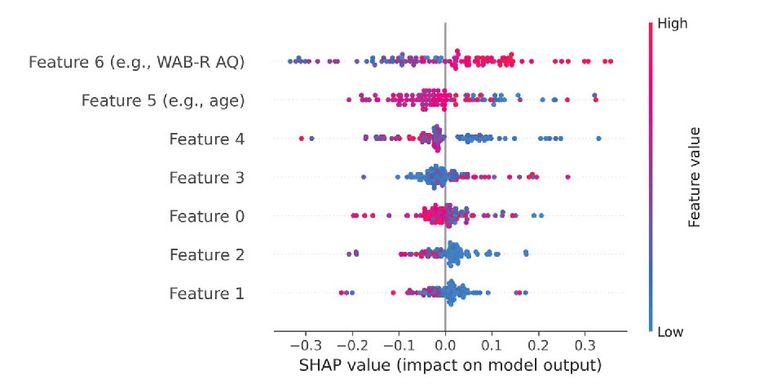
Machine Learning Predictions of Recovery in Bilingual Poststroke Aphasia: Aligning Insights With Clinical Evidence
Marte, M. J., Carpenter, E., Scimeca, M., Russell-Meill, M., Penaloza, C., Grasemann, U., Miikkulainen, R., & Kiran, S. (2025). Machine Learning Predictions of Recovery in Bilingual Poststroke Aphasia: Aligning Insights With Clinical Evidence. Stroke, 56(2), 494-504. https://doi.org/10.1161/STROKEAHA.124.047867
Individual differences in neuroplastic recovery
Kiran, S., Varkanitsa, M., Billot, A., Carpenter, E., & Falconer, I. (2025). Individual differences in neuroplastic recovery. In J. H. Grafman (Ed.), Encyclopedia of the Human Brain (Second Edition) (pp. 758–774). Elsevier. https://doi.org/10.1016/B978-0-12-820480-1.00206-0

Machine learning predictions of recovery in bilingual post-stroke aphasia: Aligning insights with clinical evidence
Authors: Manuel Marte, Erin Carpenter, Michael Scimeca, Marissa Russell-Meill, Claudia Peñaloza, Uli Grasemann, Risto Miikkulainen, and Swathi Kiran, Accepted in the Journal Stroke Q&A with Manuel Marte What is this paper about? The paper examines how well machine learning models can predict language recovery outcomes in bilingual stroke survivors with aphasia. The study analyzed data […]