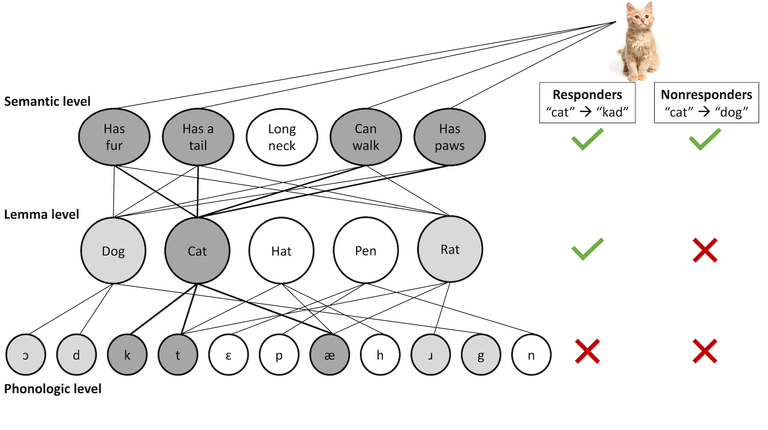
Evolution of word production errors after typicality-based semantic naming treatment in individuals with aphasia
Authors: Ran Li, Natalie Gilmore, Mia O’Connell, Swathi Kiran Q&A with Ran Li What is this paper about and why are the results important? This study implemented an error coding scale to assess changes in word production errors following a semantic-based naming therapy in individuals with chronic aphasia. It provides insights into the linguistic mechanisms that […]
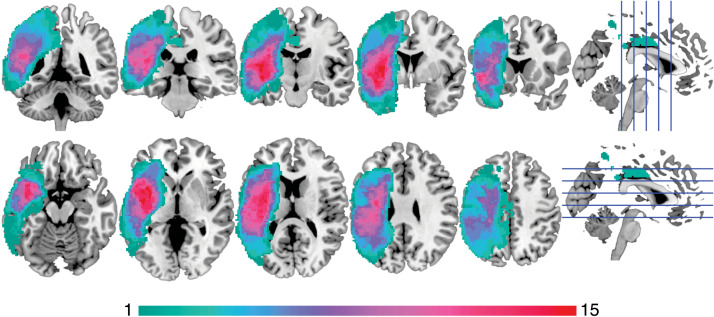
Pars opercularis underlies efferent predictions and successful auditory feedback processing in speech: Evidence from left-hemisphere stroke
Interview with collaborators of the Center for Brain Recovery and publication authors Sarah Beach (MIT) and Caroline Niziolek (University of Wisconsin Madison) Abstract Hearing one’s own speech allows for acoustic self-monitoring in real time. Left-hemisphere motor planning regions are thought to give rise to efferent predictions that can be compared to true feedback in sensory cortices, resulting […]
Quantifying Dosage in Self-Managed Speech-Language Therapy: Exploring Components of Cumulative Intervention Intensity in a Real-World Mobile Health Data Set
Q&A with Claire Cordella What is the purpose of your research? Cumulative Intervention Intensity (CII; Baker 2012) is a proposed framework for conceptualizing and calculating dose which has been used to quantify intensity of speech-language therapy (SLT) in highly controlled laboratory studies and clinical trials. However, it is unknown whether CII can be applied to characterize […]
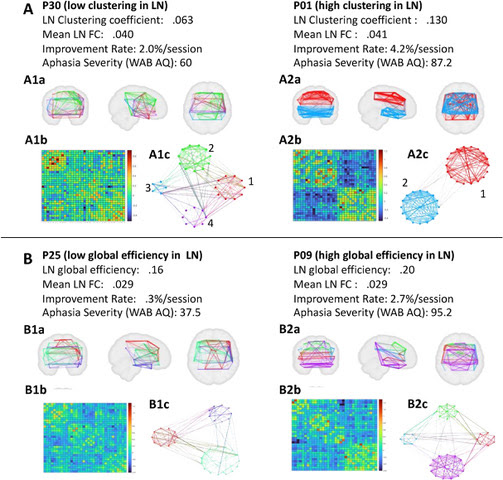
Resting-state brain network connectivity is an independent predictor of responsiveness to language therapy in chronic post-stroke aphasia
Recent paper by CBR’s researcher Isaac Falconer examines the brain network connectivity as a predictor of responsiveness to language therapy in people with aphasia. Features Q&A with author and link to full publication.