
Cortical activity for conversational responses: A functional near-infrared spectroscopy study
Cortical activity for conversational responses in young neurotypical individuals, older neurotypical individuals, and individuals with aphasia: A functional near-infrared spectroscopy study
Abstract
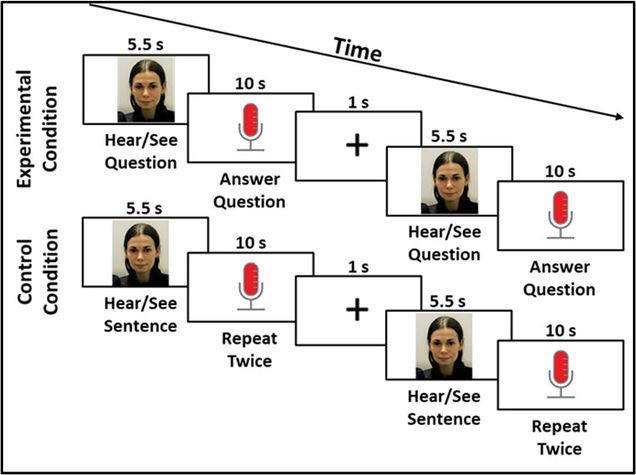
Functional near-infrared spectroscopy (fNIRS) has the potential for evaluating language and conversational interaction in an ecologically valid way given that participants can be seated and interacting with a conversational partner. Aphasia, an acquired language disorder, impacts language abilities, including conversational interaction. Understanding of cortical activity in people with aphasia for conversational tasks could provide an ecologically valid index of brain function and recovery patterns in this population. This study provides pilot data in the use of fNIRS to evaluate language production for conversational responses in young (adult) neurotypical individuals, adults with post-stroke aphasia, and age-matched (i.e., older) neurotypical adults. Experiment 1 evaluated cortical activity for conversational responses versus sentence repetition in a computer-based conversational question task. Experiment 1 results showed differentiation between experimental conditions (with greater fronto-temporoparietal cortical activity for question answering vs. repetition) in young healthy individuals that was not seen in the people with aphasia and age-matched individuals. Experiment 2 evaluated cortical activity for conversational responses in a structured conversational question task with a live interlocutor versus sentence repetition. Experiment 2 results showed lower cortical activity across regions of interest in the age-matched group and greater cortical activity for question answering versus repetition in bilateral temporal and left parietal regions of interest in the people with aphasia. This study provides preliminary evidence for the potential of fNIRS to characterize cortical activity after stroke for functional language tasks.

Q&A with Author: Emily Braun
What is this paper about and why are the results important?
This project used functional near-infrared spectroscopy (fNIRS) to measure cortical activity during conversational responses in people with aphasia and control participants. With fNIRS, we were able to detect different patterns of activity for conversational responses vs. speech production tasks with limited spontaneous formulation demands as well as different patterns across groups which varied depending on the task demand. One reason this is exciting is because it shows that fNIRS may be a good tool for evaluating ecologically valid communication situations (like conversation) that we have traditionally not been able to evaluate as easily with fMRI.
How do the findings relate to the brain and recovery?
This preliminary work opens the door to using fNIRS for evaluation of task-based cortical activity for ecologically valid communication tasks in people with aphasia (and other communication disorders). Potential future applications include evaluating underlying neural mechanisms supporting response to treatment; identifying targets for neuromodulation; and monitoring change over time.
Braun, E. J., Carpenter, E. A., Gao, Y., Yücel, M. A., Boas, D. A., & Kiran, S. (2026). Cortical activity for conversational responses in young neurotypical individuals, older neurotypical individuals, and individuals with aphasia: A functional near-infrared spectroscopy study. Imaging Neuroscience, 4, IMAG.a.1125. https://doi.org/10.1162/IMAG.a.1125
Read Paper