Cross-language interaction during sequential anomia treatment in three languages: Evidence from a trilingual person with aphasia
Peñaloza, C., Marte, M., Billot, A., & Kiran, S. (2025). Cross-Language Interaction During Sequential Anomia Treatment in Three Languages: Evidence from a Trilingual Person with Aphasia. Cortex, 189, 107-130. https://doi.org/10.1016/j.cortex.2025.05.017 Abstract Language rehabilitation research has reported mixed evidence in bilinguals with aphasia suggesting that therapy can benefit the treated language alone or additionally result in […]

Using Unsupervised Dimensionality Reduction to Identify Lesion Patterns Predictive of Post-Stroke Aphasia Severity
Kropp, E., Varkanitsa, M., Carvalho, N., Falconer, I., Billot, A., Al-Dabbagh, M., & Kiran, S. (2025). Using unsupervised dimensionality reduction to identify lesion patterns predictive of post-stroke aphasia severity. Cortex, 188, 25–41. https://doi.org/https://doi.org/10.1016/j.cortex.2025.04.015

Measurement of cross-language and cross-domain generalization following semantic feature-based anomia treatment in bilingual aphasia
Russell-Meill, M., Carpenter, E., Marte, M. J., Scimeca, M., Peñaloza, C., & Kiran, S. (2025). Measurement of cross-language and cross-domain generalization following semantic feature-based anomia treatment in bilingual aphasia. Neuropsychological Rehabilitation. https://doi.org/10.1080/09602011.2025.2522196
Using Unsupervised Dimensionality Reduction to Identify Lesion Patterns Predictive of Post-Stroke Aphasia Severity
Kropp, E., Varkanitsa, M., Carvalho, N., Falconer, I., Billot, A., Al-Dabbagh, M., & Kiran, S. (2025). Using unsupervised dimensionality reduction to identify lesion patterns predictive of post-stroke aphasia severity. Cortex, 188, 25–41. https://doi.org/10.1016/j.cortex.2025.04.015 Abstract Although voxel-based methods consistently identify brain regions associated with specific language functions, these techniques are limited when applied to broader behavioral […]
How the Stroop Effect Arises from Optimal Response Times in Laterally Connected Self-Organizing Maps
Prabhakaran, D., Grasemann, U., Kiran, S., & Miikkulainen, R. (2025). How the Stroop Effect Arises from Optimal Response Times in Laterally Connected Self-Organizing Maps. ArXiv. https://www.ncbi.nlm.nih.gov/pubmed/39975444
Cortical activity for conversational responses in young neurotypical individuals, older neurotypical individuals, and individuals with aphasia: A functional near-infrared spectroscopy study
Braun, E. J., Carpenter, E. A., Gao, Y., Yücel, M. A., Boas, D. A., & Kiran, S. (2026). Cortical activity for conversational responses in young neurotypical individuals, older neurotypical individuals, and individuals with aphasia: A functional near-infrared spectroscopy study. Imaging neuroscience (Cambridge, Mass.), 4, IMAG.a.1125. https://doi.org/10.1162/IMAG.a.1125
Temporal Variability of Dynamic Functional Connectivity as a Predictor of Network Changes and Recovery in Post-stroke Aphasia
Falconer, I., Varkanitsa, M., Billot, A., & Kiran, S. (2025). Temporal Variability of Dynamic Functional Connectivity as a Predictor of Network Changes and Recovery in Post-stroke Aphasia (P4-4.005). Neurology, 104(7_Supplement_1), 2947. https://doi.org/10.1212/WNL.0000000000210687
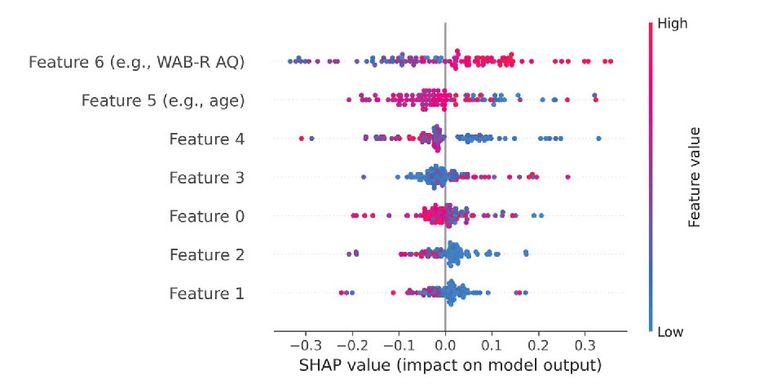
An Introduction to Machine Learning for Speech-Language Pathologists: Concepts, Terminology, and Emerging Applications
Cordella, C., Marte, M. J., Liu, H., & Kiran, S. (2024). An Introduction to Machine Learning for Speech-Language Pathologists: Concepts, Terminology, and Emerging Applications. Perspectives of the ASHA Special Interest Groups. https://doi.org/10.1044/2024_PERSP-24-00037 Purpose The purpose of this article is to orient clinicians and researchers to machine learning (ML) approaches, as applied to the field […]
An Introduction to Machine Learning for Speech-Language Pathologists: Concepts, Terminology, and Emerging Applications
Cordella, C., Marte, M. J., Liu, H., & Kiran, S. (2024). An Introduction to Machine Learning for Speech-Language Pathologists: Concepts, Terminology, and Emerging Applications. Perspectives of the ASHA Special Interest Groups. https://doi.org/10.1044/2024_PERSP-24-00037 Purpose The purpose of this article is to orient clinicians and researchers to machine learning (ML) approaches, as applied to the field of […]
Charting the Course of Aphasia Recovery: Factors, Trajectories, and Outcomes
Marte, M. J., Russell-Meill, M., Carvalho, N., & Kiran, S. (2025). Charting the Course of Aphasia Recovery: Factors, Trajectories, and Outcomes. Annual Review of Linguistics, 11(Volume 11, 2025), 111–136. https://doi.org/10.1146/annurev-linguistics-011724-121245