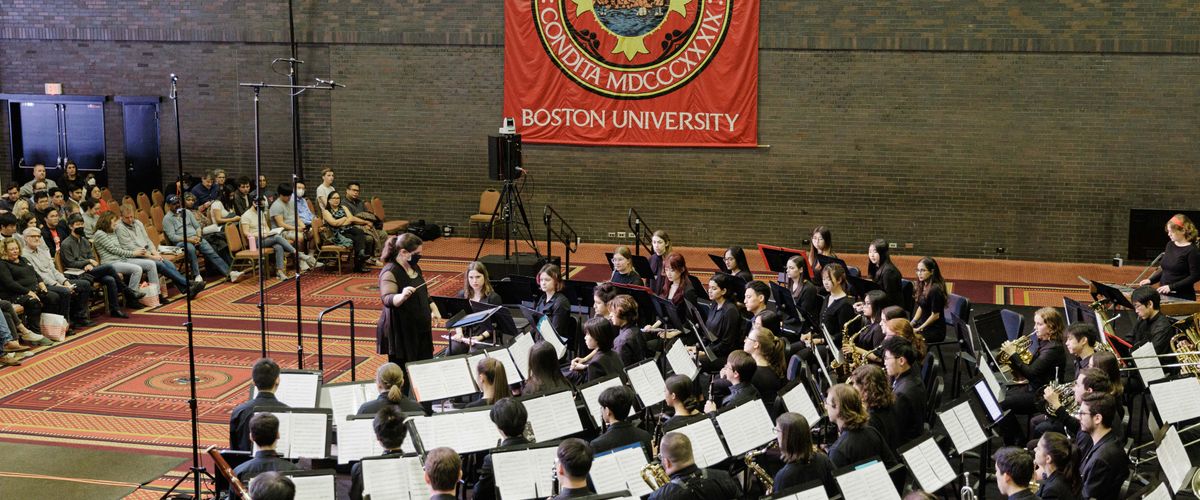
All Campus Orchestra / Concert Band – 4.30.23
Boston University Concert Band
Dr. Jennifer Bill, conductor
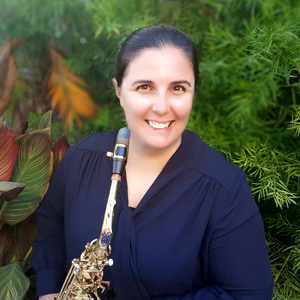
Chuze Sun, Teaching Assistant
Boston University All-Campus Orchestra
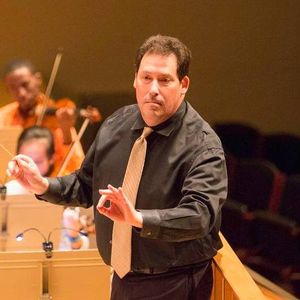
Mark Miller, conductor
Maria Kurochkina, Teaching Assistant
| Arabesque | Samuel R. Hazo (b. 1966) |
| Water Spirit | Nathan Daughtrey (b. 1975) |
| Agárrate Saxo |
Joaquín Montãnes(1916-1981) |
| With Heart and Voice | David R. Gillingham (b. 1947) |
| Lincolnshire Posy
II.Horkstow Grange |
George Percy Grainger (1882-1961) |
| Conga del Fuego Nuevo | Arturo Márquez (b. 1950) |
| — Intermission — | |
| L’Arlésienne: Suite No. 2
Pastorale |
Georges Bizet (1838-1875) |
| Symphony in B minor Unfinished
i. Allegro moderato Maria Kurochkina, conductor |
Franz Schubert (1797-1828) |
| Hungarian Rhapsody No. 2 | Franz Liszt (1811-1886) (arr. Müller-Berghaus) |
Rosters
Boston University Concert Band Spring 2023
| FLUTE | Major | Grad-Year |
| Amman Bhatti | CAS Biochemistry and Molecular Biology | Undergrad, 2023 |
| Clarice Bouvier | New England College of Optometry, Optometry | OD, 2025 |
| Brian Chang | CAS Marine Science | Undergad, 2026 |
| Bonnie | CAS Mathematics and Computer Science | Undergrad, 2025 |
| Sydnee Funai | ENG Mechanical Engineering | Undergrad, 2026 |
| Kate Herrema | PhD | |
| Anita | CAS Neuroscience | Undergrad, 2025 |
| Emily Kirslis | CM Providence College – Accounting and Spanish | Undergrad, 2019 |
| Kiya Klopfenstein | CFA Music Education | Master, 2023 |
| Bonnie | CAS Neuroscience | Undergrad, 2025 |
| Jinyi Liu | QST Business Administration | Undergrad, 2025 |
| Cynthia Lu | QST Business(Finance) | Undergrad, 2026 |
| Jennifer Ortiz Valverde | CFA Music | Undergrad, 2024 |
| Simran Raikundalia | CAS Biochemistry | Undergrad, 2025 |
| Cara Ravasio | ENG Biomedical Engineering | PhD, 2025 |
| Madison Soares | CAS Psychology | Undergrad, 2025 |
| Shruthi Sudhakar | CAS French Studies | Undergrad, 2020 |
| Kendall Thomas | CAS English | Undergrad, 2025 |
| Jenny Zhou | COM Film&tv, Advertising | Undergrad, 2023 |
| OBOE | ||
| Ariel Narayan | CFA Theatre Arts- Design and Production | Undergrad, 2025 |
| Franklin Phan | CFA Music Composition | Undergrad, 2026 |
| Nicholas Ward | CFA Music Theory and Composition | Undergrard, 2023 |
| BASSOON | ||
| Jeremy Freudberg | CAS Linguistics and Computer Science | Undergrad, 2019 |
| Rene Ross | BU School of public health | Masters, 2023 |
| CLARINET | ||
| Brendan Blakley | CAS Marine Science | Undergrad, 2024 |
| Christopher Hyon | CAS Earth and Environmental Science | Undergrad, 2026 |
| Tori Keevaufer | CAS/KHC Neuroscience & Philosophy; Psychology | Undergrad, 2024 |
| Angus Li | Duke University Biomedical Engineering | Undergrad, 2020 |
| Allison Ouellette | CAS Political Science | Undergrad, 2026 |
| Trevor Powerll | BA/MS Environmental Analysis & Policy and Energy & Environment | 2023 |
| Randy Strat | SHA Hospitality Administration | Undergrad, 2014 |
| SAXOPHONE | ||
| Faith Cerbo | CAS Biology CMG | Undergrad, 2025 |
| Chloe Costa | CAS Marine Science | Undergrad, 2026 |
| Eric Falley | School of Theology, MDiv candidate (we don’t really have majors) | Masters, 2024 |
| Caroline Ferris | Math and Computer Science | Undergrad, 2020 |
| Laboni Hassan | ENG Biomedical Engineering | PhD, 2027 |
| Sarah Josinsky | CAS CMG Biology | Undergrad, 2024 |
| Elizabeth Mutka | CAS Marine Science | Undergrad, 2024 |
| Jane Pope | CFA Bachelors Saxophone Performance & Master Music Education |
Undergrad, 2025- Masters, 2026
|
| Kyle Sousa | CFA Music, concentration in ethnomusicology | Undergrad, 2023 |
| Krista Woods | CAS Sociology | Undergrad, 2018 |
| Wenhao Zhou | Graduate School of Art and Science MS in Computer Science | Masters, 2024 |
| HORN | ||
| Jameson Beckman | COM Journalism | Undergrad, 2025 |
| Samantha Brayton | CAS Neuroscience and Psychology | Undergrad, 2024 |
| Alicia Hamm | COM Journalism | Undergrad, 2026 |
| Trina Nielsen | CFA Music Education | Masters, 2025 |
| TRUMPET | ||
| Breanne Frank | CAS Environmental Analysis and Policy | Undergrad, 2021 |
| RJ Horvat | Music Theory | Masters, 2023 |
| Sophia Pinto | CAS International Relations | Undergrad, 2023 |
| Ryan Rosenberger | ENG Electrical and Computer Engineering | Masters, 2023 |
| Lucas Sherwin | CAS Computer Science | Undergrad, 2020 |
| Tyler Smith | ENG Mechanical Engineering | Undergrad, 2022 |
| Kim Sullivan | CM | |
| Sebastian Wu | CAS Computer Science | Undergrad, 2026 |
| Guannan Zhou | Cas Econ&math | Undergrad, 2023 |
| TROMBONE | ||
| Sam Casey | CAS/KHC Neuroscience & Sociology | Undergrad, 2021 |
| Thomas Hontz | School of Law | JD, 2025 |
| Jasmine Hughes | MET Computer Science | Masters, 2024 |
| Thuc Nguyen | ENG Computer Engineering | Undergrad, 2021 |
| Sam Wilkins | CGS | Undergrad, 2026 |
| EUPHONIUM | ||
| Nathaniel Hontz | School of Law | JD, 2024 |
| Angie Madore | CFA Music Education | Undergrad, 2025 |
| TUBA | ||
| Vivek Mirchandani | CAS Neuroscience and Psychology | Undergrad, 2025 |
| Brackney Pickett | CAS Astronomy | PhD, 2026 |
| PERCUSSION | ||
| Emily Frank | COM Film & TV Studies | Undergrad, 2026 |
| Kat Howell | CM | |
| Larissa Ireland | CAS Environmental Analysis & Policy | Undergrad, 2021 |
| James Kang | Advertising, MBA |
COM ’14, Questrom ’20
|
| Jenna Mascaritolo | GRS: MS in Statistical Practice | Masters, 2022 |
| Abby Roberts | CAS Linguistics | Undergrad, 2023 |
| Taylor Williams | CFA Music Education | Undergrad, 2025 |
| PIANO | ||
| Anna Nica | Astronomy | PhD |
*CM = Community Member
Boston University All-Campus Orchestra Spring 2023
| VIOLIN 1 | ||
| Raina Tung (Concertmaster) | Mechanical Engineering | 2024 |
| Lyda Arevalo Gonzalez | Psychology | 2023 |
| So Young Bae | Molecular and Cellular Biology | Grad |
| Michelle Bernard | Biology | 2023 |
| Sydni Britton | Medical Science | Grad |
| Amber Hynes | Psychology | 2025 |
| Allison Kim | Biology | 2023 |
| Blessing Martins | Music Education | Grad |
| Carla Romney | Director of Research, CityLab | |
| Min (Lily) Tang | Biomedical Engineering | 2025 |
| VIOLIN 2 | ||
| Claudia Dorian (Principal) | Music | 2024 |
| Sydney Butler | Health Science | 2024 |
| Jessica Fessmann | Music | 2026 |
| Kendall Thomas | English | 2024 |
| Zhihe (Allen) Tian | Liberal Arts and Sciences | 2026 |
| Scarlett Wills | Art History | 2026 |
| Allyson Zheng | Biology | 2024 |
| Linxuan (Zoey) Zhou | Economics | 2026 |
| VIOLA | ||
| Taek Lee (Principal) | Liberal Arts and Sciences | 2026 |
| Ryan Appleton | Business Administration & Management | 2026 |
| Daschel Koh | Biology | 2027 |
| Annalise Kratochwill | Political Science | 2025 |
| CELLO | ||
| Narek Sahakian (Principal) | English | 2023 |
| Jason Bard | Mechanical Engineering | 2024 |
| Karyna Cheung | Linguistics | 2026 |
| Zoe Qian | Liberal Arts and Sciences | 2026 |
| Benjamin Rapaport | Neurobiology | 2024 |
| Sophia Rizzo | English | 2024 |
| Sophia Rostok | Social Impact | Grad |
| Boyan (Bessy) Wang | Liberal Arts and Sciences | 2026 |
|
BASS
|
||
| Payton Harvill (Principal) | Astronomy & Physics | 2026 |
| Levi Gordon | Biochemistry & Molecular Biology | 2026 |
| Noah Layne | Biology | 2024 |
| FLUTE | ||
| Juliana Fastiggi | International Relations | 2023 |
| Mary Pyrdol | Graphic Design | 2023 |
| Madison Soares | Psychology | 2025 |
| OBOE | ||
| Barrett Schenk | Biomedical Engineering | 2025 |
| Nicholas Ward | Theory & Composition | 2023 |
| BASSON | ||
| Peter Niziolek | Biomedical Engineering | 2026 |
| Jinghan (Tracy) Cui | Bassoon Performance | 2024 |
| CLARINET | ||
| Daniel Cho | Mathematics | 2023 |
| Andrew Battaglia | Clarinet Performance | 2025 |
| SAXOPHONE | ||
| Chuze Sun | Saxophone Performance | Grad |
| HORN | ||
| Alicia Hamm | Journalism | 2026 |
| Spencer Klein | Music Education | 2023 |
| Christopher Relyea | Horn Performance | 2026 |
| Daniel Klugman | Horn Performance | Grad |
| TRUMPET | ||
| Joel Kayser | Trumpet Performance | Grad |
| Xan Denker | ||
| TROMBONE | ||
| Aaron Buede | Trombone Performance | Grad |
| Collin Tyrrell | Trombone Performance | Grad |
| Kit Man Kong | Trombone Performance | Grad |
| HARP | ||
| Cecily Zhao | Music Education | 2025 |
| PERCUSSION | ||
| Jiahao Fang | Percussion Performance | Grad |
| Ricardo Ferrer Ferrer | Percussion Performance | Grad |
| Samuel Hoffacker | Percussion Performance | Grad |
Program Notes
Arabesque
“Arabesque” was commissioned by the Indiana Bandmasters Association and written for the 2008 Indiana All-State Band. Arabesque is based in the mystical sounds of Middle Eastern music and it is composed in three parts. “Taqasim” (tah’-zeem), “dabka” (dupp-keh) and “chorale.” The opening flute cadenza, although written out in notes, is meant to sound like an Arabic taqasim or improvisation. Much the same as in jazz improvisation, the soloist is to play freely in the scales and modes of the genre. In this case, the flute plays in bi-tonal harmonic minor scales, and even bends one note to capture the micro-tonality (quarter-tones) of the music from this part of the world. However, opposite to jazz, taqasim has very little change to the chordal or bass line accompaniment. It is almost always at the entrance to a piece of music and is meant to set the musical and emotional tone.
The second section, a dabka, is a traditional Arabic line dance performed at celebrations, most often at weddings. Its drum beat, played by a dumbek or durbake hand drum is unmistakable. Even though rhythmically simple, it is infectious in its ability to capture the toe-tapping attention of the listener. The final section, the chorale, is a recapitulation of previous mystical themes in the composition, interwoven with a grandeur of a sparkling ending.
Both sets of my grandparents immigrated to the United States; my mother’s parents were Lebanese, my father’s mother was Lebanese and his father was Assyrian. Sometimes in composition, the song comes from the heart, sometimes from the mind, and sometimes (as in this case) it’s in your blood. The Indiana Bandmasters Association asked for a piece that was unique. I had not heard any full-out Arabic pieces for wind orchestra, and I knew of this culture’s deep and rich musical properties … so I figured that one might as well come from me.(Plus, my mom asked if I was ever going to write one.) I hope you enjoy Arabesque.
– Program Note by composer
Samuel R. Hazo resides in Pittsburgh, Pennsylvania with his wife and children. In 2003, Mr. Hazo became the first composer in history to be awarded the winner of both composition contests sponsored by the National Band Association. His piece Mountain Thyme was an Honorable Mention for the 2013 CBDNA Composition Contest. He has composed for the professional, university and public school levels in addition to writing original scores for television, radio and the stage. His original symphonic compositions include performances with actors Brooke Shields, James Earl Jones, and Richard Kiley. Most recently, Mr. Hazo was asked by the Newtown School District to compose the memorial for the children and women who were lost in the tragedy at their Sandy Hook Elementary School. The result was a major work for Choir, Orchestra and Wind Band combined titled “Glorificare.” It was premiered in May of 2013 by the Hartford Symphony Orchestra and VOCE Singers performing side-by-side with the Newtown High School musicians. Mr. Hazo also composed “Bridges,” which he was requested to write by Virginia Tech University following their tragic shootings. In 2012, two of Mr. Hazo’s compositions were performed at the London Summer Olympic Games.
On the Internet, Mr. Hazo’s music has compiled over four million hits on YouTube. His compositions have been performed and recorded world-wide, including performances by the Tokyo Kosei Wind Orchestra (national tour), the Birmingham Symphonic Winds (UK) and the Klavier Wind Project’s recordings with Eugene Migliaro Corporon. Additionally, numerous titles of Mr. Hazo’s works are included in the series “Teaching Music Through Performance in Band.” He has served as composer-in-residence at Craig Kirchhoff’s University of Minnesota Conducting Symposium and has also lectured on music and music education at universities and high schools internationally. In 2004, Mr. Hazo’s compositions were listed in a published national survey of the “Top Twenty Compositions of All Time” for wind band. He is a member of ASCAP and recipient of multiple ASCAPlus Awards. Dr. Jack Stamp, in his final year of teaching at Indiana University of Pennsylvania, produced a recorded compilation of Hazo’s music.
Samuel R. Hazo has been a music teacher at every educational grade level from kindergarten through college, including tenure as a high school and university director. He has been invited to guest conduct over 70 university ensembles and half of the All-State bands in America. Mr. Hazo was twice named “Teacher of Distinction” by the southwestern Pennsylvania Teachers’ Excellence Foundation. He received his bachelor’s and master’s degrees from Duquesne University where he served on the Board of Governors and was awarded as Duquesne’s Outstanding Graduate in Music Education. Mr. Hazo serves as a lecturer and clinician for Hal Leonard Corporation.
Sources from: http://www.samuelrhazo.com/biography.html
Water Spirits
“Water Spirits” was initially inspired by tales of a mer-man sighting in Lake Minnewanka, which is located in the eastern area of Banff National Park in Calgary, Alberta, (near the school that commissioned the piece). Minnewanka translates to “water of the spirits” in Nakoda. This inspiration led me down the mer-man research rabbit hole and landed on the myth of Glaucus and Scylla in Ovid’s Metamorphoses.
In essence, the myth is a love triangle between Glaucus (a mer-man), Scylla (a nymph), and Circe (a witch). In short, Glaucus loves Scylla. Scylla does not love Glaucus, as she finds his half-fish form repulsive. Glaucus goes to Circe to ask her to cast a love spell on Scylla so that she will fall in love with him. Instead, Circe falls in love with Glaucus. When he does not return her affections, Circe takes it out on Scylla by poisoning the water in which she was bathing. This turns Scylla into a hideous sea monster with the head of six serpents and a waist of six vicious dogs. The piece follows the outline of the myth, which is filled with darkness, longing, love, denial, and betrayal.
Water Spirits was commissioned by l’École Madeleine d’Houet, Sean Craig, director, in Calgary, Alberta, Canada. It received its world premiere performance on June 12, 2019, with the composer in attendance.
– Program Note by composer
Composer and keyboard percussionist Nathan Daughtrey is driven by curiosity, relentlessly seeking ways to meld his lifelong passions. As a performing artist & clinician for Yamaha percussion and Salyers Percussion mallets, his varied career has taken him all over the world, appearing as a keyboard soloist in Australia, Asia, Eastern Europe, and throughout North America. Nathan has released two solo marimba albums – Spiral Passages and The Yuletide Marimba – the latter featuring his original arrangements of popular Christmas carols for the instrument. Additionally, he has appeared on many other albums, including Emma Lou Diemer’s Pacific Ridge, performing as soloist on her Concerto in One Movement for Marimba & Orchestra with the Slovak Radio Symphony Orchestra.
Nathan first discovered and cultivated his compositional voice through works involving percussion, including solos, duets, and ensembles. After one too many experiences being a bored, young “drummer” in the back of a band room, he made it his mission to compose wind band music across all difficulty levels with engaging, independent percussion parts that add color and drive, making those players indispensable. Perhaps best known for his percussion ensemble pieces, like Mercury Rising and Firefly, Nathan has also amassed an impressive catalog of chamber works combining percussion with woodwinds, brass, strings, and voice. Being a collaborative chamber musician on his own pieces has been the most rewarding means of combining his passions for performing and composing. This is best illustrated on the album Praxis with euphoniumist Brian Meixner, which includes recordings of Nathan’s duet Spitfire and his award-winning Coming Home for solo euphonium & percussion quintet. He maintains a healthy commission schedule, composing works across genres for performers, ensembles, and directors worldwide.
In January 2020, Nathan took over as owner and president of C. Alan Publications after wearing many hats for the company since 1998. To this new role, he brings with him the same curiosity and zeal to curate a catalog of music that is genuine, forward-looking, educational, and inspiring. Nathan lives a charmed life full of running, traveling, cooking, and concert- hopping with his wife Katie and daughter Penelope in Greensboro, NC.
Sources From: https://www.nathandaughtrey.com/biography
With Heart and Voice
With Heart and Voice was commissioned by Apple Valley High School Bands, Scott A. Jones, director (Apple Valley, Minnesota), to commemorate the 25th year of existence of this high school. Apple Valley High School’s strong commitment to the arts was a major factor in my decision to take on this commission. After visiting the school in December of 2000 and meeting many of the students, faculty, and administrators, I became greatly inspired. Thematically, the work is based on the Apple Valley High School Alma Mater, an old Spanish hymn which has made its way into most church hymnals under the name of Come, Christians, Join to Sing. It is perhaps fate that this hymn, a particular favorite of mine, happens to be the tune used for the Alma Mater. Christian Henry Bateman wrote the words for the hymn in 1843, and the first verse contains the line, “Let all, with heart and voice, before the throne rejoice”. Hence, the title, With Heart and Voice. What better way to celebrate 25 years of this great high school than with our “hearts” and “voices”? The “voice” in this case is the music, and the “heart” is the emotion that the music renders in celebration.
Although the work is largely celebratory in nature, it begins with a feeling of reticence and apprehension, much like the beginnings of Apple Valley High School. It was at one time only an idea or perhaps a sketch in the mind of the architect. Small fragments of the Alma Mater are heard in the opening moments of the piece. The piece gains momentum, texture and volume in this opening section, culminating in a dramatic statement of the first four notes of the theme. A calmness follows and a lyrical flute solo enters. This new material represents the uniqueness of the “mission” of a new school which will have roots in academic excellence and commitment to the visual and performing arts. The euphonium echoes the flute and soon more instruments join in, and the section culminates with a dramatic fanfare. This is followed by a transitional section with much more dissonance and the rhythmic activity, equated to the challenge of bringing life to this new school. A glorious statement of the Alma Mater follows, signifying the dedication of Apple Valley High School, twenty-five years ago. The ensuing section begins as a fugue with underlying unsettling rhythmic activity in the percussion.
The obvious reference of this section is to challenge — maintaining the goals and mission of the high school. The section becomes frantic and desperate, but soon subsides into peacefulness. The peacefulness is stated by the marriage of the Alma Mater theme and the “Mission” theme…after all, for the high school to survive, it must never forget its mission. An extended finale follows, which celebrates both themes in playful, joyful, and dramatic exuberance.
– Program Note from score
David R. Gillingham (b. 20 October 1947, Waukesha, Wisc.) is an American composer.
Dr. Gillingham earned Bachelor and Master Degrees in Instrumental Music Education from the University of Wisconsin-Oshkosh and the Ph.D. in Music Theory/Composition from Michigan State University. Many of his works for winds are now considered standards in the repertoire.
His numerous awards include the 1981 DeMoulin Award for Concerto for Bass Trombone and Wind Ensemble and the 1990 International Barlow Competition (Brigham Young University) for Heroes, Lost and Fallen. His works are regularly performed by nationally recognized ensembles including the Prague Radio Orchestra, Cincinnati Conservatory of Music Wind Ensemble, The University of Georgia Bands, North Texas University Wind Ensemble, Michigan State University Wind Ensemble, Oklahoma State Wind Ensemble, University of Oklahoma Wind Ensemble, Florida State Wind Orchestra, University of Florida Wind Symphony, University of Illinois Symphonic Band, Illinois State Wind Symphony, University of Minnesota Wind Ensemble, Indiana University Wind Ensemble and the University of Wisconsin Wind Ensemble.
Currently [2021] Dr. Gillingham is a professor of music at Central Michigan University and the recipient of an Excellence in Teaching Award (1990), a Summer Fellowship (1991), a Research Professorship (1995), and most recently, the President’s Research Investment Fund grant for his co- authorship of a proposal to establish an International Center for New Music at Central Michigan University. He is a member of ASCAP and has been receiving the ASCAP Standard Award for Composers of Concert Music since 1996.
Sources from: https://www.windrep.org/David_Gillingham
Lincolnshire Posy
Lincolnshire Posy, as a whole work, was conceived and scored by me direct for wind band early in 1937. Five, out of the six, movements of which it is made up existed in no other finished form, though most of these movements (as is the case with almost all my compositions and settings, for whatever medium) were indebted, more or less, to unfinished sketches for a variety of mediums covering many years (in this case, the sketches date from 1905 to 1937). These indebtednesses are stated in the score.
This bunch of “musical wildflowers” (hence the title) is based on folksongs collected in Lincolnshire, England (one notated by Miss Lucy E. Broadwood; the other five noted by me, mainly in the years 1905-1906, and with the help of the phonograph), and the work is dedicated to the old folksingers who sang so sweetly to me. Indeed, each number is intended to be a kind of musical portrait of the singer who sang its underlying melody — a musical portrait of the singer’s personality no less than of his habits of song — his regular or irregular wonts of rhythm, his preference for gaunt or ornately arabesqued delivery, his contrasts of legato and staccato, his tendency towards breadth or delicacy of tone.
– Program Note by Percy Aldridge Grainger About the Composer
George Percy Grainger (8 July 1882, Brighton, Victoria, Australia – 20 February 1961, White Plains, N.Y.) was an Australian-born composer, pianist and champion of the saxophone and the concert band, who worked under the stage name of Percy Aldridge Grainger.
Grainger was an innovative musician who anticipated many forms of twentieth century music well before they became established by other composers. As early as 1899 he was working with “beatless music”, using metric successions (including such sequences as 2/4, 21⁄2/4, 3/4, 21⁄2/4).
In December 1929, Grainger developed a style of orchestration that he called “Elastic Scoring”. He outlined this concept in an essay that he called, “To Conductors, and those forming, or in charge of, Amateur Orchestras, High School, College and Music School Orchestras and Chamber-Music Bodies”.
In 1932, he became Dean of Music at New York University, and underscored his reputation as an experimenter by putting jazz on the syllabus and inviting Duke Ellington as a guest lecturer. Twice he was offered honorary doctorates of music, but turned them down, explaining, “I feel that my music must be regarded as a product of non-education.”
Sources from: https://www.windrep.org/Percy_Aldridge_Grainger
Conga del Fuego Nuevo
Following on the success of Arturo Márquez’s Danzón No. 2 adapted for band, Oliver Nickel’s transcription of Conga del Fuego Nuevo (Conga of New Fire) gives an added kick to the concert band repertoire. In contrast to the elegant, sinuous Danzón, Conga is an uptempo, celebratory piece, bright and catchy, with the percussion section providing the signature kick at the end of the conga pattern. Márquez slows things down in the middle section to spotlight the first trumpet in a melody that recalls the mariachi tradition. The alto saxes pick it up and relax into a ritard … only to be interrupted by the return of the opening material. The piece ends in fiery fashion.
– Program Note from publisher
Arturo Márquez (b. 20 December 1950, Alamos, Sonora, Mexico) is a Mexican composer.
He began his musical training in La Puente, California, in 1966, later studying piano and music theory at the Conservatory of Music of Mexico and composition at the Taller de Composición of the Institute of Fine Arts of Mexico with such composers as Joaquín Gutiérrez Heras, Hector Quintanar, and Federico Ibarra. He also studied in Paris privately with Jacques Castérède, and at the California Institute of the Arts with Morton Subotnick, Stephen Mosko, Mel Powell, and James Newton.
In recent years, Marquez has written a series of danzones, works based on an elegant Cuban dance that migrated to Veracruz, Mexico. His Danzon No. 2 is among the most popular Latin American works to emerge since the 1950s, enhanced by its use by Gustavo Dudamel with the Simon Bolivar Youth Orchestra in their 2007 tour of the United States and Europe. In February 2006, Arturo Marquez received the Medalla de Oro de Bellas Artes (Gold Medal of Fine Arts), the highest honor given to artists by Mexico’s Bellas Artes. That evening the concert El Danzon según Márquez (The Danzón according to Márquez) was presented at the Palacio de Bellas Artes. The concert included six danzons, all contained on a forthcoming CD.
Márquez has received commissions from the OAS, the Universidad Metropolitana de Mexico, the Universidad Nacional Autónoma de Mexico, Festival Cervantino, Festival del Caribe, Festival de la Ciudad de Mexico, and the Rockefeller Foundation. He has received grants from the Institute of Fine Arts of Mexico, the French government, and the Fulbright Foundation. In 1994 he received the composition scholarship of Mexico’s Consejo Nacional para la Cultura y las Artes. Márquez’s Octeto Malandro (Misbehaving Octet) was commissioned and premiered by Philadelphia’s Relâche Ensemble in 1996, and subsequently recorded by Relâche for Monroe St. Records. Márquez’s flute concerto, commissioned by the Rockefeller Foundation and the Consejo Nacional para las Artes, was premiered by James Newton. Other works by Márquez include En Clave for piano, Son a Tamayo for harp, percussion, and tape (featured at the 1996 World Harp Congress),Homenaje a Gismonti for string quartet, and Zarabandeo for clarinet and piano.
Sources from: https://www.windrep.org/Arturo_Márquez
George Bizet, Suite No. 2 from L'Arlésienne
The new director of the Vaudeville Theatre in Paris, Léon Carvalho, wanted to reinstate the dying melodramé – a play with music accompanying the dialogue. So in1872 he commissioned Bizet to compose music for the play L’Arlésienne, which Alphonse Daudet had written in 1869. It tells the story of unrequited love set against that strange, earthy background of Provençe. Bizet, limited to 26 instruments in his original score, produced a masterpiece of dramatic insight, musically supporting the mood and atmosphere of this Provençal peasant tragedy. The opening night, however, was a disaster. The audience resented the intrusion of music with the dialogue, and chattered through the entr’actes, so that Bizet’s music was not only largely unappreciated, it was mostly unheard. Bizet was encouraged to recast some of the selections into a suite for conventional full orchestra, and the L’Arlésienne Suite No. 1 was premiered very successfully in November 1872. The Suite No. 2 was not constructed until four years after Bizet’s death in 1875, when his friend Ernest Guiraud reorchestrated other excerpts, and inserted a Minuet from Bizet’s earlier opera La Jolie Fille de Perth.
– David Gardner (edited)
Franz Schubert, Symphony No. 8 in B Minor “Unfinished” D. 759, mvt. 1
Over the course of his brief and highly productive musical life, Franz Schubert completed eight full-scale symphonies and left a nearly equal number unfinished. The B Minor Symphony was composed between 1818 and 1825, years in which he was experiencing significant compositional and physical changes. After looking to Rossini as a model for many of his earlier orchestral works, Schubert was grappling with the influence of Beethoven, whose Seventh and Eighth Symphonies had just recently premiered. Only two movements of the B Minor Symphony survived in full orchestration. There is also a complete piano version of a scherzo, for which barely two pages of orchestral score have been found, and some speculation exists that the B Minor entr’acte for his incidental music to Rosamunde may have been a probative finale. The symphony’s unique beginning has scarce equivalents earlier in the repertory; comparable perhaps only to the opening of Beethoven’s Pastorale, it presents a subdued statement of a bare melodic idea which later receives a full motivic exploration in the development section of the first movement. This sonata form movement also presents two worlds: the characteristic lyricism of Schubert the songsmith, contrasted with minor key materials of depth and vehemence more menacing than anything found in his earlier “Tragic” Symphony in C Minor.
– Eric Dudley, D.M.A. Yale Univ. (edited)
Franz Liszt, Hungarian Rhapsody No. 2 in C minor
Although Franz Liszt grew up speaking German rather than Hungarian and actually lived relatively little of his life in his native land, he always remained intensely proud of his Hungarian heritage. Among the many colorful stories about him are the accounts of his playing in public while dressed in native folk costume. Amidst the rise of Hungarian nationalism, leading to the Hungarian revolution of 1848 Liszt took on the role of Hungary’s most prominent citizen. Liszt fell easily into his role as symbol of Hungarian independence. He had a strong interest in Hungarian folk music and absorbed its influences in some of his own music. The best known of his folk inspired works are the 19 Hungarian Rhapsodies. Liszt incorporated the ‘gypsy” or Roma style into his music after visiting an encampment and listening carefully to the best “gypsy” musicians. It is a distinctive style with its wildly passionate and exotic in character (heightened by use of the so-called “gypsy scale” which contains 2 striking intervals known to music theory students as “augmented 2nds). The Hungarian Rhapsody No. 2 in c-sharp minor is the best known of the set, and like many of the others, has been arranged for orchestra. This arrangement is by Karl Müller Berghaus, who transposed it to c minor. To achieve its folk flavor, the Rhapsody is set in the form of a czárdás, a Hungarian dance that is traditionally laid out in two sections, one slow and one fast. The opening, sets a proudly ponderous tone filled with theatrically melancholy emotion. This section is punctuated by several spectacularly virtuosic clarinet solos, meant to sound as though improvised. The fast section known as the Friska (literally “fresh” in Hungarian), begins with the tinkling imitation of the cimbalom.
– Daniel Maki (edited)
Biographies
in alphabetical order