ACO Concert Band Concert 10.17.25
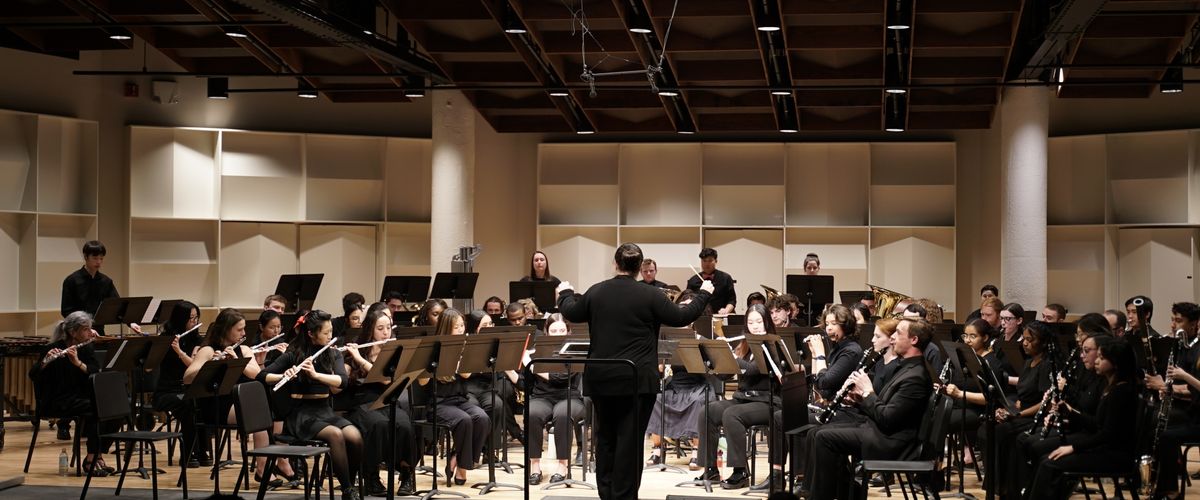
Boston University Concert Band
Dr. Jennifer Bill, conductor
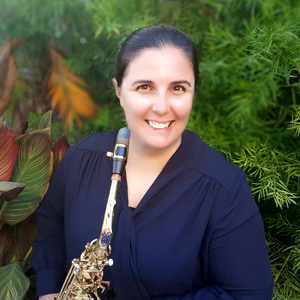
Kaitlin Oresky, Teaching Assistant
Boston University All-Campus Orchestra
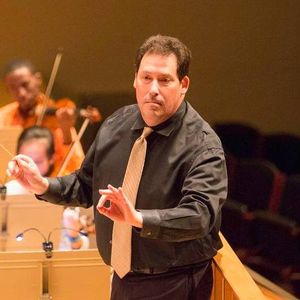
Mark Miller, conductor
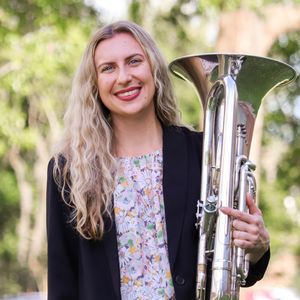
Ian Henscheid, Teaching Assistant
| The Promise of Living | Aaron Copland (1900-1990) trans. K. Singleton |
| Ireland: Of Legend and Lore | Robert W. Smith (1958-2023) |
| Dance of the Yao People Kaitlyn Oresky, Conductor |
Liu Tieshan & Mao Yuan (1926-2022) |
| Chamak I. Ember II. Luster III. Spark |
Reena Esmail (b.1983) |
| Seis Manuel Luis Javier Santiago Sierra, conductor |
Shelley Hanson (b.1951) |
| Danzas Cubanas | Robert Sheldon (b.1954) |
| — Intermission — | |
| Pomp and Circumstance March No. 4 | Edward Elgar (1857-1934) |
| Symphony No. 9 Op. 95 “From the New World” 1. Adagio-Allegro Molto |
Antonín Dvořák (1841-1904) |
| The Sleeping Beauty Suite, Op. 66a Introduction Valse Pas D’action |
Pyotr Ilyich Tchaikovsky (1840-1893) |
Rosters
Boston University All-Campus Orchestra Fall 2025
| Name | Year / Major |
|---|---|
| Violin I | |
| Sarang Narasimhan | 2029, Neuroscience |
| Soyoung Bae | PhD 4th Year, Molecular Biology, Cell Biology, Biochemistry |
| Aaron Chu | 2028, Computer Science |
| Elaine Chu | 2026, Music Education |
| Joshua Frank | 2028, Human Physiology |
| Alyssa Lee | 2029, Biology |
| Abby Mercier | 2028, Education |
| Lawrence Miao | Grad 1st Year, Artificial Intelligence |
| Leo Oiwa | 2028, Mechanical Engineering |
| Carla Romney | |
| Lauren Smith | Grad 3rd Year, Law |
| Justina Wang | 2028, Human Physiology |
| Cindy Yao | 2029, Biology |
| Claire Zhang | 2027, Biological Anthropology |
| Violin II | |
| Yudi Zhang | 2028, Physics and Chemistry |
| Leah Bae | 2029, Sociology |
| Mariana Durango Bedran | 2029, Political Science |
| Arantza Cruzado | 2029, Undeclared Engineering |
| Jenny Cui | 2026, Human Physiology |
| Peyton Johnson | PhD 1st Year, Physics |
| Michelle Kim | 2026, Biochemistry & Molecular Biology |
| Evan Leong | 2028, Data Science |
| Ling Lu | 2029, Psychology |
| Anne Thurmel | Grad 2nd Year, Computer Science |
| Erina Yao | 2028, CAS Exchange |
| Viola | |
| Ethan Wilson | 2029, Physics |
| Ambar Garcia | 2029, Psychology |
| Julie Labat | 2027, Political Science |
| Malac Mahmoud | 2028, Health Sciences |
| Brycen Martin | 2029, Electrical Engineering |
| Veronica Moy | 2029, Business Administration |
| Katie Vongsouvanh | 2029, Data Science |
| Cello | |
| Yasheng Jiang | 2027, Physics |
| Amelia Andre | 2027, Neuroscience |
| Patrick Gong-Harjula | 2028, Biology |
| Ellie Lee | 2029, Music BA |
| Jenna Lee | 2027, Advertising |
| Sophia Lorenz | 2028, Biology |
| John Olaoye | 2029, Computer Science |
| Anna Peelen | 2029, Advertising |
| Noah Shafer | 2027, English |
| Kayla Shechter | BU Academy 3rd Year |
| Frank Yang | 2027, Math and Computer Science |
| Bass | |
| Julia Glazebnik | 2029, Political Science |
| Flute | |
| Sarah Chang | 2028, Advertising |
| Erin Lee | 2029, Education |
| Sara Li | 2029, Mechanical Engineering |
| Oboe | |
| Angus Black | 2027, Astronomy and Physics |
| April Li | Grad 2nd Year, Music Education |
| Barrett Schenk | Alum 2025, Biomedical Engineering |
| Clarinet | |
| Chloe Chung | 2029, Biological Anthropology |
| Sanjana Jadhav | 2029, Neuroscience |
| Bassoon | |
| Andrew Skrzypczak | Grad 1st Year, Mechanical Engineering |
| French Horn | |
| Alicia Hamm | 2026, Journalism |
| Sandy Shiff | 2026, Statistics and Philosophy |
| Trumpet | |
| Alex Fu | 2029, Mechanical Engineering |
| Percussion | |
| Ethan Putlack | Grad 1st Year, Actuarial Science |
| Harp | |
| Velana Valdez | 2027, Neuroscience and Philosophy |
Boston University Concert Band Fall 2025
| Name | Year / Status | Major / Program |
|---|---|---|
| Flute | ||
| Jewel Ahn | 2029 | ENG – Computer Engineering |
| Clarice Bouvier | community member | Optometry Resident, Massachusetts Eye & Ear Infirmary |
| Avery Cavanagh | 2026 | CAS – Anthropology |
| Brian J. Chang | 2026 | CAS – Marine Science |
| Nandini Chilakapati | 2029 | CAS – Chemistry |
| Sophia Eriksen-Schultz | 2029 | CAS – Political Science |
| Sydnee Funai | 2026 | ENG – Mechanical Engineering |
| Sahana Gibbons | 2029 | CAS – Ecology and Conservation Biology |
| Amie Gramo | community member | |
| Kate Herrema | PhD 2027 | ENG – Biomedical Engineering |
| Shayna Kadish | 2029 | Wheelock & KHC – Education and Human Development |
| Martha Kolpien | 2027 | CAS – Earth and Environmental Science |
| Shelby Laime | 2027 | CAS – Political Science |
| Ella Lindstrom | 2029 | Wheelock – Education and Human Development |
| Albert Liu | 2029 | ENG – Biomedical Engineering |
| Cynthia Lu | 2026 | QST & CAS – Mathematics and Finance |
| Lewa Omilola | 2029 | CAS – Chemistry |
| Judith Powsner | alum 1986 | Masters in Social Work |
| Cara Ravasio | PhD 2025 | ENG – Biomedical Engineering |
| Amanda Wong | 2029 | ENG – Mechanical Engineering |
| Primrose Yooprasert | alum 2018 | Masters in Management |
| Oboe | ||
| Sage Andrews | 2028 | CAS – Biology |
| Susanna Cho | 2028 | COM – Public Relations |
| Ariel Narayan | MA 2027 & alum 2025 | COM – Media Science |
| Franklin Phan | 2026 | Sargent – Human Physiology |
| Ella Reed | 2027 | Pardee – International Relations |
| Bassoon | ||
| Eric Falley | alum 2024 | Masters of Divinity |
| Trevor Powell | alum 2023 | B.A. in Environmental Analysis & Policy / Masters in Energy & Environment |
| Andrew Skrzypczak | MS 2027 | ENG – Mechanical Engineering |
| Clarinet | ||
| Makaila Banks | PhD 2026 | Neuroscience |
| Maria Gonzalez | 2026 | CAS – Computer Science |
| Rebecca Lorentzatos | 2027 | CAS – Math and Computer Science |
| Mikayla Martinelli | community member | |
| James Robson | PhD 2026 | ENG – Biomedical Engineering |
| Cassandra G. Villarreal | alum 2016 | B.A. in History of Art and Architecture |
| Ava Wiseley | 2029 | COM – Journalism |
| Kaylee Yoo | 2028 | CGS – Business Administration |
| Bass Clarinet | ||
| Christopher Hyon | 2026 | Sargent – Health Science |
| Stephanie Li | 2028 | CAS – International Relations |
| Alto Saxophone | ||
| Mike Desouvre | community member | |
| Caroline Ferris | alum 2020 | B.A. in Math and Computer Science |
| Samantha Minuche | alum 2025 | B.A. in Neuroscience |
| Ivy Tanaki | 2028 | ENG – Mechanical Engineering |
| Cecilia Teigeiro | 2028 | CAS – Biology (Pre-medical) |
| Adena Velasquez | 2029 | CFA – Music Education |
| Tenor Saxophone | ||
| Lauren Reilley | 2027 | CAS – Neuroscience |
| Krista Singh-Woods | alum 2018 | B.A. in Sociology |
| Aaranie Srikanthan | 2028 | CAS – Biology (Cell, Molecular, and Genetics) |
| Baritone Saxophone | ||
| Griffin Preisler | 2029 | SHA – Hospitality Administration |
| Trumpet | ||
| Miranda Demers | community member | Meredith College – Biology |
| Sierra Hansen | alum 2022 | B.A. in Psychology |
| Susanna Hontz | alum 2025 | Masters in Higher Education Leadership |
| Nikhil Khemani | 2027 | CAS – Chemistry |
| Ellen Latsko | alum 2017 & 2020 | B.S. in Human Physiology and Master in Public Health |
| Jordan McMahon | alum 2017 | B.S. in Electrical Engineering |
| Samuel Norton | 2029 | ENG – Computer Engineering |
| Ryan Rosenberger | alum 2022 & 2023 | B.S. and Masters in Electrical Engineering |
| Lucas Sherwin | alum 2020 | B.A. in Computer Science |
| Tyler Smith | alum 2022 | B.S. in Mechanical Engineering |
| Selene Wu | 2026 | CAS – Computer Science |
| Horn | ||
| William Diederich | community member | |
| RJ Horvat | alum 2023 | Masters in Music Theory |
| Jared Murphy | community member | |
| Trombone | ||
| Evan Barry | 2029 | CAS – Linguistics |
| Alec Candib | PhD 2028 | CDS – Bioinformatics |
| Alec Lu | 2028 | Sargent – Human Physiology |
| Ethan Kim | 2029 | ENG – Mechanical Engineering |
| Liliana Krastel | 2029 | CAS – Earth and Environmental Science |
| Katherine Sadler | 2029 | CFA – Music |
| Bass Trombone | ||
| Thuc Nguyen | alum 2020 | B.S. in Computer Engineering |
| Euphonium | ||
| Alec Metcalf | 2029 | CAS – Political Science and Mathematics |
| Nadene Stein | alum 1984 & 1986 | B.A. in English & M.Ed. in Elementary Education |
| Tuba | ||
| Vivek Mirchandani | alum 2025 | B.A. in Neuroscience and Psychology |
| Brackney Pickett | PhD 2026 | GRS – Astronomy |
| Jason Ricciardi | 2028 | ENG – Mechanical Engineering |
| Piano | ||
| Andy Hui | alum 2022 | Master of Public Health |
| Percussion | ||
| Emma Connor | 2028 | CAS – Marine Science |
| Emily Frank | 2026 | COM – Film and TV |
| Kat Howell | community member | |
| Keira Howland | 2029 | CAS – Mathematics |
| Andy Hui | alum 2022 | Master of Public Health |
| Larissa Ireland | alum 2021 | B.A. in Environmental Analysis and Policy |
| James Kang | alum 2014 & 2020 | B.S. in Advertising & MBA |
| James Maher | alum 2022 | B.S. in Biomedical Engineering |
| Jenna Moscaritolo | alum 2022 | Masters in Statistical Practice |
Program Notes
This beautiful piece is quite transparent and chamber-like at its outset. As the work builds, Copland dramatically introduces the folk song “Zion’s Walls” and begins to alter the feel between duple and triple quite frequently. The melodies intertwine and overlap as the piece builds to its striking climax. Copland’s only full-length opera, The Tender Land (1952–1954), tells the story of a young girl, Laurie Moss, who grows up on a Midwestern farm and is about to leave home. In The Promise of Living, three generations of the Moss family and their hired hands sing a hymn of gratitude for life, the land, and the spring harvest. – windrep.org Composer Robert W. Smith has drawn from traditional Irish melodies and highlighted several castles and colorful characters in his Ireland: Of Legend and Lore. Brian Boru (942–1014) was an Irish king noted for his chivalry. Legend has it that the march was first played as his men carried his body to its final resting place. The soft air of “Grace O’Malley” honors the daughter of a chieftain for her legendary strength and leadership. She used Carrickhowley Castle as the center for her successful trade and piracy operations. Irish melodies of “Sing Ahh” and “Courtly Dance” are interrupted by threatening and warlike sounds marking Cahir Castle’s many battles and sieges from its construction in 1142 to its final surrender in 1647 during the Irish Confederate Wars. – Foothill Symphonic Winds In 1951, Liu Tieshan—a teacher at the Central Conservatory in Beijing—and several of his students traveled to southern China to study and collect folk music. Liu gathered several of the melodies they heard into a piece called Long Drum Dance of the Yao People, which his colleague Mao Yuan orchestrated in 1952 as Dance of the Yao Tribe, a multi-sectional medley of contrasting elements, beginning in haunted yearning song and ending in high-energy dance. It has since been arranged in many versions, inspired several pop songs around the world, and was used in the soundtrack to the 1980s video game The Way of the Exploding Fist. – John Henken The word chamak means “spark” in Hindi — and the title of this work was inspired by a beautiful couplet from the Indian saint-poet Kabir: जैसे तेल में तेल है which translates to: Just as a seed holds oil Each of the three movements of this piece explores a different translation of the word chamak: the first is Ember, a dark, smoky, lilting melody in Raag Bhimpalas; the second, Luster, is a warm, intimate journey in Raag Hamsadhwani; and the last movement, Spark, is a fiery, vibrant jaunt in Raag Jog. I hope this piece ignites a spark in two ways. As young creative people, just beginning to find their way in the world, I hope this piece is a reminder to follow that spark that lies within each of them. And more broadly, I hope that this piece sparks an interest in Indian classical music in the band world — these musical cultures have been separate for so many years, and I hope this piece sparks further connection between these two worlds. – Reena Esmail Seis Manuel is the third movement of the suite Islas y Montañas. The seis is the traditional song and dance form of the Jíbaro people, the farmers of the mountains of Puerto Rico. At least 50 distinctive types of seis have been identified. The term originally meant a dance for six men or six couples. This movement, Seis Manuel, is based on a traditional recurring harmonic pattern called the seis mapeyé, over which a singer improvises a melody. Because of the very long history of military bands in Puerto Rico, with a particular importance placed on low brass and clarinets, those instruments are given solos. In keeping with the Puerto Rican tradition of naming a seis after someone important to its creation, this Seis was renamed in honor of conductor Manny Laureano, who commissioned and premiered the piece. – Shelley Hanson Celebrate the joy and energy of Afro-Cuban music! Feel the beat, beginning with the opening conga, followed by a gentle and alluring son-salsa, and closing with a fast-paced mambo. An intense experience for players and audience featuring solos for piano, trombone, flute, and trumpet! Ubaldo Montesino was an old friend of mine from way back in the days of my early career as a band director in Palm Beach County, Florida in the 1970s. He had a wicked sense of humor and was one of the nicest people anyone could have the privilege of knowing. After his untimely death, the Palm Beach County Band Directors Association asked me to conduct their high school honor band and write a piece to be premiered in his honor. They suggested the title El Loco Cubano (“The Crazy Cuban”). Although Ubaldo would have approved, I just could not use that title. Instead, I decided to use three styles of Cuban music that I loved and went from there. Most Cuban music is not terribly melodic, but since I am a “melody guy,” I made the piece more melodic than most music in that genre. Ubaldo was a very talented trumpet player, and I was told that his cousin Gloria Estefan had asked him to be in her band, The Miami Sound Machine. He decided not to accept Gloria’s invitation as he loved being a band director and didn’t think her band would amount to anything — wow, was he wrong about that! So, the trumpet player in the videos is Victor Lopez (slicked-back hair and sunglasses), a fellow composer and friend who at that time was also Band Director at Miami Senior High School and later Principal at that school. Victor had presented a clinic on Latin American rhythms at the Midwest International Band and Orchestra Clinic around 2005, and I had seen that and still had his handout of percussion rhythms. I called Victor and asked him if using those rhythms as written would work in my piece, and he was certain that they would. He was right! On my way home after the premiere of the piece that night, I called Victor, thanked him, and told him I owed him dinner! – Robert Sheldon “…the neighing steed, and the shrill trump, the spirit-stirring drum, the ear-piercing fife, the royal banner, and all quality, pride, pomp and circumstance of glorious war.” The fourth march was completed on June 7, 1907—five days after Elgar’s 50th birthday—and premiered in Queen’s Hall on August 24, 1907. No. 4 is similar to No. 1, the iconic graduation march, in having a lively, rhythmic section and a broad lyrical trio melody. By listening closely, you’ll hear its resemblance to the famous march played at graduations around the world. Two months after arriving in the United States, Dvořák wrote to a friend: “The Americans expect great things from me. I am to show them a way into…the realm of a new, independent art.” Hardly daunted, he was inspired by their faith in him and quickly sought out samples of American folk idioms. Dvořák found a wealth of inspiration in African American spirituals and the music of the continent’s Indigenous peoples. The heartfelt Symphony No. 9 grew out of this fascination, creating a representation of the “New World” that seemed almost impossible from the pen of a visitor. Many of the symphony’s themes appeared to be direct folk quotations, but Dvořák insisted they were his own inventions—crafted through deep study of native melodies. His interpretations were so authentic that, even today, it can be hard to believe they weren’t direct borrowings. Dvořák gifted America a masterpiece that celebrated its unique musical soul. While the 2nd movement’s English horn solo and the 4th movement’s “Jaws”-like motif are famous, the 1st movement is structurally the strongest. Its rhythmic profile reappears throughout the work, creating unity across all four movements. The introduction begins like the start of an epic tale—an aural “once upon a time.” The music then builds in waves of energy and lyricism until the final measures, where horns and trumpets triumphantly bring the movement to a close. — Utah Symphony Orchestra & Max Derrikson (Edited) Tchaikovsky wrote his first ballet, Swan Lake (1875), admittedly for the money. The project filled his pockets but also awakened his gift for writing music that embodies dance. Thirteen years later, and after composing two symphonies and several operas, Tchaikovsky was commissioned to write another ballet—this time based on the fairy tale The Sleeping Beauty. Since its premiere, The Sleeping Beauty has become a cornerstone of ballet repertoire. Even in concert form, its music enchants—Tchaikovsky at his finest. The suite opens with music heard before the curtain rises: rather than graceful dance music, it begins with the muscular motif of the wicked fairy Carabosse, who curses Princess Aurora. Soon follows the shimmering theme of the Lilac Fairy, Aurora’s protector. We then hear the procession of Aurora’s suitors, the lively “Puss in Boots” dance from the Act III wedding, and the radiant Panorama at the start of Act II. The suite concludes with one of Tchaikovsky’s most beloved waltzes, danced by the corps with garlands of flowers in celebration of Aurora’s sixteenth birthday. — Orrin Howard (Edited)The Promise of Living - Aaron Copeland
The name Aaron Copland (1900–1990) is synonymous with American classical music. His most popular works—Appalachian Spring, Billy the Kid, Rodeo, Fanfare for the Common Man, and El Salón México—each infused a sense of folk music with his distinctive compositional style that was able to connect with a wide audience. Although written later than the aforementioned works, The Promise of Living is representative of this same distinctive Copland style. The work serves as the final movement of an orchestral suite Copland based on his opera The Tender Land.
Ireland: Of Legend and Lore - Robert W. Smith
Dance of the Yao People - Tieshan & Yuan
Chamak - Reena Esmail
ज्यों चमक में आग
तेरा साईं तुझ में है
तू जाग सके तो जाग
And a spark holds fire
Your own spirit is inside of you
If you can awaken it, you must.
Seis Manuel - Shelley Hanson
Danzas Cubanas - Robert Sheldon
Pomp and Circumstance March No. 4 - Edward Elgar
Elgar’s name first became known in London through his Imperial March (1896), which was used for Queen Victoria’s Diamond Jubilee on June 22, 1897. Building on the momentum of this success, Elgar began writing his most famous and beloved march, Pomp and Circumstance No. 1 (the first of five).
He took the title Pomp & Circumstance from Shakespeare’s Othello, Act 3 Scene 3, in which Othello bids farewell to his soldier’s profession, his warrior-like character undermined by the mistaken belief in Desdemona’s infidelity:
Elgar himself described it as “gaudily gay and brilliant,” and, with a sly smile, showcased how the march and trio themes can beautifully intertwine in a triumphant coda.
— The Elgar Society (Edited)Symphony No. 9, Op. 95, From the New World: I. Adagio – Allegro Molto – Antonín Dvořák
The Sleeping Beauty Suite, Op. 66a: Introduction, Valse, Pas D'action - Pyotr Ilyich Tchaikovsky
Biographies
in alphabetical order