BU Class Connects Russian Language Students to Local Russian Speakers
Russian in Boston offers Terriers an opportunity to learn from, and engage with, older adults of the Russophone diaspora
BU Class Connects Russian Language Students to Local Russian Speakers
Russian in Boston offers Terriers an opportunity to learn from, and engage with, older adults of the Russophone diaspora
When learning a language, it can be immensely helpful to practice conversing with native speakers. But one Boston University language class goes further, tasking students with not only practicing their conversational skills, but also with learning firsthand about native speakers’ immigration stories.
The advanced Russian language course Russian in Boston also provides a deep dive into Russophone immigration to the Boston area. The class aims to connect students to the large number of native speakers living in nearby neighborhoods and towns like Brighton and Brookline. This past fall, the class partnered with Hebrew SeniorLife, a senior living residence organization in Brookline that’s home to a large concentration of Russian-speaking residents.
East Coast locales like New York City and Greater Boston are longtime strongholds for the Russophone community. The Russian in Boston course seeks to take advantage of that resource. BU is “located in an area of the city that historically has Russian speakers,” says instructor Irina Kogel, a College of Arts & Sciences Russian language lecturer who’s originally from Belarus. “You can get a lot of practice within a classroom setting, but ultimately, we’re looking for authentic, motivating factors for students that prove they can really do something with their language abilities.”
The Russophone diaspora is vast. Russian is an official language of four countries: Russia, Belarus, Kazakhstan, and Kyrgyzstan. The language is spoken widely throughout the world, however, particularly in the former Soviet states. Russian in Boston begins with a historical overview of emigration from Russian-speaking countries into Greater Boston. The overview stretches from the pre–Russian Revolution wave of emigration, during the late 19th and early 20th centuries, all the way to the post–Soviet Union years and the present day. Students learn about immigration and integration processes by analyzing historical documents, including memoirs, photo essays, academic writings, and more. The course is typically taught every two years, unless students express interest in a yearly section.

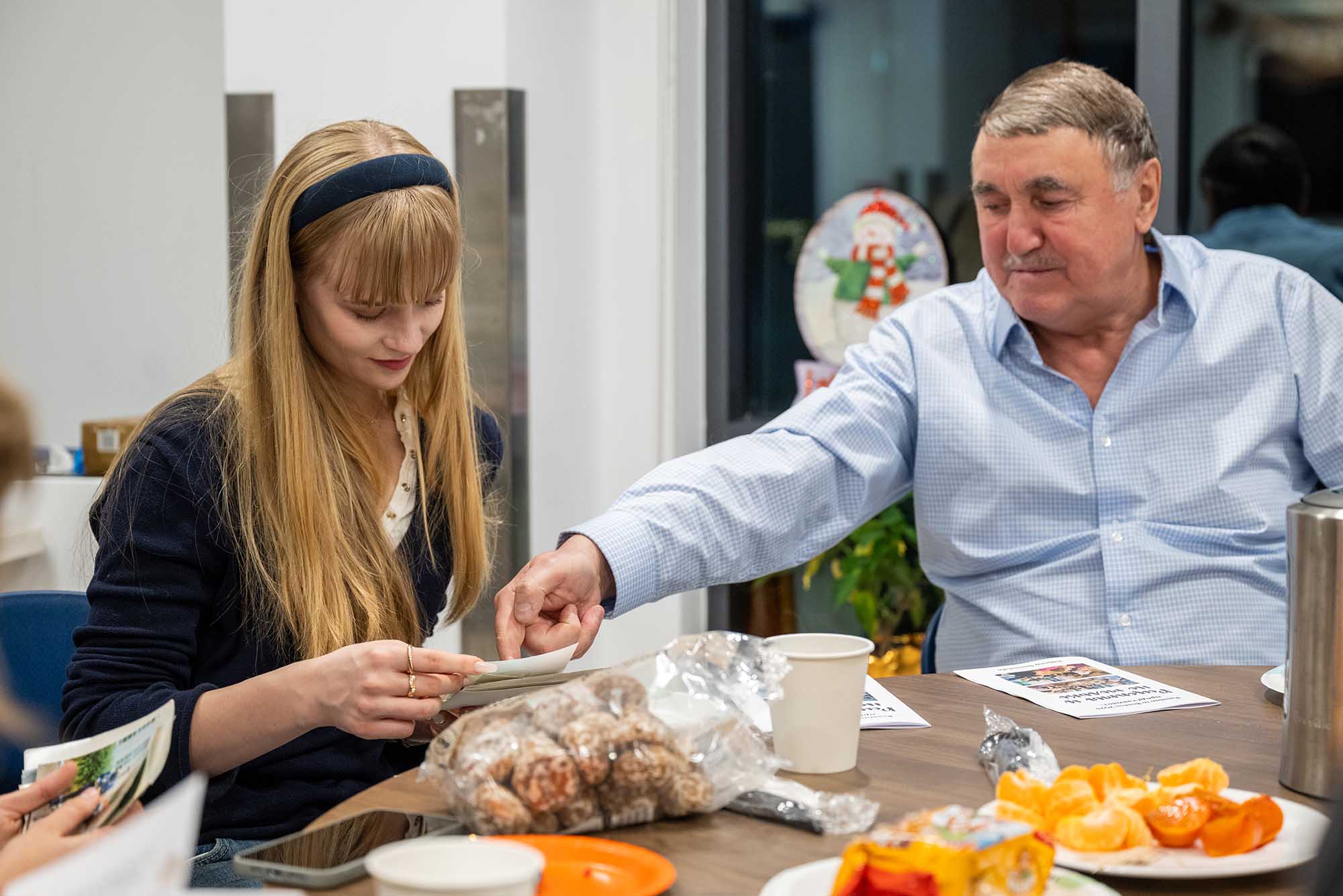
The idea is to learn about Russian history, Kogel says, then to engage with someone who personally experienced it. To that end, she paired each student with a Russian-speaking elder at Hebrew SeniorLife. Students met with the elders at the center throughout the fall semester and got to know them through conversations in Russian, asking them about their day-to-day lives, culinary traditions, and what it was like leaving their home country to begin a new life in the United States. At the end of the semester, students delivered presentations on what they learned from the elders.
Kogel says that firsthand knowledge is “richer than anything I could give [students] as prepackaged material to understand the nuance and complexity of immigration historically and today.”
For example, she notes, it’s one thing to teach students about Belarus or Ukraine in the 1930s, when Soviet policies caused the death of millions and led to mass immigration to the United States, “but if we have someone interviewing an elder who grew up in Ukraine,” she says, “they’re going to get that history in a really powerful way.”
Students say the course has helped connect them to the community, and in some instances, to their roots.
Madina Khasanboeva (COM’27, CAS’27) is a heritage speaker, meaning she grew up in a Russian-speaking family and learned the language from them. Originally from Uzbekistan and raised in New York, Khasanboeva took a previous Russian class at BU and was eager to sign up for a more immersive one. She found Russian in Boston to be one of the most memorable classes of her BU career.
“I was very curious to know about the Russian community in Boston, and this class helped me understand the variety of people within the Russian diaspora,” she says. For the class, she was paired with a 94-year-old woman from Ukraine. “My conversations with her were not only helpful in improving my Russian, but also it was a chance for her to share wisdom on the importance of community and family.”
Khasanboeva learned from her classmates, too. “I am very grateful that I was able to learn how my classmates experienced the Russian diaspora and how we all were able to relate to each other,” she says. “Professor Kogel was a big part of creating this welcoming environment and always encouraged us to share our stories, which at first seemed intimidating, but was very comforting afterwards.”
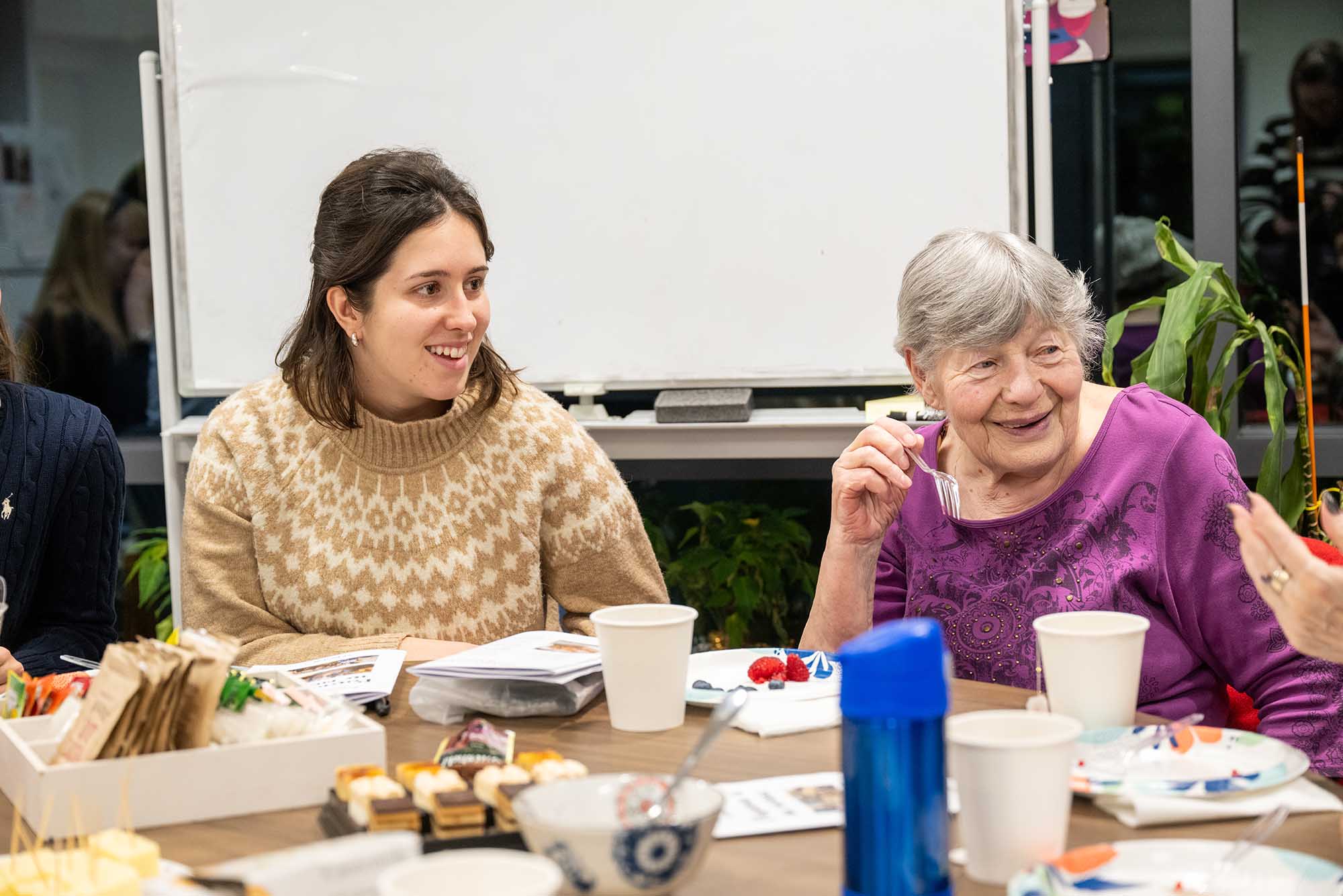
Fellow heritage speaker Beyla Khabensky (COM’29) agrees. The daughter of Kazakh and Ukrainian immigrants, she grew up speaking Russian at home, but was “quickly humbled,” she says, by in-depth discussions in class that went beyond her language capabilities.
But the challenge was worth it, Khabensky maintains, particularly after attending fun class events—and getting to know her elder partner. Meeting with him at Hebrew SeniorLife “gave me a sense of home, reminding me of time spent with my grandparents and bringing a bit of familiar culture into my life,” she says. “I’d definitely recommend this class to people like myself who want to connect deeper with their cultural background while continuing to improve their language skills.”
The experience proved equally beneficial for the elders.
“Instead of coming to me only when something is wrong, residents started stopping by to share their excitement about meeting with their BU partner,” says Hebrew SeniorLife residence services coordinator Marina Shkayeva. Some students and residents met beyond the required sessions, she adds, and certain residents began attending more community events after interacting with their paired students.
“The final [event], where the students bid farewell, was especially moving, because we could witness the genuine connections that were built,” Shkayeva says. “Residents expressed gratitude for the program and satisfaction in helping students improve their language and cultural knowledge.”
And that was precisely the goal, according to Kogel. Beyond strengthening conversational skills, she hopes students developed a better understanding of the Russophone community. For students who are heritage speakers, that might mean gaining an appreciation for the experiences of their parents or grandparents. More than anything, Kogel hopes all students now see themselves as part of Boston’s Russian-speaking community.
That label “encompasses all of us,” Kogel says. “By studying Russian, even if they were not culturally connected to it, students have become part of that community; interacting with it and having it be a meaningful part of their life going forward is the hope.”