Questrom Revises Undergrad Curriculum to Help Students Better Prepare for Internships, Jobs
Earlier core instruction and new experiential courses among linchpins
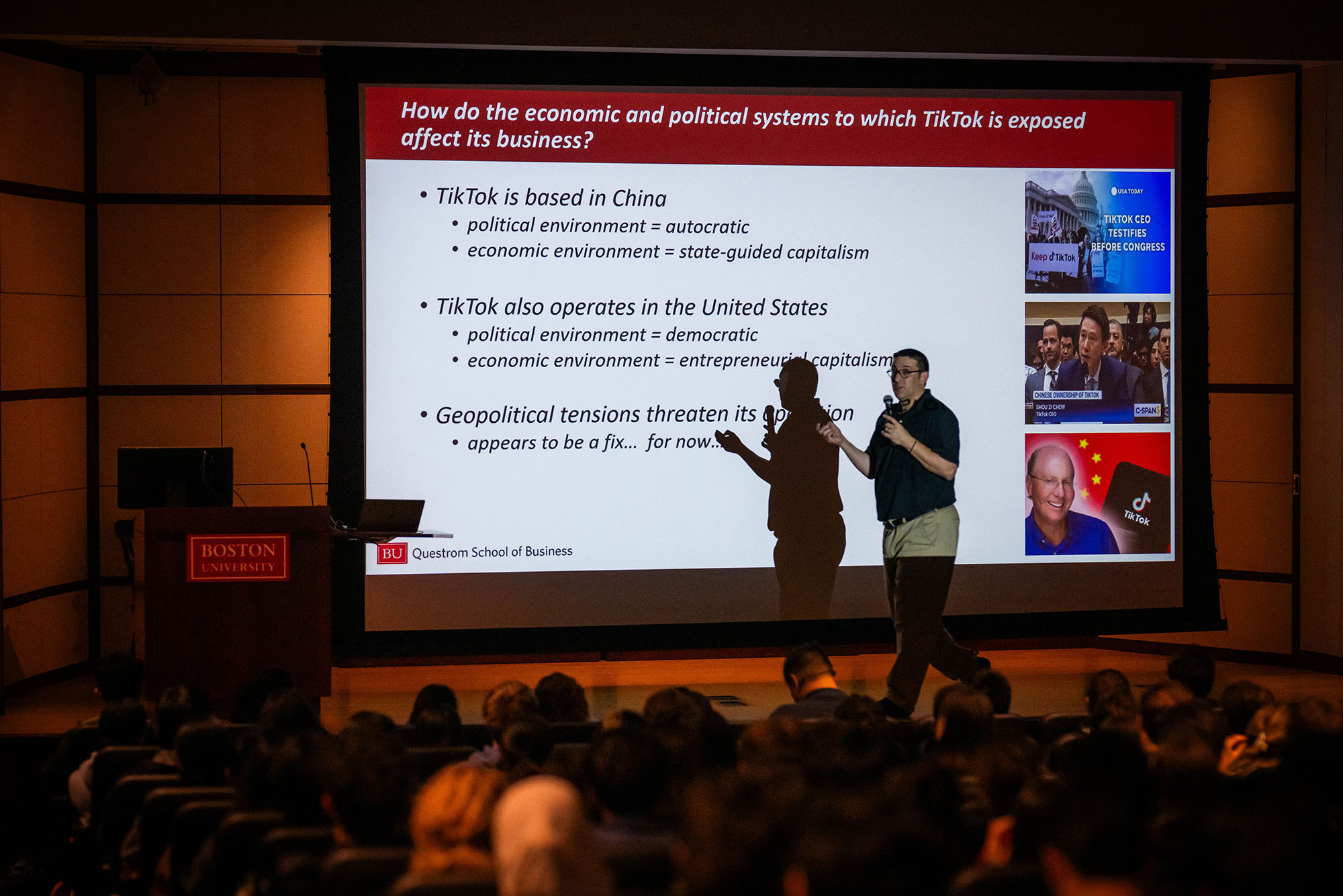
Jeffrey Furman, associate dean of undergraduate program at Boston University’s Questrom School of Business and a leader in the school’s first major curriculum overhaul in decades, teaches Business, Markets & Society, updated to introduce certain skills per the revision.
Questrom Revises Undergrad Curriculum to Help Students Better Prepare for Internships, Jobs
Earlier core instruction and new experiential courses among linchpins
Studying finance at Boston University’s Questrom School of Business, John Lyons was getting a fine education—but the timing was wrong. The sequence of instruction conflicted with many deadlines for securing internships, the potential gateways to future jobs, says Lyons (Questrom’26).
“For finance in particular—which is Questrom’s largest concentration—students would recruit for junior year internships as early as the fall of their sophomore year,” he says. “By this point, they would still be taking Questrom’s copious amount of prerequisite courses, and would usually need to teach themselves what they needed to know for technical interviews.” If they were lucky enough to nab an internship, they would then have to “relearn, in their junior or senior year, what they’d taught themselves.”
Questrom is remedying the problem. This fall, it has begun rolling out a new curriculum for undergraduates—the first such revision in about a dozen years and the first stem-to-stern overhaul in decades—that will expose students earlier to the classes and real-world experience that employers seek in interns and employees.

The new curriculum eliminates the school’s “integrated core.” That was four core courses—quantitative methods, finance, marketing, and operations—that had been taught together, usually during a Questrom student’s junior year, says Barbara Bickart, Questrom senior associate dean of programs and an associate professor of marketing. The integrated core was innovative at its creation 30 years ago; today, its timing didn’t work. Junior year is too late for many companies that expect the students they hire for internships to have learned certain disciplines by sophomore year. The core’s courses have been separated, and students will take them earlier in their studies or whenever seems appropriate.
“The new curriculum is a big step in the right direction,” says Lyons, who had some advice for administrators as they worked on it. The changes will allow students “to begin taking higher-level elective courses in their sophomore year, so they will be able to hit the ground running when recruiting rolls around,” he says. And students will begin internships after their freshman year.
A survey of recent Questrom grads found many feeling on their back foot when competing for internships because they hadn’t taken finance until junior year. Anita Carson, Questrom’s Larz Anderson Professor in Operations and Technology Management, studied 52 other undergraduate business schools and found that most let students take finance before their third year, while Questrom delayed it by requiring numerous prerequisites first.
The retooled curriculum allows students to take finance, marketing, and/or operations management courses during sophomore year. “With content, capacity-building, and hands-on experiences carefully layered and crafted across the four-year [curriculum], the day one–ready undergrad delivers” for employers, says Susan Fournier, Questrom’s Allen Questrom Professor and Dean.
The curriculum changes address another problem that Questrom heard from employers, says Bickart: that students weren’t “facile” at handling the business world’s often ambiguous data to make decisions. So three new mandatory, experiential learning courses will let students get their hands dirty:
- a semester-long Core Innovation Project, resembling the integrated core’s challenging students to identify potential new products or services for Boston-based companies such as Dunkin’, Gillette, and New Balance;
- a Global Business Experience in which students will either study and work abroad or complete a course at Questrom where “they engage with experienced international executives, including Questrom alumni,” to explore key global business challenges, says Jeffrey Furman, a Questrom professor of strategy and innovation and associate dean of the school’s undergraduate program;
- a course in a student’s field of concentration addressing a project relevant to a corporate partner.
The new curriculum will phase in over several years, starting with freshmen this semester. ”Our sophomores, juniors, and seniors will still be completing the previous curriculum,” Bickart says. The new approach will teach students what the school calls “quests”: critical and innovative thinking, analytics, teaming and leadership, markets and competition, the global business context, and tech literacy and tech-evolution of business and markets, such as artificial intelligence. The quests, Fournier says, are “core capacities that students need for successful careers, as reinforced by companies who hire our students.”

Furman teaches one example of the new curriculum: an old course—Business, Markets, and Society—that he redesigned to introduce the markets/competition and global business quests. He also converted a formerly online lecture into an in-person one “to help generate community among the students,” he says.
The class, Fournier says, “was totally redesigned to provide essential foundations in the role and purpose of business and the functioning of markets and competition, all thorough the lens of leveraging the power of business for value creation for society.”
The last revision, more than a decade ago, sidestepped big changes, such as reordering the core, because of faculty resistance, Bickart says. This time, Carson’s data about other schools teaching core courses, particularly finance, earlier in students’ careers clinched the case for change, as did employers demanding better-trained students for internships and non-faculty staff who work with students. Employers and alumni told the school that students needed better preparation “for the accelerated hiring timelines for highly competitive roles,” says Monica Parker-James, associate dean for Questrom’s Feld Center for Career & Alumni Engagement, “and for the trend toward students completing multiple internships, often starting after their first year.”
“A series of incremental improvements simply cannot deliver against the transformational changes affecting businesses and jobs,” Fournier says. “To be willing to start over and reverse-engineer backwards from the contemporary world of business takes courage, commitment, and a faculty and staff willing to change. It’s culture change at scale.”
Furman believes the curricular changes will help students navigate ever-morphing business conditions from big changes like artificial intelligence. “AI is different in its nature of automation,” he acknowledges, “but technology has been automating tasks since Gutenberg and since the wheel. The tasks associated with many jobs end up changing as a consequence of automating technologies. But it turns out employment has pretty much remained robust, as long as people have generalizable and flexible skill sets.”
Bickart agrees: “A lot of the kinds of things that a student might do in an entry-level job could be done by AI. So then what will they be doing? I’m not sure we even know the answer to that yet. I want to give them skill sets that aren’t so specific, that are going to allow them to be successful in a career, that they can take and be successful regardless of what’s going on in the company.”
The new curriculum’s multiyear rollout provides time for tweaking the new curriculum. “We can’t just wait for another 10 years for another task force,” she says. “We’ll have to kind of continually be assessing what we’re doing, and I’m sure things will change. Everything is a little bit of an experiment. And I don’t think we’re afraid to say, hey, this isn’t working, we’ve got to change this.”