Making a Case for Classical Music
New York Times’ Tommasini champions the new
Anthony Tommasini (CFA’82) talks about his role as chief classical music critic for the New York Times. Photos by Joshua Paul
At an age when schoolmates were captivated by Mickey Mantle, Anthony Tommasini had a different idol: Giacomo Puccini. When he was 15, he would ride the train to Manhattan from his Long Island suburb to blissfully endure the vertigo of the fifth balcony of the Metropolitan Opera House. There, he soaked up the exhortations of a pining Tosca and the arias of a lovesick Madame Butterfly. From then until now, when he occupies a seat in the orchestra, the chief classical music critic of the New York Times has been consumed by music.
At 62, Tommasini (CFA’82) is a bespectacled, reserved man whose solemn, almost hangdog demeanor is a counterpoint to the outsized personalities of many of the divas he writes about. In his perch as one of the most influential classical music critics in the world, Tommasini treads respectfully—he is, after all, covering the Metropolitan Opera for its loftiest patron as well as the wide-eyed novice.
If Tommasini has an agenda, it is to save classical music from death by inbreeding, and to expand the repertoires of major orchestras to include the works of the next generation of classical composers. And although he is too modest to count them as personal victories, his commentaries have contributed to a rejuvenation of the New York Philharmonic under the direction of the young Alan Gilbert and what appears to be a promising revival of the moribund New York City Opera.
He has also been a weighty supporter of boundary-pushing artists like Norwegian pianist Leif Ove Andsnes, Los Angeles composer Stephen Hartke, and composer and 2009 Pulitzer finalist Harold Meltzer. When George Steel, a relative newcomer to opera, was hired two years ago as general manager and artistic director of the New York City Opera, Tommasini applauded what others saw as a risky move. Now, the company is inarguably on the upswing.
Born to musically indifferent parents, Tommasini as a preschooler incessantly picked out tunes on a toy keyboard, “like Schroeder,” he recalls. After he persuaded his parents to buy an actual piano, he attracted attention not only for his playing—at 16 he won a competition performing a Mozart concerto at Manhattan’s Town Hall—but also for his unbounded appetite for musical knowledge.
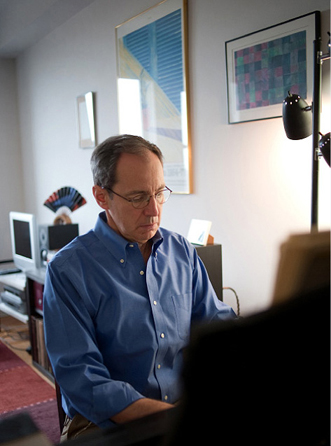
“I figured out a lot of things on my own,” says Tommasini, sipping tea in the 14th-floor Central Park West apartment he shares with his long-time partner, psychiatrist Benjamin McCommon. “A grammar school teacher who was a big opera buff gave me some advice, but part of it was just luck.” That luck still astounds him. He lost his opera virginity, one might say, with Lucia in Gaetano Donizetti’s tragic Lucia di Lammermoor, sung by world-renowned Australian soprano Joan Sutherland, whose obituary he would write for the Times more than four decades later. His first Turandot in the Puccini classic was the celebrated Swedish dramatic soprano Birgit Nilsson. And the starstruck teen’s introduction to what would be a lifelong procession of Aidas was the remarkable Leontyne Price, the first African American soprano to conquer the opera stage.
He joined the Times staff in 1996 and was named chief classical music critic in 2000. Today, his essays, musings, and often-pointed but never acerbic criticism have earned him free rein at the million-plus circulation paper, a commentary and video blog, and a vast, mostly appreciative readership.
Tommasini—Tony to his friends—is no snob. Winner of the School of Music’s 1998 Distinguished Alumni Award, he is as likely to wax poetic over Frank Loesser’s Guys and Dolls as he is over Christoph Willibald Gluck’s Alceste. To the occasional grumblings of insular opera aficionados (“…the narrow limits of Tommasini’s personal aesthetic seem to constrain his appreciation of large segments of the wide world of opera,” sniffs one blogger), Tommasini is committed, he says, to writing reviews that speak to both specialists and novices. “I’m a generalist, in the very best sense of the word.”
His mentors include composer Virgil Thomson, the New York Herald Tribune music critic from 1940 to 1954, and Richard Dyer, now retired after 33 years as the Boston Globe’s classical music critic.
His long friendship with Dyer began in December 1986, when the Globe critic asked the young freelancer, who had contributed a few pieces to the paper, if he would be willing to drive to Worcester on New Year’s Eve to cover a Pavarotti concert that was a recap of one Dyer had already written about.
“He’d been well trained as a musician,” says Dyer. “He really did know what he was hearing. As my predecessor, Michael Steinberg, once said, ‘I was interested in people who shared my standards, but not my taste.’”
Tommasini brought a fresh outlook; he was interested in new music and over time, says Dyer, “he became more widely and profoundly educated.”
After contributing for almost a decade to the Globe, Tommasini decided his apprenticeship was over. “I wanted a job,” he says. “But there was no job.”
His partner was about to attend medical school in New York, and a friend suggested that Tommasini come to New York and be a freelancer. “I did,” he says, and wrote for several publications until the Times offered him a contract, which led to a staff position and culminated in his promotion to chief classical music critic in 2000.
Classical music, rock, or Yankees
A fixture on behalf of the Times at the Bayreuth Festival and other long-esteemed classical showcases, Tommasini is equally attentive to new, occasionally disastrous incarnations of staples such as Puccini’s Tosca or Mozart’s Don Giovanni. And he is distinguished from many classical music critics by his passion for American composers and underperformed contemporary works that excite and astonish him, such as Judith Weir’s A Night at the Chinese Opera.
The classical music world’s general resistance to new compositions irks Tommasini. “You don’t hear people saying, ‘I love movies, but who wants to go to a new movie?’” he says. “Suppose you had a repertory theater that produced four new plays, four 19th-century plays, and four early to mid-20th-century plays”—the same ratio “would be a radical season for the Boston Symphony Orchestra.”
And he dismisses people claiming classical music is elitist. “What does it cost to go to a rock concert or see the Yankees or the Knicks play?” he asks. “Rush tickets, at $20, can be for the best seats in the house, and there is more free classical music than any other art form. BU alone has about three events a day.”
“Of all the performing arts, classical music has been the most hopelessly bound to past repertory,” Tommasini wrote in the Times’ Critic’s Notebook in 2002. “It’s essential for those who want this art form to have a future as well as a history to encourage new work and cajole ensembles, orchestras, and opera companies into supporting living composers. Yet such calls are not meant as a criticism of the standard repertory. These works have survived for a reason. The problem is that repertory staples are trotted out too often for their own good.”
“What I admire in Tony’s criticism is not only his wide and deep knowledge of music—rare is the critic who holds a doctorate in music and has made professional recordings—but the humanity of his outlook,” says Alex Ross, who covers classical music for The New Yorker. “In a phrase, his writing is keen and kind.” And according to Dyer, “Tommasini was a nice guy 20 years ago and he still is, in a job that has corrupted more than one. He never puts on airs in his writing or in his thinking.”
His home, although it boasts location, location, location (it’s a stroll away from the iconic Cathedral Church of St. John the Divine, and a person unafraid of heights can lean out the window for a sweep of the entire park, east and south to Manhattan’s glittering skyline), is as free of ostentation as Tommasini himself. Photos of family and friends punctuate shelves housing a vast CD collection. A wall in his Spartan home office, where he writes his Times reviews and essays, is a portrait gallery of friends lost to AIDS. Those early, cruel years of the HIV epidemic still resonate with Tommasini and have infused him with an ever-percolating gratitude for his professional accomplishments and good fortune, the surprise of rich new musical works, and the companionship of the man he loves.
Born in Brooklyn, Tommasini grew up in a family of five in Malverne, N.Y., where his first exposure to live music was a production of the 1956 Harold Karr musical Happy Hunting, starring Ethel Merman. Later he would take his parents to concerts, but for years his classical fix came largely from an unwieldy collection of records, which in those days, he recalls, cost no more than $3. “In seventh grade I went to St. Paul’s, a small, all-male private school in Garden City, where I was the music,” he says. He taught himself to play the organ he alone commanded every morning at chapel. “I liked being a big shot.”
At the end of his sophomore year, Tommasini was accepted to a summer program at Dartmouth College sponsored by Juilliard Prep. The experience transformed his life both musically and socially. “I was home,” he says. “The one thing I’d never done was play with other musicians, and the program threw me in with them; they were used to it, but it was all new for me. I remember wasting time just going to orchestra rehearsals for hours.”

Tommasini was admitted to the highly regarded Oberlin College Conservatory of Music, but he opted for a broader liberal education at Yale. “I knew I was smart, and I wanted to go to a good college,” he says, “but I also thought, I’m a talented pianist, but I’m not great.” After four years of music woven into solid academics, he went on to earn a master’s in music at Yale, followed by a doctorate at the College of Fine Arts. Under the tutelage of BU’s Leonard Shure, Tommasini rethought his prospects as a concert pianist. Shure was “an astonishing pianist and teacher, and I never knew I could work so hard, partly because we were all terrified,” he says. Throughout his late ’70s and early ’80s years at BU, he waited tables at Victoria Station. “It was exhausting,” says Tommasini, who also taught piano privately until the day he began teaching music at Emerson College.
When he came up for tenure in his early 30s, Emerson did away with his position. “The moral of the story,” he says, “is that the best thing that ever happened to me was not getting tenure at Emerson, or I might still be there, and none of this would’ve happened.” His Emerson experience taught Tommasini a lesson he likes to pass along to young people: “It’s very important to have perseverance, but you don’t want to be so fixed on a goal” that you miss other opportunities.
Miraculous, hilarious, charming
It was at Emerson he encountered Virgil Thomson. At the time, the school’s focus on musical theater meant that talented singers weren’t getting roles because “they weren’t good actors or they were fat,” says Tommasini, who decided to embrace productions where the music came first. When Emerson staged the Thomson opera The Mother of Us All, Thomson loved the production, and a friendship was born. In 1984, Thomson, who had produced a series of lyrical musical portraits of subjects ranging from his Paris contemporary Gertrude Stein to the colorful New York mayor of the 1930s and ’40s, Fiorello LaGuardia, composed one about Tommasini. Tommasini in turn played piano on a recording of some of Thomson’s works. He later focused on Thomson’s portraits in his doctoral thesis, which became the biography Virgil Thomson: Composer on the Aisle, published in 2004.
After Emerson, Tommasini was casting about for teaching positions, when he offered himself to the Globe, and to Dyer, whom he knew slightly. For two years Tommasini photocopied every Globe article he wrote and sent them to Thomson in New York. “We’d meet at the Chelsea Hotel, where Thomson had an apartment, for the postmortems,” says Tommasini. “Between him and Richard Dyer, I had the best mentors.”
Nearly 30 years later, Tommasini says, he still looks to the legacy of Thomson for the humanity and humor that bring criticism to life. “It’s impossible to come up with words to describe a piece of music, and every day I have to come up with those words, and it’s always been hard and never gets easy,” he says. “But Virgil came up with the most homespun ways to get across how music sounded. No one ever topped him at that. It was miraculous. And hilarious. And charming.”
His place in the firmament of music scribes secure, Tommasini still considers himself part educator. “I still care a lot about illuminating things and about teaching,” he says. “Some opera bloggers hate me because I don’t throw terms like tessitura around. But if I’m writing a review of Das Rheingold, I’m also writing for people who have never seen an opera.”
After experiencing a 2002 Metropolitan Opera performance of Madame Butterfly in the company of a young friend unfamiliar with the tragic story, he wrote: “The uplift in Madame Butterfly comes from Puccini’s music. As the story sinks into tragedy, the searing, melodically haunting music expresses the inexpressible about infatuation, selfless love, foolish devotion, motherly bonding, and abject shame. That Puccini takes you so deep provides a kind of comfort—the comfort of sad truth.”
Rather than glorying in ownership of a towering international voice in what he calls the most conservative of the performing arts, Tommasini appears humbled by the notion. He’s accustomed to people expressing envy of his concertgoing lifestyle, but reminds them that the real work—the writing—comes afterward. It’s hard work, always. And when it comes to producing that work, on deadline, day after day, says Tommasini, his status, however powerful, is mainly a distraction.
“A lot of people are waiting to see what I’m going to say, but if that were in my head, I couldn’t write,” he says, describing music criticism as a mix of opinion and news. Unlike theater critics, whose opinions can close a Broadway show, music critics can encourage or discourage readers to attend a production that is going to have its 11 performances no matter what a reviewer says. But the self-effacing Tommasini does apply his influence, happily, when he implores concertgoers to open their minds and expand their horizons.
Emerging musicians will always revere Mozart and Beethoven, whose brilliant work, it should be remembered, was considered brash in their time, but Tommasini is heartened by the adventurous strides of young artists. He writes enthusiastically about a new freedom among gifted young musicians who are moving beyond fixed ideologies.
Tommasini believes we have entered what he calls a “postdogma period,” characterized by American composers and musicians from the new generation. These are the people who, with Tommasini cheering on the best of them, will, he writes, “save classical music from itself.”
Susan Seligson can be reached at sueselig@bu.edu. Alan Wong can be reached at alanwong@bu.edu. Devin Hahn can be reached at dhahn@bu.edu.
This article was originally published in the Winter-Spring 2011 edition of Bostonia.
Comments & Discussion
Boston University moderates comments to facilitate an informed, substantive, civil conversation. Abusive, profane, self-promotional, misleading, incoherent or off-topic comments will be rejected. Moderators are staffed during regular business hours (EST) and can only accept comments written in English. Statistics or facts must include a citation or a link to the citation.