Why Russia can’t change
Scholar Uri Ra'anan writes about the country's problems with transfer of power
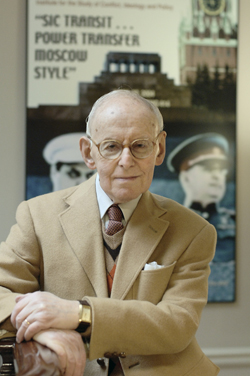
After many years of studying the past, University Professor Uri Ra’anan is looking forward to 2008. That’s when Russian President Vladimir Putin will reach the end of his term, and under the country’s 13-year old constitution, his successor will be chosen in a national election. It’s also when many of Ra’anan’s theories will be put to the test.
The transfer of political power in Russia is always chancy, and its unpredictability has long fascinated Ra’anan, who is a professor in the University Professors Program, a professor of international relations, and the director of the Institute for the Study of Conflict, Ideology, and Policy at Boston University. He is also the editor and a coauthor of Flawed Succession: Russia’s Power Transfer Crises, published in 2005 by Lexington Books. For the benefit of others similarly fascinated, Ra’anan will discuss the book on Wednesday, February 15, at 7 p.m. at Barnes and Noble at Boston University.
Ra’anan reports that the only discussion in Moscow about the looming Russian election “is not whether Putin will step down or who will succeed him, but what will he do to stay in power.” To Ra’anan, however, that analysis is less a condemnation of the man and more a reflection of a dysfunctional system. Such dysfunction, he says, affects everything in Russia from foreign policy to the everyday life of its citizens, and it shows no sign of improving.
Ra’anan’s research has persuaded him that a leader who has wrangled his way into power — a common practice of czars, prime ministers, and presidents of the USSR and Russia — will never feel he has gained his position lawfully, breeding a permanent angst, fear, and paranoia.
“If you didn’t rise to power legitimately, you feel constantly endangered — that someone could come along and push you out,” Ra’anan says. The only thing that can make it legitimate, he says, is if the mechanism of transfer of power is time-honored, consistently.
The battle for power throughout Russia’s history was documented by Robert Conquest in his 1962 Power and Policy in the USSR. Conquest’s work inspired many scholars of Russian history, Ra’anan among them.
“When he did this pioneering work,” he says, “people said [to Conquest], ‘How do you know for sure?’”
From today’s perspective, in Ra’anan’s opinion, Conquest’s conclusions were on the mark. So it seemed only natural to ask Conquest to write the introduction to Flawed Succession.
Much of the research for the book was hard to come by. Because the Russian government insists on “protecting the reputations of those long since dead,” many volumes of valuable source material are locked away in Russia’s presidential archives, which have been classified top-secret since 1953. But a Stalin biographer, one of just a few scholars allowed for a period of about 14 days many years ago to look at the archives and take notes, left his papers, including some archival material, to the Library of Congress, where the public, and Ra’anan, could view it.
Ra’anan believes that protecting the reputation of political leaders has become a tradition in Russia that now trumps the law. “The people who keep talking about democratizing Russia are missing the point,” he says. He believes that Russian society must pass through two or three more stages before it can operate as a democracy, not the least of those stages being following its own rules. It’s that failure of rules, he says, that makes citizens uncertain of their future and unwilling to save or invest in business. Ra’anan takes his thesis one step further, arguing that domestic unrest is also the root of Russia’s problems in foreign policy. For example, he says, without Russia, Iran could not go nuclear, and Russia has found every excuse not to hamper Iranian efforts in that regard. “We wonder, ‘Are they nuts? Do they really want a nuclear Iran?’ and the feeling in Putin’s case is, ‘Hey, by the time this is in effect, I will not be interested.’”
Flawed Succession is dedicated to Ra’anan’s late son, Gavriel Ra’anan, an accomplished scholar who died of a brain tumor in 1983 at the age of 24. His book International Policy Formation in the USSR: Factional “Debates” During the Zhdanovshchina was published posthumously in 1983; its subject matter predates the chronicles of Flawed Succession.