Site miners will match medicine and engineering
New program spots potential for life-saving collaborations
George O’Connor, a School of Medicine professor and asthma researcher at the Pulmonary Center, appreciates the value of serendipity. It was, after all, a fortuitous dinner with his Boston University colleague Bela Suki during a National Institutes of Health symposium in Washington, D.C., last year that led to an ongoing collaboration on a mechanical ventilation system that could one day help save the lives of patients with respiratory failure.
Suki is an associate professor of biomedical engineering at the College of Engineering, but news of his research never traveled across campus to O’Connor until they met in Washington.
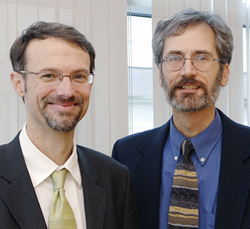
Now, O’Connor is trying to identify the potential for similarly valuable collaborations, whose genesis need not be dependent on chance. He is one of two newly appointed University “site miners,” faculty members who will devote 20 percent of their professional time to identifying and cultivating research partnerships between engineers and clinicians that are intended to help translate promising technologies into better patient care. Mark Grinstaff, an ENG associate biomedical engineering professor and College of Arts and Sciences associate chemistry professor, is the other new site miner.
“The job of the site miners is to sift through the various projects and expertise ongoing at each campus, to try and mine the gems that have some sort of natural affinity for one another,” says Mark Klempner, a MED professor and the associate provost for research at the Medical Campus, which along with the College of Engineering and the Office of Technology Development is funding the positions. Every two years, an administrative committee will appoint one clinical site miner from the Medical Campus and one engineering site miner from the Charles River Campus.
“I think there’s a tremendous opportunity, because of the resources that are here, both in engineering and the medical school,” says Grinstaff, who researches synthesized biomaterials with uses ranging from sealing eye wounds to delivering cancer drugs.
Grinstaff and O’Connor are scientific matchmakers who will seek out the technologies that hold the most promise for improving health-care practice and vice versa, looking into clinical challenges that might have technology-based solutions. They’ll meet with each other to discuss what they’ve found, and they’ll arrange meetings where potential collaborations can be discussed and critiqued by the engineers and clinicians themselves.
But the site miners’ work will not end there. “It’s not just about identifying innovative ideas,” explains Kenneth Lutchen, an ENG professor and biomedical engineering department chairman. After promising matches are made, the site miners will help researchers apply for grants needed for further research such as making prototypes that could be used in human trials.
Lutchen says the site miners are part of ongoing, University-wide efforts to “help move innovation from the lab to the bedside.” These efforts were recently given a boost by the Wallace H. Coulter Foundation, which awarded Boston University a five-year, $2.9 million grant to foster translational research in biomedical engineering, the funding source that O’Connor and Suki hope will help fund human trials of the mechanical ventilation system.
“There is a lot of potential that just wasn’t being tapped,” says O’Connor, who adds that the separation between the two campuses made it easy to overlook the possibilities for collaboration. “They’re over there, and we’re over here, and we weren’t really aware of what everybody was up to.”
Nevertheless, the human connections are just as important as money when it comes to finding technology that can improve patient care, says Ashley Stevens, director of the Office of Technology Development. Stevens says that about two thirds of the inventions that his office works to license and bring to market originate from either the Medical Campus or the College of Engineering. He even gives the Boston University Shuttle (the BUS) some credit for bridging those two sources of innovation since it began running more frequently and reliably in the fall of 2004.
“It’s such a people process,” Stevens says, and that’s where Grinstaff and O’Connor think they’ll have the biggest impact.
“I think for many of these problems [of advancing patient care] you need to have a combination of strengths from multiple areas. That’s what makes translational research exciting,” says Grinstaff.