Skip to Main Content
Boston University
  • Bostonia
  • BU Today
  • The Brink
  • University Publications

    • Bostonia
    • BU Today
    • The Brink
  • School & College Publications

    • The Record
Other Publications
BU Today
  • Sections
News, Research, Community

Shedding light on cancer detection

Fiberoptics could make diagnosis more accurate, less invasive
January 12, 2006
  • Chris Berdik
Twitter Facebook
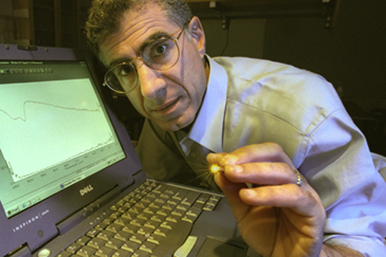
Irving Bigio. Photo by Kalman Zabarsky

This story was published on BU Today November 4, 2005.

Imagine that years of acid reflux disease has altered the lining of your esophagus, putting you at a high risk for esophageal cancer. To check for malignancy, a doctor would most likely use tiny forceps fed through an endoscope to snip random biopsy samples from your esophagus. Then you’d wait anxiously while the samples were sent to a lab and examined by a pathologist.

Irving Bigio, a College of Engineering professor of biomedical engineering and electrical and computer engineering, is researching an alternative. It’s called optical biopsy, where a doctor shines light on the target tissue with a fiberoptic probe. Because cancer changes the structure of cells, light scattered by healthy tissue emits a different spectrum than light scattered by malignant tissue, and this “spectral signature” can be read by a small spectrometer at the other end of the probe.

Optical biopsies are one aspect of a technology known as optical spectroscopy which Bigio and his colleagues at the Biomedical Optics Lab are working on during the third year of a five-year, $5.5 million grant from the National Cancer Institute (NCI). They are also using the grant to research a technique whereby doctors can measure the amount of a chemotherapy drug in a tumor, all by the glow of a tiny, noninvasive fiberoptic probe.

The technologies are in an advanced stage of research, with several patents held by Los Alamos National Laboratory in California (where Bigio worked before coming to BU and founding the Biomedical Optics Lab in 2001) and some patents being licensed to corporations. In addition, Bigio’s lab and its institutional partners are already testing the optical techniques in clinical trials, aiming to make the techniques sufficiently reliable and easy enough to use that they become standard patient care.

Nevertheless, it may be years before the optical biopsy and chemotherapy measurements are common medical practice. “I’ve seen a number of new technologies go through the feasibility and prototype development phase and then stall there and never make it to the clinic,” says Houston Baker, NCI’s program director for imaging technology development.

NCIs grants like the one awarded to Bigio’s project, and to three other international teams, seek to speed up that transition for optics and more quickly incorporate new technologies into the fight against cancer.

Still, Bigio knows that the science of medicine can be hurried only so much. “It’s going to take a lot of patients, and a lot of data to demonstrate that this technique works,” he says.

Explore Related Topics:

  • Faculty
  • Photography
  • Share this story

Share

Shedding light on cancer detection

Share

  • Twitter
  • Facebook
  • Reddit
  • LinkedIn
  • Email

Latest from BU Today

  • Things-to-do

    Getting to Know Your Neighborhood: Coolidge Corner

  • This Weekend @ BU: September 24 to 27

  • Class of 2030

    Class of 2030: Nicole Treviño Begins Her BU Journey

  • University News

    William Fairfield Warren Distinguished Professorships Awarded to Five Senior Faculty

  • University News

    Annual Safety Fest to Take Place This Week on Medical, Charles River Campuses

  • Engineering

    College of Engineering’s 2026 Catalyst Summit Focused on Decoding Everyday Health

  • Rankings

    Boston University Achieves Its Highest-Ever Ranking from U.S. News & World Report

  • Watch Now

    Video: Leaders Among Us—President Gilliam in Conversation with Yvette Cozier

  • BUPD

    Want to Take a Walk with Bean?

  • New Appointment

    New BUPD Deputy Chief Brings Community-Centered Policing to the Forefront

  • New Appointment

    Prominent Women’s Health Researcher and Academic Leader Named Dean of BU Chobanian & Avedisian School of Medicine

  • Transportation

    MBTA Green Line B Branch Service to be Suspended September 26 to October 4

  • Things-to-do

    This Weekend @ BU: September 17 to 20

  • Varsity Sports

    BU Women’s Soccer Gears Up for Another Deep Playoff Run

  • Climate Change

    Sustainability Festivals on Medical and Charles River Campuses

  • University News

    Warren Towers’ Tower A Reopens to Students

  • University News

    Boston University Honors Four Junior Faculty With Prestigious Career Development Professorships

  • Class of 2030

    After Struggling to Support Himself in High School, Freshman Ryan Sim Is Ready to Chart His Own Course

  • New Appointment

    New University Librarian Aims to Create the Library of the Future, With the Community’s Help

  • 25th Anniversary of 9/11

    Mitchell Zuckoff Wrote Boston Globe Stories about 9/11

Section navigation

  • Sections
  • Must Reads
  • Videos
  • Series
  • Close ups
  • Archives
  • About + Contact
Get Our Email

Explore Our Publications

Bostonia

Boston University’s Alumni Magazine

BU Today

News, Research, Community

The Brink

Pioneering Research from Boston University

  • Twitter
  • Facebook
  • Youtube
  • LinkedIn
  • Instagram
  • Weibo
  • TikTok
© Boston University. All rights reserved. www.bu.edu
© 2026 Trustees of Boston UniversityPrivacy StatementAccessibility
Boston University
Notice of Non-Discrimination: Boston University prohibits discrimination and harassment on the basis of race, color, natural or protective hairstyle, religion, sex or gender, age, national origin, ethnicity, shared ancestry and ethnic characteristics, physical or mental disability, sexual orientation, gender identity and/or expression, genetic information, pregnancy or pregnancy-related condition, military service, marital, parental, veteran status, or any other legally protected status in any and all educational programs or activities operated by Boston University. Retaliation is also prohibited. Please refer questions or concerns about Title IX, discrimination based on any other status protected by law or BU policy, or retaliation to Boston University’s Executive Director of Equal Opportunity/Title IX Coordinator, at titleix@bu.edu or (617) 358-1796. Read Boston University’s full Notice of Nondiscrimination.
Search
Boston University Masterplate
loading Cancel
Post was not sent - check your email addresses!
Email check failed, please try again
Sorry, your blog cannot share posts by email.
Shedding light on cancer detection
0
share this