Skip to Main Content
Boston University
  • Bostonia
  • BU Today
  • The Brink
  • University Publications

    • Bostonia
    • BU Today
    • The Brink
  • School & College Publications

    • The Record
Other Publications
BU Today
  • Sections
News, Research, Community

Prison Education Program expands with new grant

Bridge to College prepares inmates for degree programs
November 10, 2005
  • Dick Taffe
Twitter Facebook
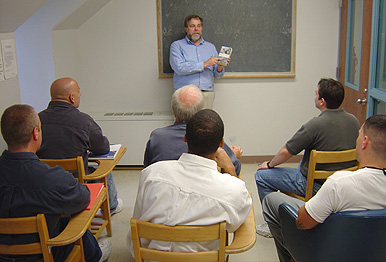
They may be a captive audience, but professors say inmates are among their most motivated students. Above, Robert Cadigan teaches inmates at Bay Sate Correctional Center.

Boston University’s Prison Education Program (PEP), run by Metropolitan College, has thrived for more than three decades despite the ongoing difficulty of finding inmates with the requisite college courses to qualify. But MET Dean Jay Halfond says a new grant should solve that dilemma.

The $180,000 grant, from the Lynch Foundation — founded by Peter Lynch, a president at Fidelity Investments, and his wife, Carolyn — will support a two-year pilot Bridge to College program. Each year 75 prisoners can be enrolled in courses aimed at addressing the specific needs of first-year college students. Those who pass all the courses will be eligible the following year to enroll in regular PEP courses.

“This is designed to broaden access and exposure to higher education in state prisons while ensuring the academic standards of the Prison Education Program and the success of the students,” says Halfond. “It will allow us to expand the program and move more prisoners towards college degrees and more constructive lives.”


A 50-state analysis released this month by the Institute for Higher Education Policy shows that postsecondary courses are available to only 5 percent of the U.S. prison population. A majority of prisoners involved are taking vocational courses and are not earning college degrees, even at the associate’s level, in any significant numbers. BU is one of only a few private, four-year institutions working inside prison walls.

In 1972, under the leadership of President John Silber, BU began offering college-level liberal arts courses to Massachusetts prison inmates on the proven premise that education curbs recidivism. Over the next two decades, support from federal Pell Grants available to prisoners spurred the University of Massachusetts, Curry College, and several community colleges to offer courses in prisons. These courses served as feeder programs for PEP. But when Congress eliminated Pell Grants in 1994, most participating colleges bailed out — including all Massachusetts colleges except BU.

“Our enrollments began to drop in the late ’90s as students either graduated or were released, and fewer new students could meet the qualifications of the BU program,” says Robert Cadigan, a MET professor, who teaches in the program. Enrollments gradually increased, he says, because of a probationary admissions policy created in 1999 by Carl Sessa, a MET assistant dean, and efforts by groups such as Partakers, Inc., to help potential students meet admissions requirements.

“But because of the exodus of the other Massachusetts schools, incarcerated students have not been able to secure the freshman-level transfer courses needed to be admitted to BU’s program,” says Halfond. “This grant will enable us to broaden our reach and impact more lives. These students are highly motivated and appreciative, and we can see the direct benefit we bring to them and to the community they hope to reenter.”

BU is among only about a dozen schools nationwide teaching credit courses inside prison walls (others offer correspondence courses). This year 180 students are enrolled in 22 PEP courses at the Norfolk, Bay State, and Framingham state correctional institutions and at the South Middlesex Correctional Center.

Explore Related Topics:

  • Awards
  • Boston
  • Local
  • Share this story

Share

Prison Education Program expands with new grant

Share

  • Twitter
  • Facebook
  • Reddit
  • LinkedIn
  • Email

Latest from BU Today

  • Boston

    Eight Boston Experiences Every BU First-Year Should Try

  • Dining

    Where to Eat When You’re Hungry at BU

  • Scholarships

    Boston University’s 2026 Menino Scholars and Community Leaders Scholars Arrive Ready to Change Their World

  • 10 BU Hacks Every Terrier Should Know

  • Student Life

    Everything You Need to Know about Splash (and Why You Should Attend)

  • Film & TV

    “Tony” – Anthony Bourdain Biopic of Iconic Chef and TV Host

  • Your Guide to BU Student Discounts, Freebies, and Terrier Card Perks

  • This Weekend @ BU: September 3 to 7

  • Clubs

    Design, Build, Drive: Meet Terrier Motorsport

  • Meet Boston University’s New Provost, Colin Duckett

  • Students

    Your First Year at BU: A Guide for International Students

  • University News

    Boston University Matriculation 2026: Welcome Class of 2030!

  • Marine Science

    Marine Science Career Accelerator Helps Student Careers

  • Campus Life

    Move-in 2026 Photo Gallery

  • Campus Life

    Video Captures the Emotion of Move-In

  • Engineering

    Research Program for Boston High School Teachers

  • Internship

    Student Interns Learn What Makes Municipal Government Work

  • Faculty

    Opening Up the World of Writing to Boston University’s Medical Campus Faculty

  • Arts & Culture

    Wheelock Family Theatre Gives High School Students a Hands-On Role in Theater Management

  • Social Media

    BU Expert on Meta’s $17.1 Billion Settlement Over Social Media Addiction Claims

Section navigation

  • Sections
  • Must Reads
  • Videos
  • Series
  • Close ups
  • Archives
  • About + Contact
Get Our Email

Explore Our Publications

Bostonia

Boston University’s Alumni Magazine

BU Today

News, Research, Community

The Brink

Pioneering Research from Boston University

  • Twitter
  • Facebook
  • Youtube
  • LinkedIn
  • Instagram
  • Weibo
  • TikTok
© Boston University. All rights reserved. www.bu.edu
© 2026 Trustees of Boston UniversityPrivacy StatementAccessibility
Boston University
Notice of Non-Discrimination: Boston University prohibits discrimination and harassment on the basis of race, color, natural or protective hairstyle, religion, sex or gender, age, national origin, ethnicity, shared ancestry and ethnic characteristics, physical or mental disability, sexual orientation, gender identity and/or expression, genetic information, pregnancy or pregnancy-related condition, military service, marital, parental, veteran status, or any other legally protected status in any and all educational programs or activities operated by Boston University. Retaliation is also prohibited. Please refer questions or concerns about Title IX, discrimination based on any other status protected by law or BU policy, or retaliation to Boston University’s Executive Director of Equal Opportunity/Title IX Coordinator, at titleix@bu.edu or (617) 358-1796. Read Boston University’s full Notice of Nondiscrimination.
Search
Boston University Masterplate
loading Cancel
Post was not sent - check your email addresses!
Email check failed, please try again
Sorry, your blog cannot share posts by email.
Prison Education Program expands with new grant
0
share this