Lecture in Review: Translating Translation: Multilingual Texts in Taiwan’s Literature by Lin King
By Cheryl Ong
 Having weathered Acela seat-assignment bungles and battled through what she described as Boston’s “coffee shop wasteland” (relative to New York City, anyway), acclaimed translator Lin King arrived at Boston University on April 17 to give her highly anticipated lecture on “Translating Translation: Multilingual Texts in Taiwan’s Literature.” The talk capped off a semester of presentations by nine other accomplished translators.
This was not the first time faculty and students of BU’s Literary Translation Program had shared a room with King. Last November, at the American Literary Translators’ Association Conference in Tucson, several of us were on hand when Taiwan Travelogue won the 2025 ALTA First Translation Prize and King took the stage to read an excerpt.

Buzz around King’s translation of the novel has only grown in the intervening months: Taiwan Travelogue won the National Book Award for Translated Literature and shortly before King’s lecture it was shortlisted for the International Booker Prize.
For two students in the 25-26 MFA cohort, the book held particular interest because of its premise: a Japanese writer touring Japan-controlled Taiwan in 1938 with a Taiwanese interpreter. Lane Harper, who works primarily from Japanese, and Cheryl Ong, who translates from Chinese and Japanese, were especially excited to hear about the multilingual aspects of the translation, in which Japanese, Mandarin, and Taiwanese Hokkien (Taigi) had not just been preserved, but showcased.
They were not disappointed. King discussed both the complexity and the unique opportunities she had as a translator of a text that was itself a fictionalized translation. The first opportunity was to push back again the resistance to the use of footnotes in American publishing. Since the original text included copious footnotes by the author writing in the guise of a translator, King took the opportunity to add her own notes, in a move both necessary and precedent-setting. One instance where the text benefitted from the additional explanatory notes was where Taiwanese place names were rendered in Japanese form for historical accuracy, which might otherwise have confused English readers familiar with the Chinese names.
She also highlighted the decisions she had made regarding the transliteration of the Taiwanese language known as Taigi, which has been “so rarely translated into English” and “only very recently systematized in Taiwan.” She decided to use the Taiwanese Ministry of Education’s Taigi dictionary for her romanizations and translated the names of food into Taigi where the Taigi reading of the word might have only been implicit in the original Mandarin text.

King’s lecture gave insights into Taiwanese literature beyond Taiwan Travelogue. Lin King also went into the details of her work on The Boy from Clearwater, a two-volume biographical graphic novel series which applies a remarkable multilingual approach to documenting Taiwanese history and the languages which have shaped the lives of people there for generations. While the original graphic novels had had the luxury of printing all three languages in their respective scripts with Mandarin translations for the other two, layout constraints meant that the English version had to employ a very different strategy. King explained that they decided to preserve the multilingualism in texture, if not in form, by color-coding the all-English translation according to the corresponding original language.
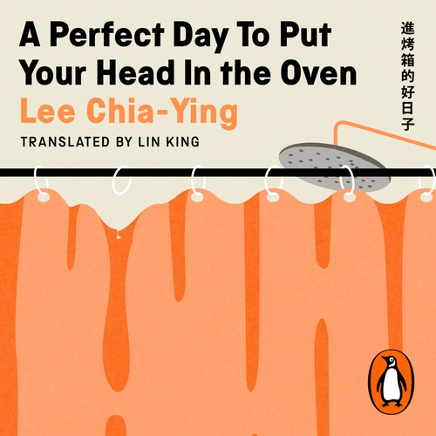
Finally, King talked about her forthcoming translation, a novel entitled A Perfect Day to Put Your Head in the Oven, by Boston-based Taiwanese writer Lee Chia-Ying, who was also present in the audience that day! King described some of the difficulties she’d had in translating this novel—references to Chinese characters and their components, for example—and explained how the success of Taiwan Travelogue had in fact made publishers more receptive to more experimental translation this time around.
During the lively Q&A session, King answered questions on whether the conventions of publishing Chinese and Japanese texts in translation might or should change; the inspiration behind her own forthcoming novel centered on an American’s fascination with Japanese popular culture; the way the colonial dynamics between characters in Taiwan Travelogue are yet another level of translation to consider as she translated the book; and her experience talking to Japanese middle-school students about the sensitive Taiwan-Japan histories presented in A Boy From Clearwater.
While Lin King has become a prominent spokesperson for Taiwanese literature, she was careful to emphasize the need for visibility across the breadth of the literary landscape there:
“It’s impossible for one book, one story to represent a whole culture, and for a culture as multilingual, as complex, as dominated by multiple rounds of very different colonization, from Spanish and Portuguese all the way to Japanese, the only thing we can do is to produce a cacophony of voices and to hope to carry that into English, and to hope to sustain enough interest among readers, such that they’re able to read Taiwan from many different perspectives…We are diverse enough to encompass very different views, very different voices, and still be thought of as one identity.”
Lin King’s lecture and the rest of the Literary Series Archive are available online here.