MFA Students Travel to Tucson for ALTA48

On a sunny November day in Tucson, Arizona, forty translators gathered around two poems written in Icelandic, a language that few if any of them had studied. Led by Icelandic translator and editor Larissa Kyzer, the group spent the morning working from glosses to produce versions of the poems in English, Chinese, Spanish, French, Welsh, and Nepali. As the translators worked in groups of two or three, testing phrases out loud and debating their choices, questions flew across the room: how best to render the structure and rhyme of the originals? What happens when you translate sound rather than sense? In what ways do constraints foster creativity? By the end of the session, the room had generated vastly different versions of the same two poems, each a testament to the expansive possibilities inherent in the translator’s craft.
The panel set the tone for the 48th annual meeting of the American Literary Translators Association (ALTA), held in early November. Four students from BU’s MFA in Literary Translation program—Cheryl Ong, Maria Antonia Blandon, Lane Harper, and Val Galitskiy– had traveled to Tucson with me, program director J. Keith Vincent, my associate director Anna Zielinska-Elliott, Turkish professor Roberta Micallef, and MFA alumna Dina Famin, for three exciting days of panels, workshops, poetry readings, and conversations with translators and publishers from around the world.
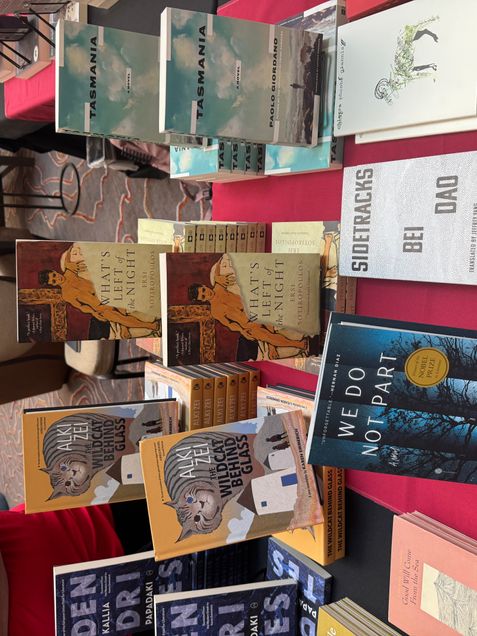
For many of the BU students, ALTA48 was their first conference. But ALTA is no ordinary academic conference. Participants speak informally from notes rather than reading prepared papers or projecting slides, and the vibe is friendly and welcoming. Alongside the panels and poetry readings, ALTA hosts a book fair and award ceremonies for books in translation. This year, BU Professor Christopher Maurer was on the shortlist for the Spain-USA Foundation prize for his annotated translation of Federico García Lorca’s lecture on artistic inspiration, Finding Duende. There is also special programming designed to help first-time attendees connect with the wider translation community. As Val noted in a reflection he wrote about his experience of the conference, “At the very beginning someone said that ALTA is different because you are welcome everywhere, and if you see a group going to lunch, you can simply ask to join them. And this really turned out to be true, because that is exactly how I ended up having long conversations with two former ALTA presidents.”
“ALTA48 was my first time knowing that an association like the American Literary Translation Association existed,” wrote MFA student Maria Antonia Blandon in her own reflection. She is working on a project based in the archive, held at BU, of the great translator Gregory Rabassa, best known for his masterful rendering into English of Gabriel Garcia Marquez’s One Hundred Years of Solitude. At ALTA Maria Antonia had the chance to meet one of Rabassa’s most illustrious mentees, the translator Suzanne Jill Levine, who was at the conference to launch her recent book, Unfaithful: A Translator’s Memoir. “For me it was energizing and invigorating to participate in the midst of all these great translators,” Blandon reflected.
Cheryl attended a panel on how to render code-switching in novels (when characters speak in more than one language) when translating into English. She also had conversations with conference attendees on questions of foreignization and domestication—topics debated regularly in BU’s translation seminars. Hearing from translators working across different languages expanded her thinking about how much “foreignness” English readers might accept in translated texts. “It made me wonder if as translators we might be bolder to stretch the limits,” she commented.
Lane, who came to our program with an interest in translating Japanese horror fiction, was happy to find two panels directly relevant to her work, one on “Aesthetic Embodiment: Translating the Grotesque,” and another called “To Translate with the Body: Gender, Performance and Versionings.” What she heard at these panels, Lane wrote in her reflection, “made me aware that the physical experiences I’ve had contribute to the way I perceive similar experiences in a text, and thus my translation process cannot be distinguished from my physical body: in translating a text, I absorb it into my body; it becomes a part of me and I become a part of it.”

Val went to the conference expecting to hear all about how AI is transforming the work of translation. In fact, he found that the few panels that touched on AI were sparsely attended. The poetry readings every night, by contrast, were packed, including a much beloved annual ALTA event called “Declamación,” where translators “showed their artistic personalities by singing, reciting, and acting” their favorite translations from memory. These events made Val reflect that no matter how developed technology becomes, literary translators will keep translating. Why? Because they love doing it. “It is like walking,” he wrote, “no matter how advanced cars and planes become, people still walk and enjoy hikes.”
The BU delegation presented a panel titled “Reading Interstitially: Re-thinking World Literature in Translation” in which we argued in various ways for moving beyond the search for a single “correct” translation to see different translations as a rich spectrum of possible readings. Professor of Turkish Roberta Micallef introduced Artichoke, a website she has created to disseminate translations of Ottoman and Turkish literature for the classroom. MFA program alumna Dina Famin, who is starting a PhD in Russian at Brown this year, spoke about the complex publication history of translations of Franz Kafka. Associate Director Anna Elliott talked about how to teach a text in multiple translations with examples by the Japanese novelist Tanizaki Jun’ichirō, and I introduced genjipoems.org, a digital repository created by BU students of poetry in The Tale of Genji in multiple translations. Our current students chimed in on the panel as well. Maria Antonia spoke about multiple versions of the opening lines of Don Quixote, Lane discussed debates around fan translations of Japanese animation, and Cheryl talked about the value of using a range of different translations to convey the multiplicity of possible interpretations of the dense and often ambiguous language of Classical Chinese.

The students left Tucson inspired to pursue their own translation projects. “Talking to publishers of translations and browsing translated texts gave me a better picture of what the industry is looking for and how my translation interests could align with it,” Ong wrote. Having recently encountered works by Singaporean and Japanese authors whose writing remains little known abroad, she returned from ALTA “inspired to work harder to bring them to readers who would appreciate them as much as I do.”
For Blandon, the conference revealed literary translation as a practice sustained by passionate practitioners. “What makes translation such an attractive craft, in both scholarly and day-to-day life, are the incredible, intelligent, proficient people who enrich translation studies with their experience,” she observed. The translators she met became “role models to help us shape our way through this rocky but exciting career in translation.”
As the students attended panels and events over the three-day conference, they built connections with translators and publishers. “Getting to know other translators, familiarizing ourselves with the literary translation scene in the US and beyond, it placed us in community with people who are so passionate about literature beyond the confines of our classrooms,” Ong wrote, “and lit the fire under us to boldly venture further out into it when we emerge equipped by our MFA program in May next year.”
As Lane pointed out in her reflection, the practice of translation involves allowing a text to resonate in one’s own body and sensorium. Building a community also requires physical presence—sharing meals, attending readings, testing phrases aloud in a room full of fellow translators. As Val observed, translation is like walking: an embodied practice, sustained by the pleasure of doing the work ourselves. Our days in Tucson reminded us that the translator’s craft, like walking, is something we experience with our own bodies, in the company of others on the same path.
Many thanks to the Ira and Godeleine Ziering Family Foundation and the Department of World Languages & Literatures for making it possible for us to be there.
The BU MFA in Literary Translation is now accepting applications for the incoming class. If you have questions or would like to learn more about the program, contact Professor J. Keith Vincent at kvincent@bu.edu
