Mentors
Project Description
Following a myocardial infarction, the necrotic tissue in the infarction zone is replaced by a fibrotic scar. Even though this scar tissue helps to hold the heart together and maintain its structure, it does not contribute to the heart’s function and can impair its ability to contract and relax properly. One of the main goals of the Cell-MET program is to engineer a vascularized cardiac patch that can be grafted onto scar tissue to assist the heart with its pumping action. Succesful engraftment of the cardiac patch int the host tissue depends on rapid anastomosis of the engineered vasculature to the host vasculature because failure to establish adequate blood flow within the first few days can lead to necrosis of the patch and ultimately graft failure.
To better study vascular engraftment, the Chen lab is currently developing a vascular-engraftment-on-chip model that is composed of a microfluidic device with an engineered vascular bed and a living tissue explant. Together with Terry Ching, a postdoctoral researcher in the Chen lab, the REU student will help with the design and manufacturing of diverse prototypes of the microfluidic chip and conduct ex vivo engraftment experiments with engineered vasculature.
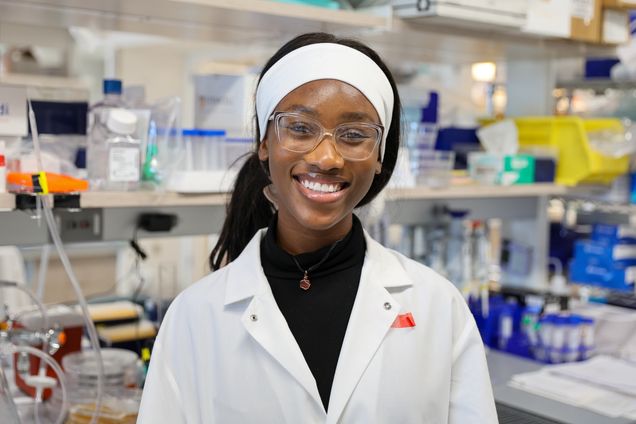
Research Participant
Program: CELL-MET REU
Hear what Akhila Johny’s taking with her from her time at BU.
Learn More
Research Goals
- Manufacturing microfluidic devices for studying vascular engraftment:
- Using sheet lamination, the REU student will manufacture two-channel devices with an engineered vascular bed and a tissue chamber so that the engineered vasculature can grow into a mouse adipose tissue explant.
- Describing the dynamics of vascular engraftment of the engineered vascular bed into the tissue explant.
- The REU student will visualize and quantitatively evaluate vascular ingrowth into the tissue explant over the course of one week using time-lapse microscopy and fluorescently labeled cell.
Learning Goals
- Through this project, the student will gain technical expertise in vascular engineering.
- Specifically the student will learn wet lab skills such as vascular cell expansion and maintenance, immunofluorescence, time-lapse, and confocal microscopy, as well as the design and manufacturing of microfluidic devices.
- In addition, the student will also gain experience in experimental design and data analysis.
Timeline
Weeks 1-2: Orientation in the lab, manufacturing first iteration of devices, learning vascular cell culture..
Weeks 3-5: Conduct first round of ex vivo engraftment experiments, and optimize the design of the model system if required.
Weeks 6-9: Conduct second round of ex vivo engraftment experiments with optimized model system.
Week 10: Finish data analysis and synthesize final presentation..