News
Dr. Naya to serve on NIH Study Section
BU Biology Associate Professor Francisco Naya has been invited to serve as a permanent member on the Cardiovascular Differentiation and Development (CDD) study section at the NIH. Members are selected on the basis of their demonstrated competence and achievement in their scientific discipline as evidenced by the quality of research accomplishments, publications in scientific journals, and other significant scientific activities, achievements and honors. Study sections review grant applications submitted to the NIH, make recommendations on these applications to the appropriate NIH national advisory council or board, and survey the status of research in their fields of science. These functions are of great value to medical and allied research in this country.
Michaela Smith’s Research Featured in The Conversation
Michaela Smith of the Frydman Lab recently published an article for The Conversation featuring her research with Wolbachia mosquitos and Zika.
Dr. Joyce Wong Presents De Lisi Distinguished Lecture
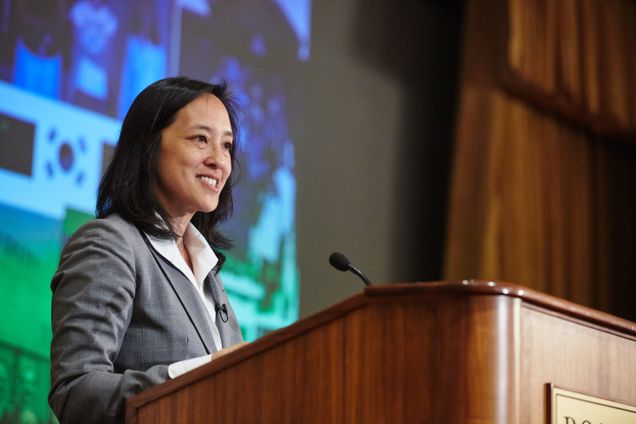
Read the full article in ENG News.
Deborah Perlstein’s group, has received the 2017 National Science Foundation Graduate Research Fellowship
Dr. Bansil Featured in BU Research
Physics professor Rama Bansil and graduate student Maira Constantino (GRS ’17) have been featured in BU Research for their work on Helicobacter pylori, a corkscrew-shaped bacterium that can cause ulcers and stomach cancer. Along with collaborators, they have shown that H. pylori is able to traverse the gel-like mucin lining of the stomach using a combination of enzymatic secretions and a spiral swimming motion. Their work has implications for drug delivery and cancer treatment. Read the full story in BU Research.
Dr. Bradham Awarded New NSF Grant
Biology Department Professor Cynthia Bradham has been awarded a three year National Science Foundation grant from the Division of Integrative Organismal Systems. The title of the research abstract is “The Molecular Basis of Skeletal Patterning” and Professor Bradham is the sole P.I. on the grant.
Dr. Gilmore Gives Plenary Lecture at BCI Symposium
Tom Gilmore, Professor and Associate Chair of Biology, gave a plenary lecture at the 19th Annual
Biomedical & Comparative Immunology Symposium in Miami, FL, on March 31, 2017. His talk, "A Billion Years of NF-kappaB," described his lab's work on a key protein involved in immune diseases from marine invertebrates to humans.
Dr. Segrè Awarded Hariri Institute Research Award
With BU Physics Professor Kirill Korolev, BU Biology Professor Daniel Segrè has been granted a $20,000 research award from the Hariri Institute. The funded project aims to develop a computational tool that can use microbial genomes to predict microbial interactions and ultimately ecosystem dynamics. Beyond prediction, this computational tool will be used to develop design principles for artificial communities and infer microbial interactions in medical and environmental microbiomes. The latter constitutes a major challenge faced by the microbiome research today as interactions are inferred from patterns of co-occurrence in cross-sectional data or temporal correlations in longitudinal data. The computational tool will constrain interaction types using genome-scale metabolic models and remove network motifs inconsistent with the need to co-localize in space. As a result, it will considerably improve the power of sequencing surveys to identify interactions. Congratulations to Professors Segrè and Korolev!
Dr. Segrè Research Featured on Cover of Cell

In a study published on March 9 in the journal Cell, researchers used systems biology approaches to study the emergence of primordial metabolic networks, showing that early biochemistry could have arisen prior to the introduction of phosphate.
The featured article can be viewed here for a short time and the full article can be found here.
Albert Mondragon Awarded the DeLill Nasser Award
MCBB PhD student, Albert Mondragon, of the McCall Lab recently received the DeLill Nasser Award for Professional Development in Genetics for the Spring 2017 for his research characterizing the molecular machinery controlling acidification during cell death and clearance in fruit flies. These awards are given to outstanding graduate student and postdocs to support travel to meetings and laboratory courses. Congrats Albert!