Research
Current Research:
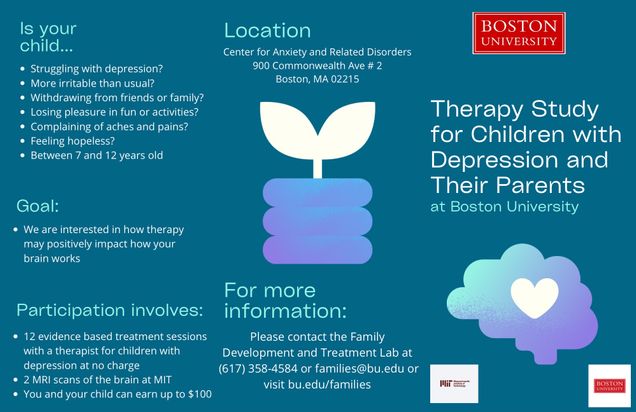
Therapy Study for Children with Depression and Their Parents (in collaboration with the Gabrielli Lab at MIT)
The purpose of this study is to better understand the effectiveness of family focused therapy for youth with depression. This research aims to identify brain pathways associated with successful treatment outcomes for depressed children and to better predict which children and families will best benefit from this type of treatment. We are enrolling 20 children (ages 7-12) with depressive disorders, and their parents, as well as 20 children (ages 7-12) without depressive disorders and their parents. Parents and children who take part in this research study will participate in assessment and treatment at the Family Development and Treatment Lab at Boston University and MRI scanning at the Department of Brain and Cognitive Sciences at the Massachusetts Institute of Technology.
Participants taking part in this study will attend an intake meeting at the beginning of the study to confirm eligibility, undergo 2 MRI scanning sessions, participate in 12 sessions of Family-Focused Treatment for Childhood Depression (FFT-CD) (only for children experiencing depression), and complete a post-treatment follow-up interview.
If you are interested in participating, please select the applicable pre-screen survey link:
If you have any questions, please call (617) 358-4584 or email families@bu.edu for more information.

Alzheimer’s Disease Research Center Project:
IN ENGLISH:
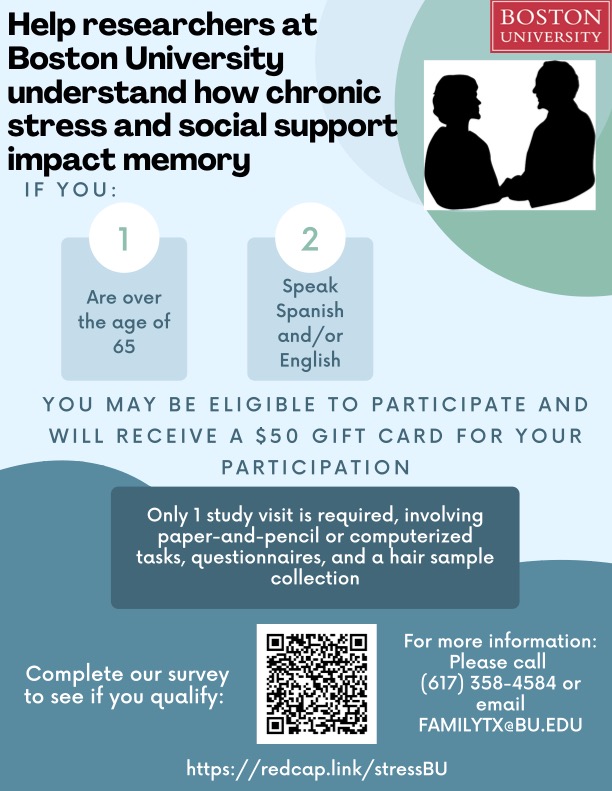
Help researchers at Boston University understand how chronic stress and social support impact memory. If you are over the age of 65 and speak Spanish and / or English, you may be eligible to participate and will receive a $50 gift card for your participation.
Only 1 study visit is required, involving paper-and-pencil or computerized tasks, questionnaires, and a hair sample collection.
Complete our survey to see if you qualify: https://redcap.link/stressBU
Please call (617) 358-4584 or email familytx@bu.edu for more information.
IN SPANISH:
Ayude a los investigadores de Boston University entender cómo el estrés crónico y el apoyo social afectan su memoria. Si es mayor de 65 años y habla español y/o inglés podría calificar para participar, y recibirá una tarjeta de obsequio de $50 por su participación.
Solo tendrá que acudir a 1 visita del estudio, en la que habrá tareas y cuestionarios para completar con lápiz y papel o con computadora y una toma de muestra de cabello.
Complete nuestra encuesta para ver si califica: https://redcap.link/stressBU
Si desea más información, llame al (617) 358-4584 o envíe un correo electrónico a familytx@bu.edu.
IN ENGLISH:
IN SPANISH:

Electroconvulsive Therapy Family Experiences Study:
- Do you have a family member who has had electroconvulsive therapy?
- We would like to hear about your experiences!
- For more information: ECT Flyer and ECT Brochure
Previous Research:
Depression in kids…
- Makes it difficult for children to achieve their potential
- Makes it challenging to have fulfilling relationships
- Often continues throughout childhood and into adulthood.
- IS TREATABLE!
S.O.S.
This project is testing two therapeutic approaches based on other successful treatments for children with depression.
- One program focuses on individual therapy in which the child will work one-on-one with a therapist. The goal is to provide emotional support and to encourage healthy behavior and coping.
- The other program focuses on working with the family to help the child and parents work together to solve problems. The goal is to strengthen the child’s coping and teach the family how best to encourage their child’s healthy behavior.